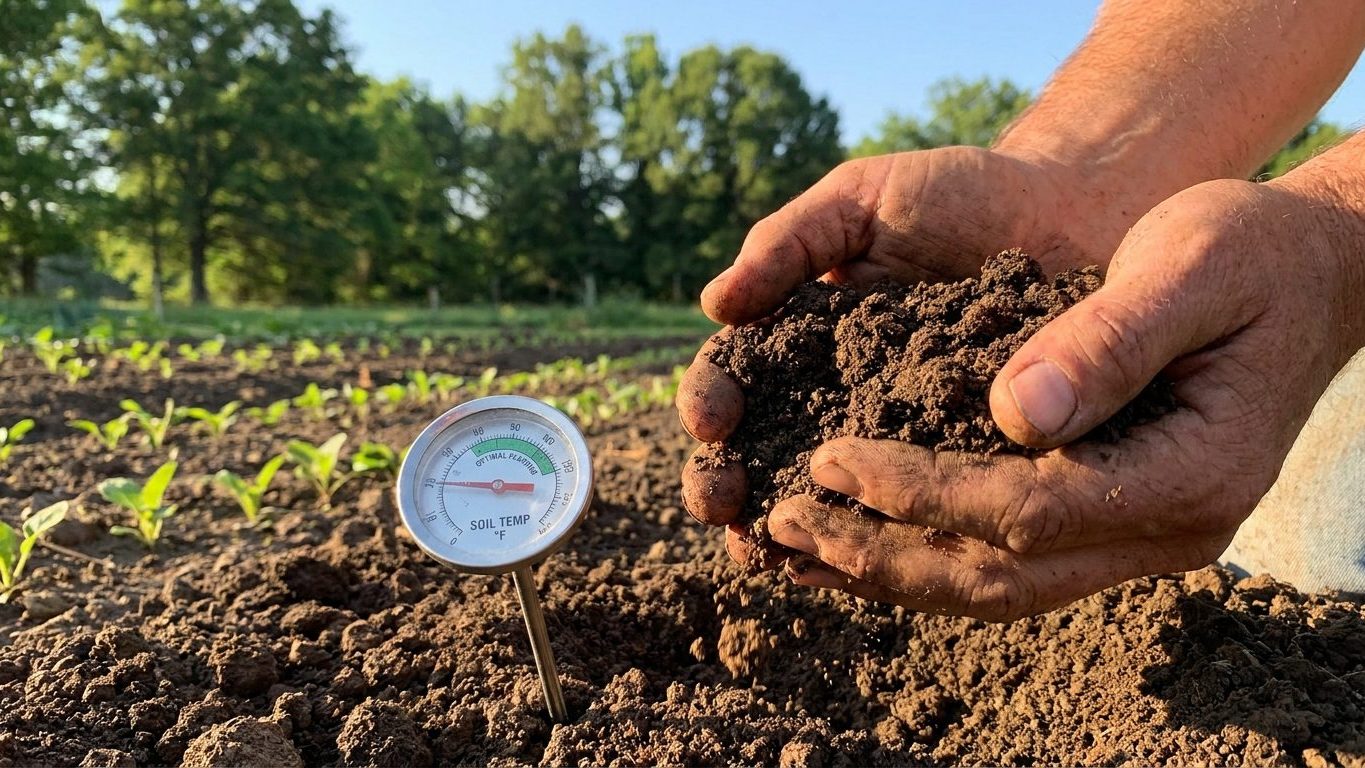

Winter squash needs warm soil, not just a frost-free date, before seed or transplant goes in the ground. In Arkansas, that generally means waiting into mid-to-late April, well past the last spring frost, and choosing types that can finish curing on the vine before the first fall frost arrives in early-to-mid November.
When the soil is warm enough in Arkansas

The question every gardener asks first is: what date? For Arkansas, NOAA’s 1991-2020 Climate Normals put the last spring frost, at the 32F freeze-probability threshold, somewhere between March 12 and March 28, based on station USW00013963. That’s a 30-70% probability band, not a single guaranteed day. Treat it as the point where the odds of frost tip from likely to unlikely, not a switch that flips safe on a calendar square.
Here’s where the real timing lesson sits: winter squash doesn’t care about frost risk directly. It cares about soil temperature, and soil warms up on its own schedule, usually a few weeks after the air stops threatening frost. Seed sown into cold, wet soil in late March will often just sit and rot rather than germinate. Waiting until the soil has had time to warm, typically well into April in most of Arkansas, matters more than chasing the earliest theoretically frost-free day.
This is also where the two frost thresholds diverge in a way worth knowing. NOAA’s 32F data gives the March 12-28 window described above. But the National Weather Service in Little Rock also tracks the lighter 36F threshold, which pushes the practical safe window to April 3 through October 31. Tender seedlings, the kind winter squash produces, respond to that 36F line, not the harder 32F freeze date. A gardener who plants by the 32F date alone is planting into a period where a light frost is still a real possibility.
| Threshold | Spring | Fall |
|---|---|---|
| 32F freeze (30-70% probability) | March 12-28 | November 7-20 |
| 36F light frost (NWS Little Rock) | April 3 | October 31 |
Arkansas also spans USDA Plant Hardiness Zones 6b through 8a, a range built entirely on average annual extreme minimum winter temperatures rather than spring timing. It’s a useful marker for perennial plants and overwintering, less so for deciding when to plant an annual vine crop like winter squash. For a dated planting recommendation, the reference city matters more than the zone range: Little Rock’s own extension office is the better source than a statewide zone number. That’s exactly the kind of local calibration your state extension service, reachable at uaex.uada.edu, is built to provide.
How long the season lasts here
Subtracting the frost dates gives a real number, and it’s a generous one. Using the earliest last-spring-frost date (March 12) against the latest first-fall-frost date (November 20), the longest possible frost-free window runs about 253 days. Using the opposite pairing, the latest spring frost (March 28) against the earliest fall frost (November 7), the shortest realistic window still comes out to about 224 days. Either way, that’s somewhere between seven and eight and a half months of frost-free ground.
That length changes the calculus completely compared to a short-season territory. A window over 220 days doesn’t just fit one planting of winter squash comfortably, it leaves room to consider a second sowing later in the season, particularly for the quicker-maturing types, since even a late-June or early-July planting still has months to finish before November frost arrives. In a shorter-season state, growers often have exactly one shot, and every week of delay in transplanting or germination becomes a real risk to the crop. In Arkansas, a slow start from a cool, wet spring is rarely fatal to the whole season.
That extra room also changes whether transplanting is worth the trouble. Where the season barely covers a single planting, gardeners often start seed indoors weeks early just to buy time, then deal with the root disturbance and hardening-off transplanting brings. With a window this long, direct-seeding once the soil has warmed is a perfectly reasonable default, and it sidesteps the transplant shock that vine crops, winter squash included, tend to resent. The details of staggering plantings, and which types respond best to a second sowing, are covered in our guide to succession sowing winter squash.
None of this erases the frost-date uncertainty described earlier. A long average window is still an average. A grower who plants the earliest possible date every year, banking on the shortest end of that window, is playing the same odds as anyone chasing the 30% side of a freeze-probability band. The safer read is to use the length of the season as a buffer for setbacks, not as an invitation to push the calendar’s edges every single year.
Heat and water in Arkansas

Season length only tells half the story. The other half is what the plant has to survive during the months it’s growing, and Arkansas summers ask a lot. The reference station used for Arkansas’s Climate Normals (Little Rock) averages 69.2 days a year at or above 90F. That’s not a description of every square mile of the state, since river bottoms, higher elevations in the northwest, and shaded microclimates all run cooler, but it’s a solid signal that most of the growing season includes stretches of genuine heat stress on a vine crop.
Winter squash is exactly the crop where this kind of heat load becomes a scheduling issue disguised as a weather issue. The fruit has to mature and start curing on the vine before frost shuts things down, and an immature squash pulled early neither cures properly nor stores well afterward. A hot summer speeds up flowering and fruit set, but it also speeds up water loss from both soil and plant, meaning the fruit-filling stage, when the squash is putting on its final size and rind hardness, is the point where a lapse in soil moisture shows up fastest.
Rainfall in Arkansas isn’t scarce on paper. Summer totals average around 10 inches across June, July, and August combined (June 3.55 inches, July 3.33 inches, August 3.16 inches), out of roughly 50.4 inches for the year. That’s meaningfully wetter than a true dry-summer climate. But two things complicate reading that number as “enough.” First, August, right when many squash plantings are filling out fruit, is also the driest of the three summer months. Second, rain that falls during a 90-plus-degree stretch, often as a single thunderstorm, tends to run off or evaporate fast rather than soaking down to root depth. On sandy soil especially, that inch of rain can be gone within a day.
The practical upshot is that Arkansas sits in a middle zone: not dry enough to require constant irrigation from day one, but hot enough, and unevenly rained-on enough, that skipping supplemental watering during a August dry spell is a real risk to fruit size and rind quality. The humidity that comes with those summer rains also brings its own pressure, powdery mildew and other foliar disease show up readily on Winter Squash in a warm, humid stretch, which argues for spacing vines with airflow in mind rather than crowding them for shade alone. A rain gauge on the actual garden, not the regional average, is what tells a grower whether that week needs a hose or not.
Which winter squash suit Arkansas
Given all of that, the type of winter squash matters more here than any particular growing trick. A season running 224 to 253 days gives Arkansas gardeners room to grow slower-maturing types that some shorter-season states simply can’t finish, which opens up more of the winter squash category than a state working with a tight window would have available.
Heat tolerance during flowering and fruit set is the next filter worth applying, since 69.2 average days above 90F a year means most plantings will face at least some stretch of genuine heat stress during the growing season. Types bred or selected for reliable fruit set under heat, and grown with attention to airflow and consistent root-zone moisture rather than shallow, frequent watering, tend to carry through those stretches better.
Disease resistance deserves to be the first criterion, not an afterthought, given the humidity that rides along with Arkansas’s summer rainfall pattern. Powdery mildew and other foliar diseases find warm, damp foliage an easy target, and a type with some built-in resistance, combined with spacing that lets air move through the planting, will often outperform a technically higher-yielding type that succumbs to disease before the fruit finishes curing.
This page won’t name a specific variety, and that’s a deliberate choice rather than an oversight. Cultivar performance shifts by region in ways a general resource can’t responsibly capture, and a name recommended here without local trial data is a guess dressed up as advice. The types trialled and recommended for actual growing conditions across Arkansas, tested against the state’s own heat, humidity, and disease pressure, are exactly what the University of Arkansas’s Cooperative Extension Service tracks and publishes. That’s the source worth checking before buying seed, not a generic list built for a national audience.