
Coastal and Southern California don’t have a spring frost date to plant around, because in an average year none occurs at all. That single fact reshuffles the whole squash calendar: instead of asking “when is it safe,” growers here ask “when is the soil warm enough and the water plan ready,” while gardeners in the Central Valley, the Sierra foothills, and Northern California are still working against real, if unlisted here, freeze dates.
When the soil is warm enough in California

The usual first question, when can I put Winter Squash in the ground, assumes a frost date exists to count forward from. At the coastal and southern reference station behind these normals, it doesn’t. NOAA’s 1991-2020 Climate Normals return no computable freeze normal for that location (coded -666 in their system), and the underlying daily records back it up: zero days at or below 32°F across 30 years, with the frost-free season listed at a full 365 days. That’s not a rounded figure or a nicer-sounding average. It’s what the station recorded.
Treat that as a probability, not a guarantee. An average year without freeze isn’t every year, and a cold snap can still surprise a low-lying yard near the coast. But for planning purposes, growers in this part of the state aren’t waiting out frost risk at all. They’re waiting on soil temperature and day length, which move on their own schedule regardless of what the thermometer does on any given January night.
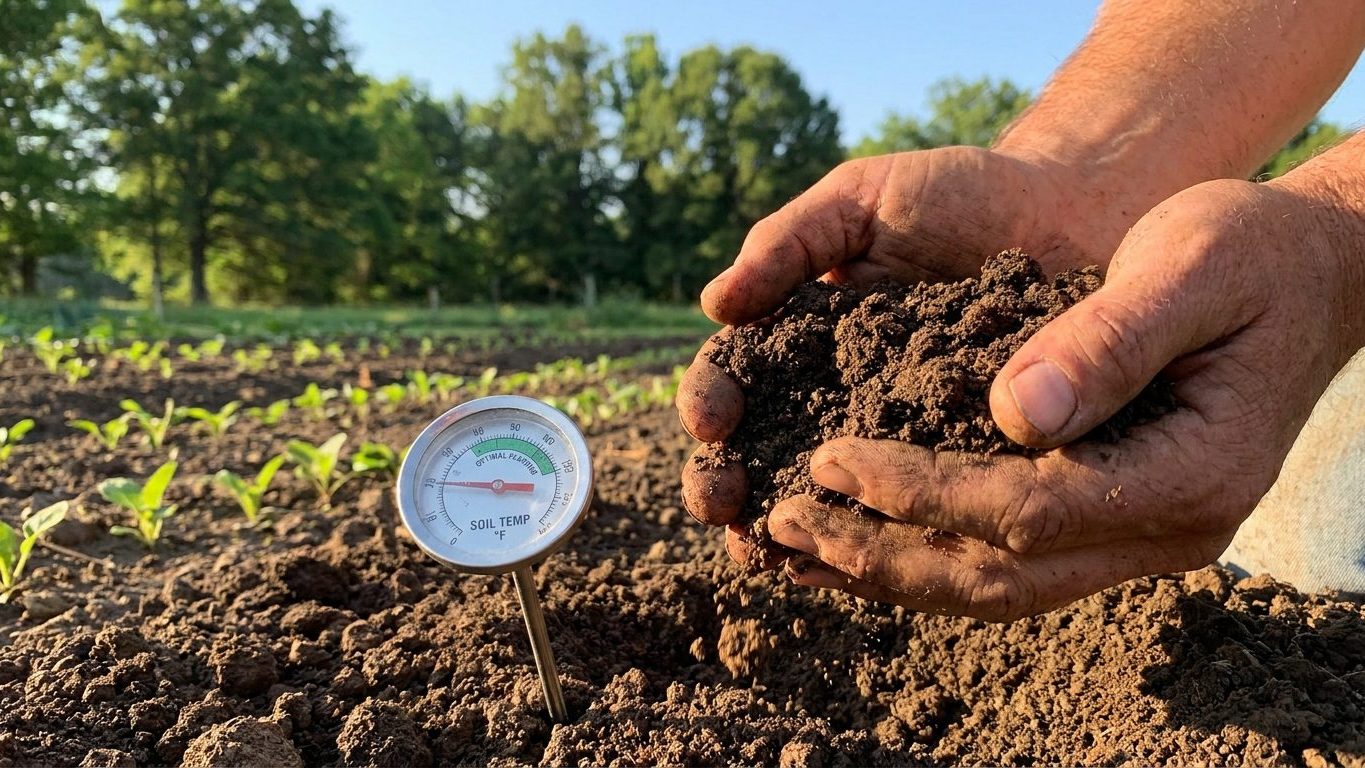
That’s the detail worth sitting with: frost is normally used as a proxy for soil warmth, because soil takes a few extra weeks to catch up once air temperatures stop dropping below freezing. Remove the frost constraint, and soil warmth becomes the thing to track directly, not infer. Winter squash seed germinates poorly in cold, wet soil no matter how mild the air feels, so a sunny February afternoon in Los Angeles is not the same as squash-planting weather. Growers here do better watching soil temperature at planting depth than watching the calendar.
None of this applies to the rest of the state the same way. Northern California, the Central Valley, and the Sierra foothills do freeze, sometimes hard, and generalizing a Los Angeles-area normal to Sacramento or Redding would be a mistake worth avoiding. Those growers need their own local frost dates, from their nearest NOAA station or their county extension office, before setting a planting date. The USDA Plant Hardiness Zone Map reflects that spread directly: California spans zones 5a to 11a, an enormous range built on average annual extreme minimum temperature alone. A gardener in the Sierra and a gardener three miles from the Pacific are, climatically, working in different states. When making any dated recommendation, the reference city matters more than the statewide range ever will.
How long the season lasts here
Subtracting a last frost date from a first frost date is the usual way to size up a growing window. That math doesn’t run here, because both dates are the same non-event: no freeze occurs in an average year at the coastal and southern reference station, and the frost-free season is recorded as 365 days. For practical purposes, the frost-bound growing window in this part of California isn’t short or long. It doesn’t exist as a limiting factor at all.
That changes what’s worth doing with the season, not just how long it runs. Where frost caps the calendar, growers get one shot: pick the earliest-maturing type, sow it on time, and hope the fruit finishes before the cold arrives. Remove that cap, and the calendar opens up to something else entirely, sowing in relays rather than all at once, so vines at different stages are never all competing for water and pollinators in the same week. A grower here can stagger plantings by several weeks and still expect each round to mature, which is exactly the situation our succession sowing guide is built to walk through in more detail.
The table below lays out the contrast plainly, because California is really two different growing calendars wearing one state name.
| Territory | Frost pattern | What decides the season |
|---|---|---|
| Coastal & Southern California | No freeze in an average year (365-day frost-free season, reference station) | Soil warmth, water supply, summer heat load |
| Central Valley, Sierra foothills, Northern California | Freezes; exact dates not covered by these station facts | Local frost dates, best pulled from a nearby NOAA station or county extension |
For that second group, the strategy flips: one sowing window, chosen carefully, matters more than any succession plan, and transplanting rather than direct-seeding becomes worth the root disturbance risk if it buys a few extra weeks of maturing time before frost returns in fall.
Heat and water in California

At the Los Angeles-area reference station, the mean count of days reaching 90°F or higher is 2.4 a year. That’s a modest number, and it says something specific: this is not a punishing-heat climate by the numbers, at least not at this particular station. Summer heat load here is closer to mild than extreme, which matters for a crop that can stall or drop blossoms once daytime temperatures climb into the high 90s for stretches at a time.
Rainfall tells the opposite story. Summer rain across June, July, and August totals about 0.1 inches at that same station, against 12.2 inches for the full year. August, the driest month, gets essentially none: 0.0 inches on the books. June comes in at 0.08 inches, July at 0.04. Whatever moisture the garden gets from June through August, it isn’t coming from the sky.
That’s the real climate signal for Winter Squash in this part of the state: not extreme heat, but extreme summer drought. Winter squash is the crop where the whole season’s work rides on the fruit finishing fully on the vine, since an immature squash doesn’t cure and doesn’t keep in storage the way a properly ripened one does. In a hot, dry territory like this one, irrigation isn’t a backup plan, it’s the entire water budget for the plant from midsummer on. Vines that would coast through a rainy stretch elsewhere are running on whatever the grower delivers by hose or drip line here.
That figure never reads alone, though. Soil type changes how far that irrigation has to stretch: a sandy bed drains the same watering within a day, while clay holds it closer to a week, so two gardens receiving identical water can behave very differently. Heat, even mild heat by the 2.4-day count, accelerates evaporation from bare soil and from leaf surfaces, meaning water applied in a single weekly soak works less efficiently than the same total split into smaller, more frequent doses. None of this applies uniformly across California. A cooler, damper summer in the fog belt closer to the coast, or up toward the Bay Area, brings a different problem entirely, powdery mildew and slower ripening rather than drought stress, and a grower there should read the low rainfall figure as a starting point for their own microclimate, not a fixed rule for the whole region.
Which winter squash suit California
None of this points to a specific variety, and that’s deliberate. The types trialled and recommended for a given county come from the University of California’s own extension research, not from a general guide that can’t see your soil, your microclimate, or which pests are active in your area this year. That’s what UC ANR’s extension network exists for, and it’s the right next stop before buying seed.
What these facts do support is reasoning by type. In the frost-free coastal and southern zone, where the growing window effectively doesn’t close, there’s room to grow longer-season vining types that need more days on the vine, the sprawling hubbard and kabocha types among them, since nothing forces an early finish. Water access matters more than days-to-maturity in that decision.
Where summer heat runs higher than the mild 2.4-day count at the coastal reference station, which describes much of the Central Valley, airflow around the vines and some afternoon shade at the root zone help fruit set continue through the hottest stretch, since blossom drop is a common response to sustained high heat. In the Sierra and Northern California, where real frost brackets a shorter season, the earliest-maturing types on offer from local trials become the safer bet, because a squash that’s still filling out when frost lands neither cures nor stores.
In the cooler, foggier microclimates near the coast, disease resistance, particularly to powdery mildew, becomes the first filter to apply, ahead of size or storage life. Refusing to hand over a named variety here isn’t a gap in this guide. It’s the honest answer: the trial data that actually separates one squash from another for a specific California county lives with the researchers who ran those trials locally, and that’s exactly what the extension office link above is for.