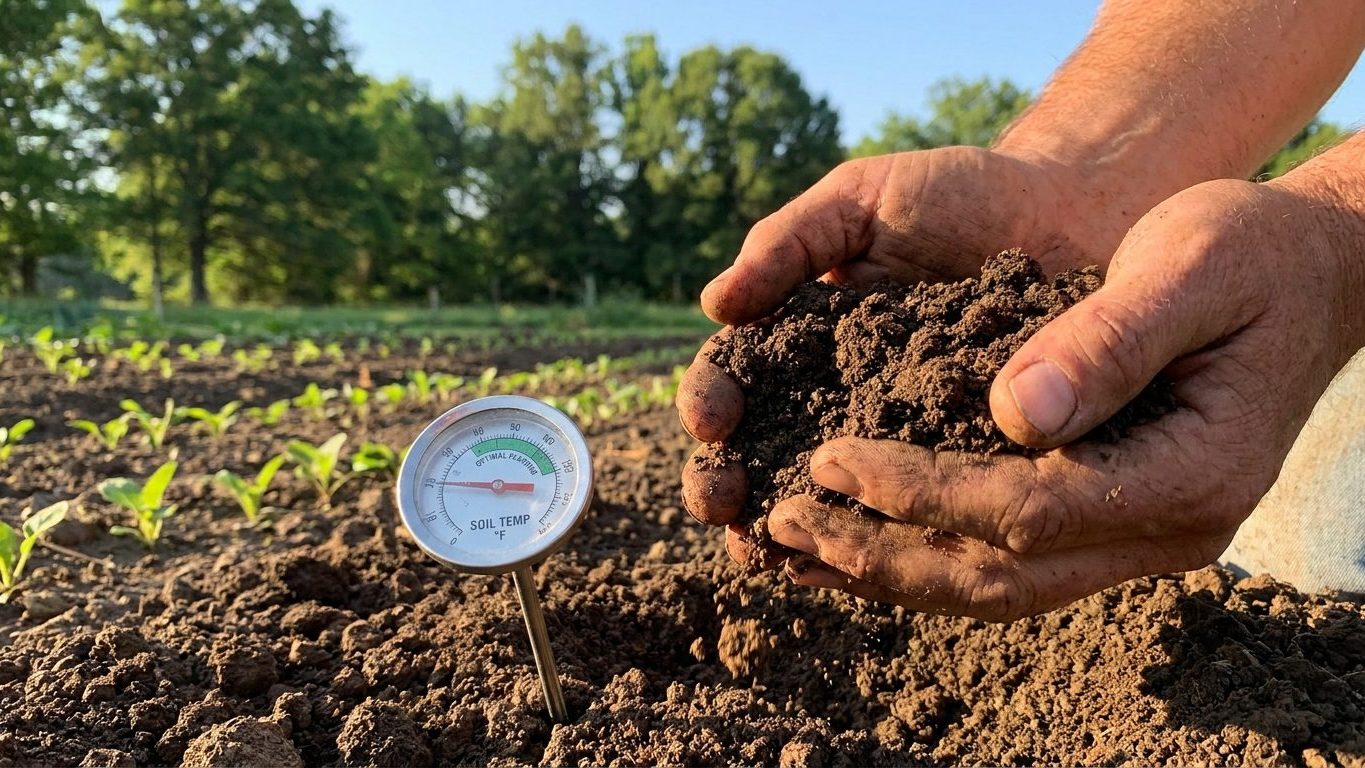

Winter squash goes into Maryland ground once the danger of frost has passed and the soil itself has warmed, typically from early to mid-April depending on where in the state you garden. The real work is matching the growing window and summer heat load to the right type of squash, not just picking a calendar date.
When the soil is warm enough in Maryland

The last spring frost across most of Maryland falls between April 3 and April 16, according to NOAA’s 1991-2020 Climate Normals for freeze probabilities (the 30-70% band, from station USW00093721). That’s the frost date most gardeners quote, but it’s a probability, not a promise, and it isn’t actually the number that matters for winter squash.
Squash seed doesn’t care about frost. It cares about soil temperature, and soil takes time to catch up once the air stops freezing. A garden bed can sit at 55°F or cooler for a week or two after the last frost risk has technically passed, and squash seed sown into cold, damp soil rots before it sprouts more often than it germinates. That’s why the frost date on this page is a proxy, not the actual trigger: treat it as the earliest point to start watching your soil, not the day to plant.
Western Maryland changes this picture. Garrett and Allegany counties sit in mountainous terrain where both frost dates run weeks later than the state’s reference normals, so a gardener in Oakland or Cumberland is working with a shorter, later window than someone near Baltimore or on the Eastern Shore, where the milder coastal influence tends to push both dates in the opposite direction.
What “warm enough” looks like in practice
Rather than counting days from a frost date, most experienced growers wait for a stretch of settled, mild nights and check the soil directly, either with a soil thermometer pushed a few inches down or simply by feel: cold and slow to crumble means wait, workable and warming means go. Raised beds and black plastic mulch both speed this process along, which matters more in a cooler Western Maryland spring than it does near the Chesapeake.
None of this points toward a specific variety, and it shouldn’t. The types of winter squash that thrive in a mid-Atlantic climate differ from those bred for shorter or hotter seasons elsewhere, and the named cultivars actually trialled for Maryland conditions are something your local Extension office tracks, not something a general planting guide can responsibly invent. The University of Maryland Extension publishes exactly that kind of regionally tested variety information, and it’s the better source once you’ve settled on timing.
Whatever type you choose, skip synthetic seed treatments if you’re managing pests organically and instead rely on practices like row cover at emergence to keep early feeding insects off young seedlings, floating it loosely enough that plants can push it up as they grow.
How long the season lasts here
Subtracting Maryland’s frost dates gives a growing window of roughly 193 to 216 days, depending on where in that April 3-to-April 16 and October 26-to-November 5 range your particular spot falls. That’s close to seven months of frost-free growing at the long end, and it’s a genuinely generous window by national standards.
A window that long changes the math on how you plant. In territories where the frost-free season barely covers what a single squash planting needs, gardeners have exactly one shot: sow at the earliest safe moment and hope the fruit finishes before fall frost arrives. Maryland’s season is rarely that tight. With six-plus months to work with, there’s usually room for a second, later sowing of a faster-maturing type, planted in early summer once the first round of vines is established and sized up, extending harvest into fall rather than concentrating it all at once.
This is also where the transplant question gets interesting. Squash famously resents root disturbance, and in a short-season territory that risk is often worth taking anyway because every week of head start counts. In Maryland’s longer window, direct-seeding is the lower-risk default for most plantings, since there’s enough season left to let seed germinate in place without racing the calendar. Transplants still make sense for a deliberate second sowing, where getting seedlings started indoors in June buys extra maturing time before the October frost window opens.
Succession sowing itself is worth planning out properly rather than improvising in the moment, since spacing plantings a few weeks apart works differently depending on which type of squash you’re staggering and how much room the vines need. This site’s succession sowing guide walks through how to time a second planting so it actually finishes before frost rather than getting caught out by it.
The caution that applies statewide also applies here: Western Maryland’s later frost dates mean a shorter effective window in Garrett and Allegany counties, which makes a second sowing a tighter bet there than it is on the Eastern Shore or around Baltimore, where the season stretches longer on both ends.
Heat and water in Maryland

At the Baltimore reference station, the year averages 24.6 days at or above 90°F, according to NOAA’s 1991-2020 Climate Normals. That’s a real heat load, enough to stress cool-weather crops, but it’s a moderate figure rather than an extreme one, well short of the summer-long heat stretches gardeners deal with farther south or inland.
Winter squash is unusually dependent on how these heat and moisture numbers play out, because the fruit has to mature fully on the vine before frost shuts things down. An immature squash pulled early neither cures properly in storage nor keeps through winter, so everything upstream, the sowing date, the heat during fruit set, the water available while fruit is filling out, feeds directly into whether that fruit actually finishes.
Summer rainfall across June, July and August averages about 12.6 inches at the same reference station, with June running driest at 3.98 inches, July at 4.48 and August at 4.09. That’s a reasonably wet summer by national standards, not the dry-climate situation where irrigation has to carry the entire fruit-filling period. But it’s not evenly distributed, and a dry stretch in June, right when vines are establishing and starting to flower, can still leave plants short of water at a critical moment.
The two figures interact more than either does alone. A single summer thunderstorm dropping an inch of rain in twenty minutes mostly runs off rather than soaking into the root zone, and 24.6 days above 90°F is enough evaporative demand to dry out a sandy bed within a day or two of a rain event. Clay soil holds moisture longer under the same rainfall, which means two Maryland gardens with identical weather can need very different watering schedules depending on what’s underfoot. A rain gauge on your own plot, not the regional average, is what actually tells you whether to water this week.
What Maryland’s numbers don’t describe is a hot, dry climate where irrigation is the whole story. With moderate heat and decent summer rain, the bigger disease risk here tends to run toward humidity rather than drought: powdery mildew and other fungal issues that build up on vines during muggy stretches, particularly if plants are crowded or leaves stay wet overnight. Watering at the base rather than overhead, and giving vines enough spacing for air to move through the foliage, matters at least as much as any irrigation schedule.
Which winter squash suit Maryland
Maryland’s roughly seven-month window is long enough that season length rarely forces a gardener into only the earliest-maturing types, the way it does in a genuinely short-summer territory. That opens the door to a broader range of squash types, including some that need more time to size up and cure fully before frost.
Heat load points toward types and growing setups that tolerate Maryland’s 24.6 average days above 90°F without stalling, and that benefit from a bit of shade at the root zone, whether from companion planting, mulch, or simply letting vines sprawl enough to shade their own soil. Airflow matters just as much: types and spacing choices that keep foliage from staying damp and crowded reduce the mildew pressure that a moderately humid mid-Atlantic summer tends to bring.
Disease resistance is the first filter worth applying here, more than earliness or size. With summer rainfall running close to 12.6 inches and plenty of muggy stretches in between, powdery mildew and related fungal pressure show up reliably in Maryland gardens by mid-to-late summer, and a type bred with resistance to it will outlast one that isn’t, even if both were planted the same week.
What this page won’t do is hand you a specific variety name, and that’s a deliberate choice rather than an oversight. The named cultivars that actually perform well in Maryland conditions, tested against this state’s real disease pressure and season length, are exactly what the University of Maryland Extension tracks through its own trials and county offices. A general guide inventing a variety recommendation would be guessing at something Extension has already measured. Start with the type, whether that’s an early-maturing bush habit, a sprawling vine suited to a long fruiting period, or a mildew-resistant selection, and let your county Extension office point you toward the specific varieties that have actually proven themselves on Maryland ground.