
Two windows, not one frost date, decide when winter squash goes into Arizona soil. In the low desert (Phoenix, Yuma, Tucson), sow from mid-February through March, then again from late July into August. Skip the gap between: that stretch sits inside the region’s long run of 90-degree-plus days, and pollination stalls before a single squash sets.
The short answer for Arizona
Start with what the frost record actually says for the Phoenix reference station, because it changes the whole logic of a squash calendar here. NOAA’s 1991-2020 normals list a 365-day frost-free season for this station. A 32-degree dip did show up between late December and mid-January, but only in 6 of the last 30 springs. That is not a frost line a gardener can plant around. It is closer to a coin flip that almost always lands the same way.
So a calendar built on “two weeks after last frost” simply does not apply to Arizona’s low desert the way it would in a state with a real spring freeze. The variable that actually rules the calendar here is heat load: the Phoenix reference station averages 168.9 days a year at or above 90 degrees. That is not a heat wave. That is close to half the calendar, and it lands squarely over the months a gardener might otherwise assume are prime growing season.
Winter squash needs a period of active flowering and fruit set that heat like this interrupts. That is why the workable windows sit on either side of the deep heat rather than inside it. The February-to-March sowing lets plants flower and begin setting fruit before the 90-degree run really takes hold, then finish maturing on stored heat as summer builds. The late-July-to-August sowing works the other side: it uses the monsoon’s modest moisture, July averaging 0.91 inches and August 0.93 inches at the same station, to get seedlings established, with harvest landing after the worst of the heat load has passed.
Neither window is a guess. Both come directly from the two hard numbers this territory actually has on record: a frost season that functions as no season at all, and a heat season long enough to swallow most of the calendar year. Everything below builds from those two facts, not from a frost date this region rarely sees.
What will not work here
Planting in June is the single most common misstep, and the climate record explains exactly why it fails. June is the driest month on the books for this station, just 0.02 inches of rain, and it sits inside the thick of the 168.9-day stretch above 90 degrees. Flowers open, but fruit does not follow. A gardener who sows in June and waters faithfully will often still watch the plant stall at bloom, because the failure is heat-driven, not a watering problem.
A slow variety planted at the tail end of the spring window runs into the same wall from the other direction. If a winter squash needs a long run of days to mature and it goes in near the end of March, it is racing the building heat load rather than beating it. The spring window works because it front-loads flowering before the 90-degree days pile up. Push that sowing date too late and the plant is trying to finish in conditions the record shows are already stacking against it.
Weekly watering, the default habit in a lot of gardening advice, underdelivers here. Summer rainfall across June, July and August totals only about 1.9 inches at this station, against 7.2 inches for the full year. Most of that summer share falls in two months, not three, and it often arrives as a short, hard thunderstorm rather than a slow soak. On sandy low-desert soil, that kind of rain moves through the profile within a day. A week between waterings gives heat this intense, at nearly 170 days a year above 90 degrees, plenty of time to pull moisture back out of the root zone before the next watering arrives.
Waiting on a frost date to trigger planting fails in a different way: it delays gardeners who are watching for a freeze that statistically shows up in only 6 of every 30 springs. By the time that non-event convinces someone the season has “started,” the real window, set by heat rather than cold, is already closing.
What changes across Arizona
Arizona’s USDA hardiness zone range runs from 4b to 10b, one of the widest spreads of any state in the country. That is not a rounding difference. Zone 4b describes conditions closer to the northern Rockies; zone 10b describes conditions closer to coastal South Texas. A single statewide planting calendar cannot honestly cover both ends of that range.
The two-window calendar described above, built from the Phoenix reference station’s frost and heat data, applies to the low desert: the zone 9b-10b belt that includes Phoenix, Yuma and much of Tucson. There, the limiting factor is heat, not cold, and the calendar bends around a long, hot middle of the year.
Higher ground works on the opposite logic entirely. Flagstaff and the White Mountains sit at the cold end of that 4b-10b spread, where a real, hard fall frost ends the growing season and a real spring frost delays its start. A gardener at that elevation is back to something closer to a conventional frost-to-frost calendar, just compressed into a shorter window because the growing season itself is shorter at altitude.
Places in between, Prescott, Sedona, the higher desert transition zones, sit somewhere across that spread and will not match either extreme cleanly. The honest answer for a state this size is that there is no single planting date, only a range tied to where on that 4b-10b spread a given garden actually sits. Rather than guess from a city name, check the USDA Plant Hardiness Zone Map directly against a specific address; elevation changes zone faster in Arizona than almost anywhere else in the country.
Where to check this for your own county
The University of Arizona Cooperative Extension is the state’s land-grant extension service, and its site sits at extension.arizona.edu. That is the address to use, not a search result or a third-party gardening blog quoting it secondhand.
Two things are worth looking for once there. First, a county-level planting calendar. Arizona’s extension system is organized by county office, and a Cochise County office will publish different guidance than a Maricopa County or Yavapai County office, because the elevation and heat load differ enough within the state to matter, as the zone spread above already shows. Second, look for variety trial results specific to that county. Extension offices in hot, dry states often run their own cucurbit trials, testing which winter squash varieties actually finish a crop under local heat and water conditions rather than under a seed catalog’s generic description.
A county recommendation beats a state one every time, because it is built from conditions closer to the actual garden. A single reference station’s climate normals explain the mechanism behind Arizona’s heat-driven calendar, but they are not a substitute for a number pulled from a weather station or trial plot in the reader’s own county. Treat what is written here as the reasoning, and the county extension office as the specific answer.
If you follow the almanac, here is when to plant winter squash by the moon. It is a tradition, not a proven method.
Checking this against your own garden
Every date above is a normal, an average built from three decades of records at one station. A reader’s own soil and own plants will confirm or contradict it faster than any calendar can.
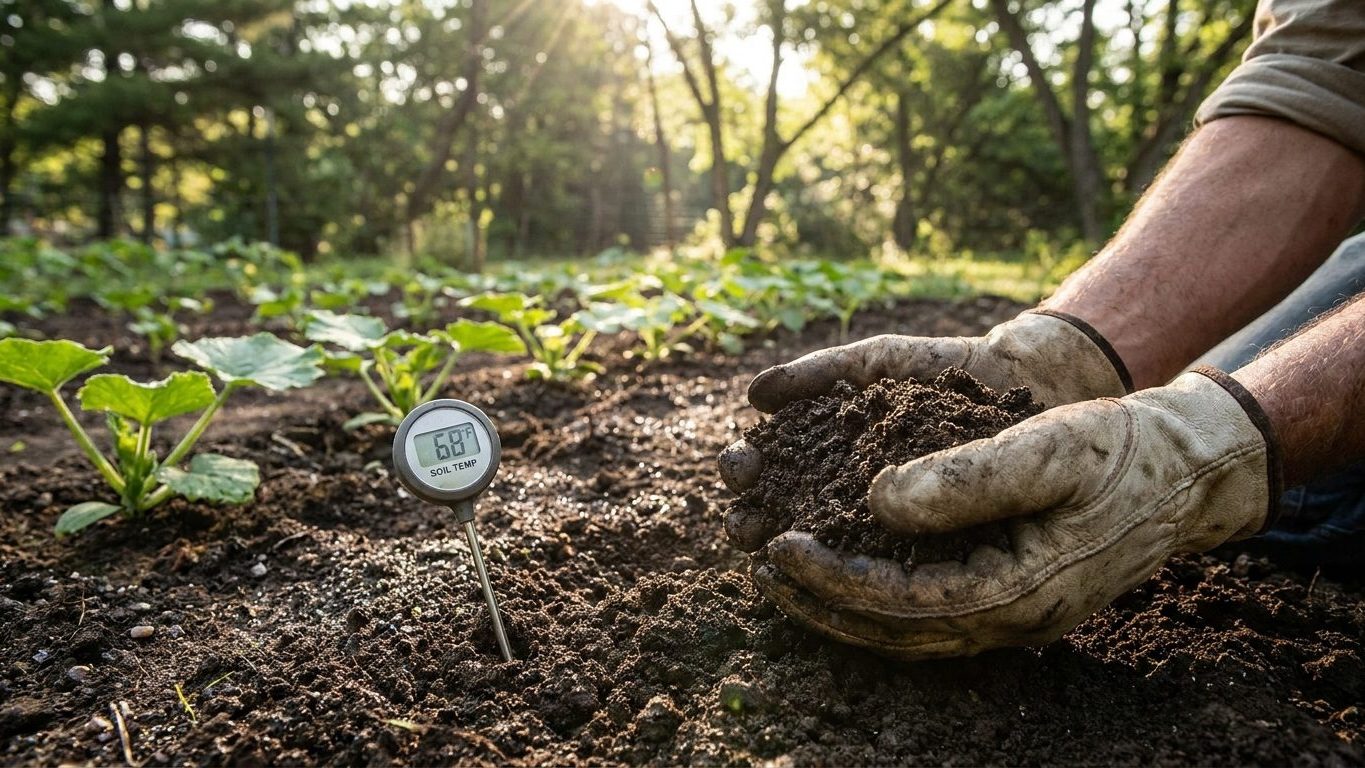
Soil warmth by feel is the first check. Push a hand into the planting bed a couple of inches down at midday. Cool, slightly damp soil that feels cold to the touch after a few seconds is not ready for squash seed, regardless of what the calendar says the date should be. Soil that feels warm and just slightly moist, closer to body temperature than to the tap, is doing what the spring or late-summer window is banking on.
The first flush of male flowers is the second signal, and it shows up before any female flower with a tiny swollen base appears. A strong early run of male blooms means the plant has enough warmth and daylight to commit to flowering; a weak, sparse flush suggests conditions are still marginal, often a sign the heat load or the soil temperature has not caught up to the calendar yet.
First true leaves, the second set that appears after the rounded seed leaves, tell a slower story. Fast, healthy true-leaf growth within the expected week or so after germination confirms the window was timed well for that particular garden. Slow, stunted true leaves, even with adequate watering, usually mean the plant germinated into conditions harsher or cooler than the surrounding neighborhood average, worth noting for the next planting cycle rather than fighting through on the current one.