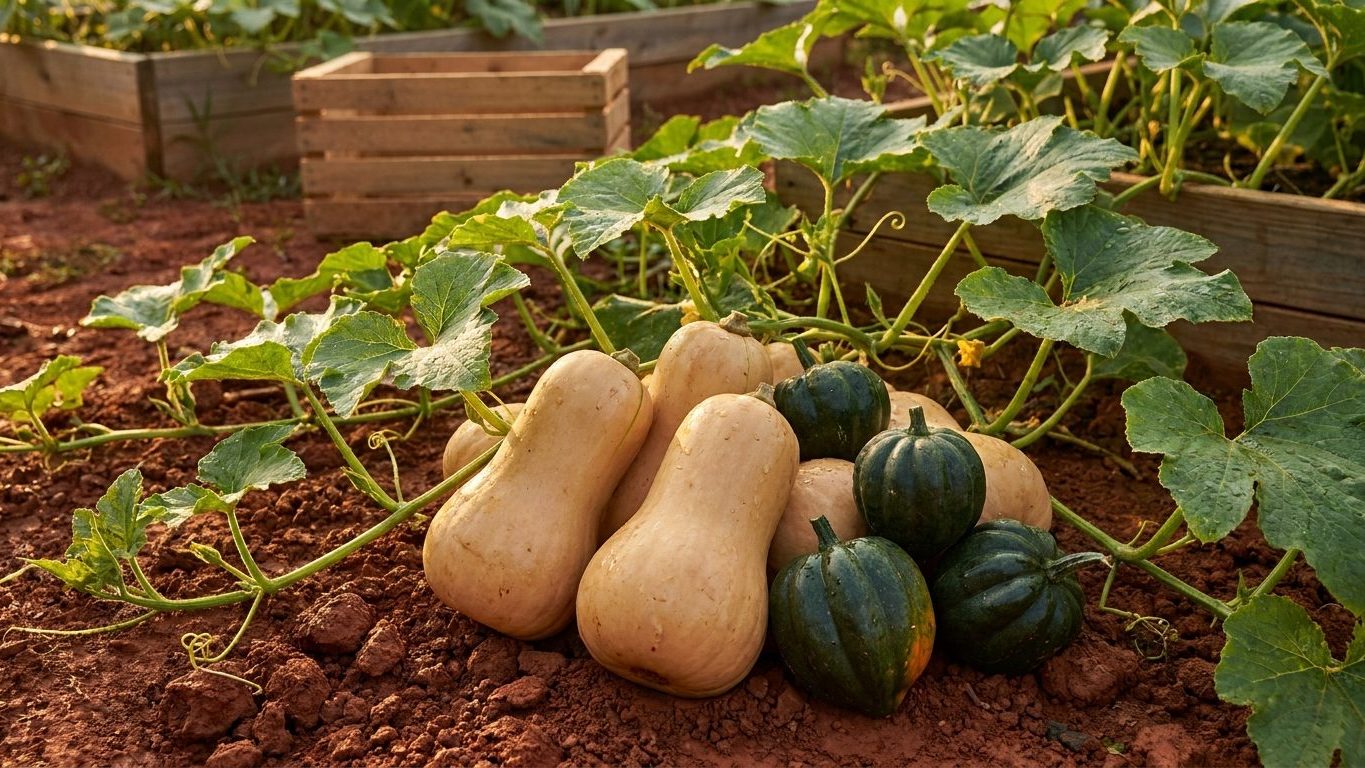

Louisiana’s long, humid summers point growers toward one group of winter squash above all others: Cucurbita moschata, the butternut and cushaw family. These varieties shrug off the heat, resist the diseases that thrive in Gulf Coast humidity, and tolerate the state’s unpredictable frost pattern better than any other winter squash type.
The short answer for Louisiana
Start with the botanical family, not the variety name. Louisiana’s growing season is defined by 70.7 days a year at or above 90°F, and that heat load is what decides which winter squash actually produces fruit here. Moschata types, which include butternut, Seminole pumpkin, calabaza and cushaw, hold pollen viability and set fruit even when nighttime temperatures stay warm, something maxima types (hubbard, kabocha, banana squash) struggle to do once the thermometer camps out above 90°F for weeks at a stretch.
That’s the core decision for anyone planning a Louisiana squash patch: lead with moschata, treat everything else as a gamble.
Waltham Butternut is the workhorse choice, widely grown across the state because it matures reliably and stores well. Seminole pumpkin, an heirloom developed by Indigenous growers in the humid Southeast, deserves more attention than it gets. It was bred for exactly this climate, tolerates both drought stretches and downpours, and resists the vine borers that wreck other squash. Cushaw varieties, with their curved necks and pale green stripes, are another Deep South tradition worth growing, especially where soil stays a little heavier or wetter than average.
Pepo types (acorn, delicata, spaghetti squash) sit in a middle zone. They can work in Louisiana, but they need more vigilance against squash vine borer and powdery mildew than moschata does. If a gardener wants to try acorn or delicata, it makes sense to treat those as a secondary planting, not the main crop.
The frost dates matter less here than they would in most states. NOAA’s 1991-2020 climate normals put the first fall freeze between December 17 and January 8, and the last spring freeze between January 18 and February 8, but a 32°F freeze only happens in 86.8 percent of years at the reference station. Roughly one year in seven, south Louisiana sees no freeze at all. That means the planting calendar bends around heat tolerance and disease pressure far more than it bends around a frost date that may not even arrive.
Given that spread, most Louisiana gardeners get two windows: an early spring planting timed to set fruit before peak summer heat locks in, and a second, late-summer planting aimed at a fall harvest before the (unreliable) December frost.
What will not work here

Large-fruited maxima types are the clearest failure case. Hubbard squash and its relatives typically need 100 to 120 days of relatively cool, dry conditions to size up properly. Louisiana’s summer doesn’t offer that. With 70.7 days a year above 90°F, pollen sterility and blossom drop set in during exactly the stretch when a slow-maturing maxima would still be trying to finish its fruit. Growers who bring hubbard seed down from a cooler-climate seed catalog usually end up with a lot of vine and very little squash.
Watering on a fixed weekly schedule is the second common failure. Summer rainfall averages about 21.3 inches across June, July and August, with July the driest of the three at 6.79 inches. That sounds like plenty of water, but it rarely arrives evenly. Gulf Coast summer rain tends to come as short, heavy thunderstorms that run off rather than soak in, especially on compacted or clay-heavy ground. Combine that with near-daily temperatures pushing evaporation hard, and a squash bed watered only once a week can dry out between storms even in a summer with above-normal rainfall. The fix isn’t more water on a set schedule, it’s checking soil moisture directly and watering deeply when it’s needed rather than by the calendar.
Tight spacing is the third trap. Louisiana’s humidity, stacked on top of that rainfall pattern, creates ideal conditions for powdery mildew and downy mildew on winter squash leaves. Vines planted close together, the way a gardening book written for a drier state might suggest, trap moisture and slow airflow. That’s an invitation for fungal disease to move through an entire row in a matter of days. Wider spacing than the seed packet recommends, plus mulching to keep splashing rain off the lower leaves, does more to protect a Louisiana squash patch than any fungicide schedule.
Cool-season squash relatives that need a stretch of cool nights to set fruit, some winter squash marketed for northern short-season gardens, also underperform here. If a variety’s description leans heavily on “quick to mature in cool climates,” it’s a signal to look elsewhere.
What changes across Louisiana
Louisiana spans USDA Hardiness Zones 8a to 10a, and that range, built on the USDA’s measure of average annual extreme minimum temperature, tells a real story about how differently the state behaves from north to south. There is no single planting answer for “Louisiana.” A gardener near Shreveport in the north is working with a meaningfully different climate than one near New Orleans or along the coast.
North Louisiana, toward the 8a end of the range, sees more reliable winter freezes and a shorter window where winter squash vines can grow undisturbed. That actually works in a moschata grower’s favor in one sense: cooler nights during spring and fall help with fruit set, since extreme heat is what interferes with pollen viability in the first place.
South Louisiana, down toward 9b and 10a, barely freezes at all in some years, as that one-in-seven no-freeze statistic shows. Gardeners there get a much longer growing window, potentially stretching a fall squash crop deep into what would be winter elsewhere. But they also carry the heaviest heat load and the highest humidity, which raises disease pressure and narrows the practical planting windows even though the calendar looks wide open.
The takeaway isn’t which zone is “better,” it’s that a reader in the Florida Parishes and a reader near the Arkansas line are gardening under different rules even though they’re both in Louisiana. Anyone unsure exactly where their property falls on that 8a-to-10a spread should check the USDA Plant Hardiness Zone Map directly rather than guessing from a regional description, since even neighboring parishes can sit in different zones depending on elevation and distance from the coast.
Where to check this for your own county
A state-level answer smooths over parish-by-parish differences in soil, microclimate and disease pressure that a local extension office tracks in detail. The LSU AgCenter is the state’s land-grant extension service, and it’s the right next stop for anyone ready to move from “what works in Louisiana” to “what works on my property.”
Two things are worth hunting for on the AgCenter site specifically. First, the parish-level vegetable planting calendar, which translates the statewide frost and heat patterns described here into actual sowing windows for a specific area, something especially useful given how much the frost dates shift between north and south Louisiana. Second, any variety trial results or recommended cultivar lists for winter squash, since county agents often track which specific butternut, cushaw or Seminole pumpkin selections have performed well in local trial gardens, information that goes well beyond what a general “moschata does best here” statement can offer.
A county-specific recommendation will always beat a state-wide one. Moschata types outperform maxima types across Louisiana’s heat and humidity, and the frost dates barely matter compared to summer heat stress. It can’t tell a reader whether their particular parish’s soil, drainage or local pest pressure calls for a specific cultivar swap. That’s local knowledge, and the AgCenter’s parish offices and published guides are built to carry it.
Checking this against your own garden
Every fact here describes averages. A reader’s own garden will confirm or contradict those averages faster than any calendar can, and three signs are worth watching closely.
Soil warmth by feel comes first. Winter squash seed germinates poorly in cold soil, so before planting, a hand pressed into the bed at planting depth should feel comfortably warm, not cool or damp-cold. If the soil still feels chilly in what the calendar says should be a planting window, waiting a week or two costs little and avoids seed rot.
The first flush of male flowers is the second signal. Squash plants typically produce male flowers before female ones, and a heavy early flush of males with no females yet is completely normal. What matters is watching for female flowers, recognizable by the small swollen bulge behind the petals, since their arrival marks the start of the fruit-setting window and tells a gardener whether pollinator activity in their specific yard is going to be a limiting factor.
The first true leaves, the ones that emerge after the initial rounded seed leaves, are the third marker. Their size and color say a lot about whether the local soil and moisture are actually supporting the plant the way the season “should.” Small, pale true leaves usually point to a nutrient or watering gap worth addressing early, before the vine puts energy into flowering. None of these signs require a thermometer or a rain gauge, just a regular look at the bed, and together they tell a gardener more about their own microclimate than any state-wide planting date ever will.