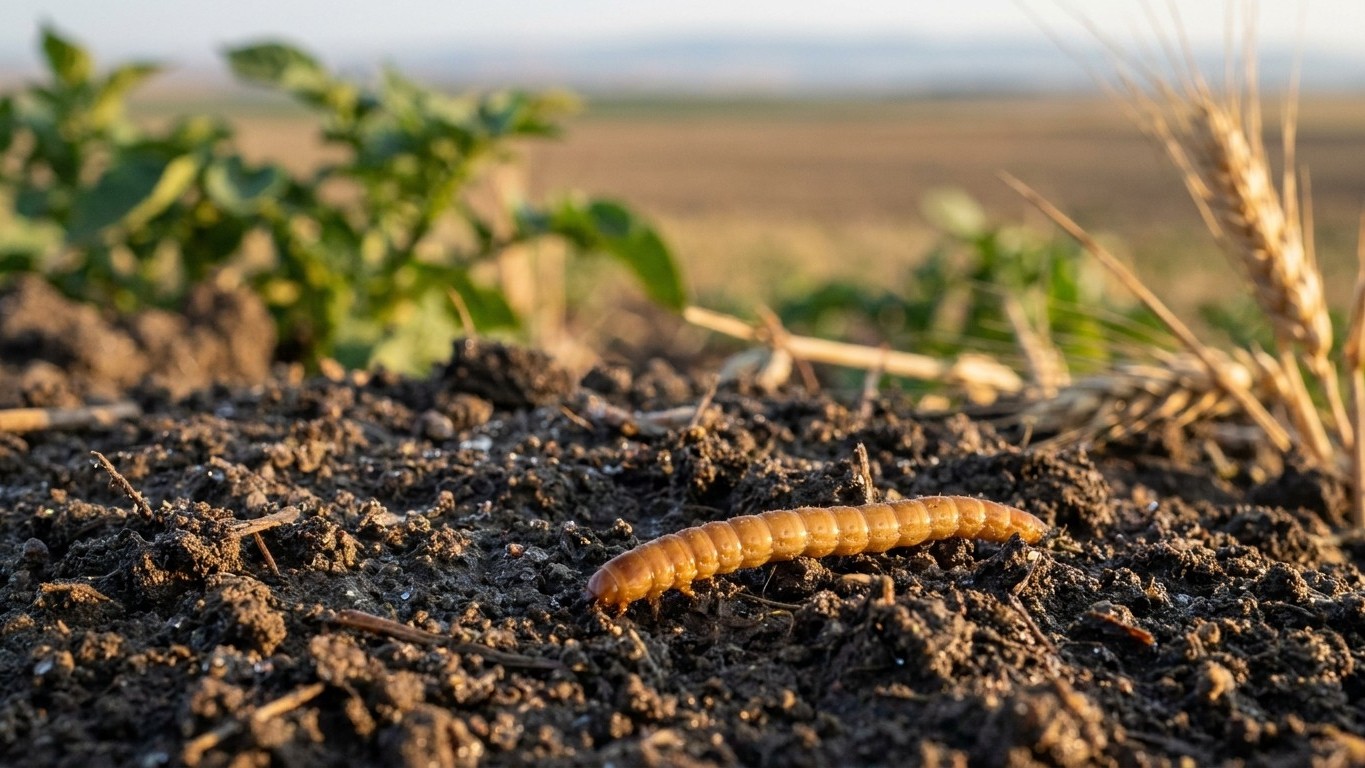

Wireworms show up in Washington fields as soon as soil temperatures climb into the mid-50s, usually late April through May east of the Cascades, and again in a smaller fall pulse once September rains soften dry topsoil in the Columbia Basin. Nothing stops them completely once they’re established, but a combination of pre-plant soil sampling, insecticide seed treatments, and multi-year crop rotation keeps populations low enough that potatoes, wheat, and corn stay marketable. In western Washington’s wetter ground, activity stretches longer into early summer because soil warms more slowly.
Which Wireworm Species Are Actually a Problem Here

Washington growers deal with a handful of click beetle larvae, but two species dominate the conversation among Columbia Basin potato and grain producers: the Pacific Coast wireworm (Limonius canus) and the sugar beet wireworm (Limonius californicus). Both are native to the region and have adapted to irrigated cropping systems, which is part of why they’re harder to manage than imported pests that lack local staying power.
A third species, Ctenicera pruinina, sometimes called the Great Basin wireworm, turns up more in dryland wheat country east of the Cascades. It behaves differently than the Limonius species, favoring drier, less-irrigated fields and often causing damage in a single dramatic flush rather than a slow chronic drain on stand counts. Identifying which species is present matters because bait station results and insecticide timing differ between them, something Washington State University Extension researchers have documented through years of Columbia Basin field trials.
When Wireworms Show Up in the Washington Growing Calendar
The larval stage is the destructive one, and it’s also the longest. Wireworms spend two to six years underground as larvae before pupating into adult click beetles, which means a field infested one spring can stay infested for half a decade even without a fresh egg-laying event. That long larval window is the single biggest reason wireworm damage feels unpredictable from one season to the next.
Adult click beetles emerge in spring, generally April into early June depending on elevation and soil temperature, mate, and lay eggs in grassy or recently-tilled ground. The larvae that hatch from those eggs do most of their feeding in the top six inches of soil during two windows: a spring push right after planting when seed and young roots are the softest target available, and a shorter fall push when soil moisture returns after summer irrigation cutoffs or harvest.
Between those two active windows, wireworms retreat deeper into the soil profile, sometimes eight to twelve inches down, to avoid summer heat and winter cold. That vertical migration is why a field can look wireworm-free in July and then show stand gaps again the following April. Anyone managing land near Moses Lake, the Yakima Valley, or the Skagit Valley’s mixed vegetable ground should treat spring stand establishment as the highest-risk period, full stop.
Soil Temperature Is the Real Trigger, Not the Calendar Date
Wireworm feeding activity tracks soil temperature more reliably than it tracks the date on a calendar. Feeding typically ramps up once soil at planting depth holds steady in the 50 to 55 degree Fahrenheit range, and it slows sharply above 75 degrees. That’s why a cool, wet Washington spring can push wireworm damage into late May in a year when a warmer spring would have wrapped up most of the feeding by early May. Growers who track soil temperature at seed depth, rather than relying purely on planting dates from prior seasons, catch the risk window more accurately.
Crops at Risk and How Damage Actually Looks
Potatoes take the most visible economic hit because wireworm tunneling directly damages the tuber, leaving small dark holes that don’t heal and that graders reject outright. Even light wireworm pressure can drop a field from U.S. No. 1 grade into processing-only or cull categories, which matters a lot given how much of Washington’s potato crop, one of the largest in the country, moves through fresh-pack and frozen-processing channels that both demand clean skin.
Wheat and corn show a different symptom pattern. Instead of visible tuber damage, wireworms chew into the seed or the base of the young seedling underground, which causes stand gaps, wilted single plants scattered through a row, and in bad years entire replant situations. Because the damage happens below the soil line, growers often don’t connect thin stands to wireworms until they dig up a struggling seedling and find the telltale hollowed-out stem or missing seed.
Grass pasture and CRP ground converted to row crops carries elevated risk for the first two to three seasons after conversion. Adult click beetles prefer grassy cover for egg-laying, so a field that spent years in grass often carries a larger wireworm population than neighboring ground that stayed in continuous row-crop rotation. This is one of the more consistent patterns growers in the Palouse and Columbia Basin report when they bring old CRP acres back into wheat or potato production.
What Actually Stops Wireworms in Washington Fields
No single tactic eliminates an established wireworm population. Effective management in Washington relies on stacking several tools, starting well before planting and continuing through the rotation.
Pre-Plant Soil Sampling and Bait Stations
Bait stations, buried mixtures of wheat and corn seed that attract wireworms over a one- to two-week period before planting, remain the most reliable way to estimate population density in a specific field. WSU Extension recommends placing multiple stations per field in fall or early spring, since a single sample point can miss patchy infestations that concentrate near old fence lines or grassy field edges. Growers who skip this step and rely on last year’s damage as a guide often either over-treat clean ground or under-treat a hot spot that flares up mid-season.
Insecticide Seed Treatments and In-Furrow Applications
Neonicotinoid and diamide seed treatments applied at planting remain the primary chemical control for wheat, corn, and potato seed pieces in Washington. These treatments don’t kill wireworms outright in most cases; instead, they reduce feeding activity and cause enough disruption that the larva stops attacking the seed or seedling long enough for the plant to establish a stronger root system. In-furrow liquid applications at planting offer an alternative for growers who want more localized control, particularly in potato ground where seed-piece treatments alone haven’t held up against heavier pressure.
Crop Rotation and Cover Crop Timing
Rotating out of grass-heavy cover and avoiding back-to-back potato or wheat plantings on known infested ground gives wireworm populations fewer consecutive years to build. A three- to four-year rotation that includes a non-host or less-preferred crop, such as certain legumes, reduces the food supply available during the larvae’s peak feeding years. Cover crop termination timing also matters: killing a grassy cover crop too close to planting can leave a flush of decaying root material that temporarily concentrates wireworm feeding right where the next crop’s seed goes into the ground.
Tillage Timing as a Supplemental Tool
Tillage doesn’t eliminate wireworms, since they simply move deeper in the soil profile to escape disturbance, but well-timed fall tillage can expose some larvae to predation by birds and reduce the grassy egg-laying habitat that adult click beetles prefer. This works best as a supplemental practice layered onto seed treatments and rotation planning, not as a standalone fix.
Regional Differences Across Washington
Eastern Washington’s irrigated Columbia Basin sees the heaviest documented pressure, largely because the combination of potato, wheat, and corn rotations on the same irrigated ground gives wireworms a stable, well-watered food source year after year. Dryland wheat country in the Palouse deals more with the Great Basin wireworm species and tends to see damage concentrated in specific low-lying or previously grassy fields rather than spread evenly across a farm.
West of the Cascades, wetter and cooler soils in the Skagit Valley and Puget Sound lowlands extend the spring feeding window later into the season, sometimes into June, because soil warms more slowly under regular rainfall. Vegetable growers in these areas, particularly those growing potatoes for the fresh market, often report that wireworm risk lingers longer than growers assume based on eastern Washington timelines.
Washington’s wireworm pressure connects to broader Pacific Northwest patterns, and growers managing multi-state operations often compare notes with counterparts dealing with similar species in Oregon and Idaho, where the same Limonius species drive most of the potato and grain damage. For a broader look at wireworm biology and control options that apply across all these regions, the general wireworm control guide covers identification and treatment basics in more depth.
One detail that surprises a lot of new Columbia Basin growers: a field can test clean on a spring bait station and still show stand damage the following fall, because that same field’s wireworm population simply migrated in from an adjacent grassy ditch bank or fallow strip during the intervening months. Field edges, not just field centers, deserve a look before ruling out wireworm risk entirely.