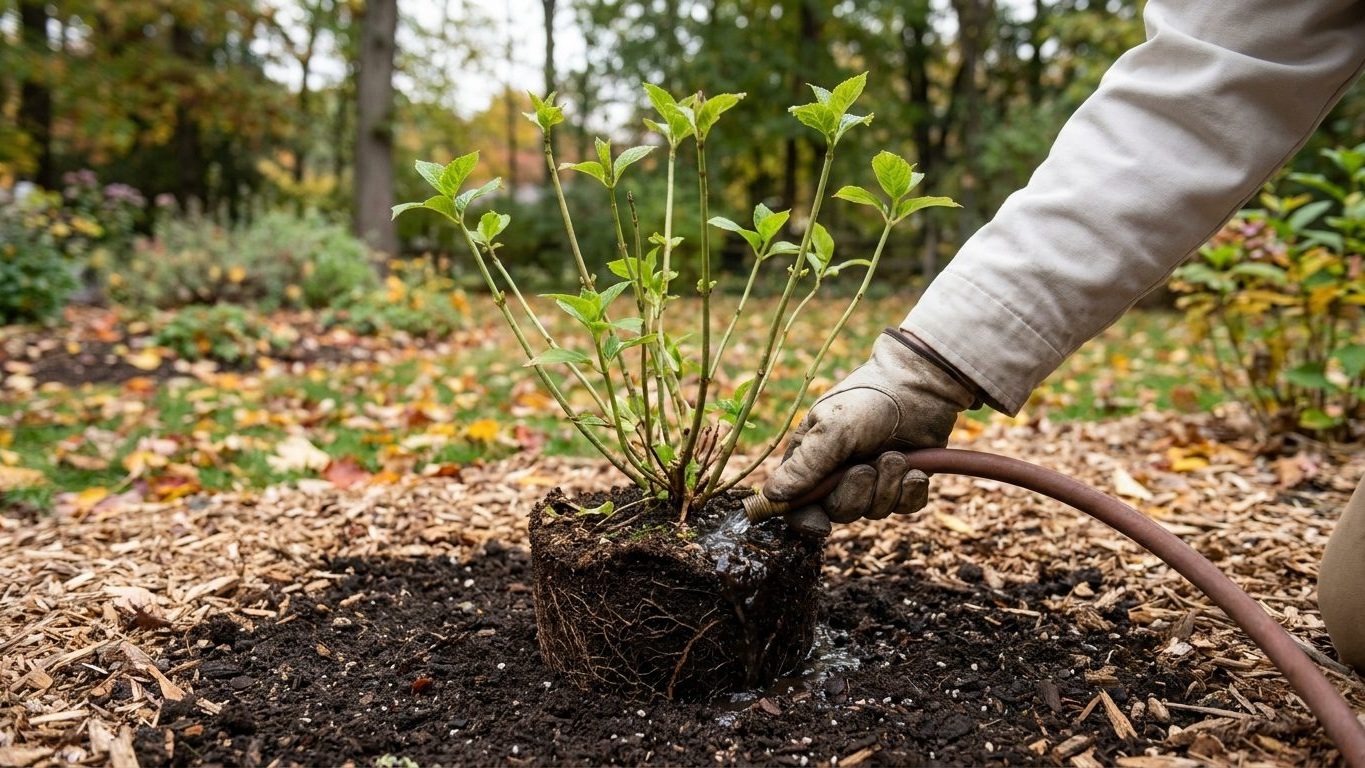

The safest first-year hydrangea routine is mostly about what you don’t do: no heavy pruning, no aggressive feeding, no rushing to change flower color. Water deeply, mulch lightly, and let the plant spend its energy on roots. The one thing that trips up first-year growers more than anything else is treating this like a mature, established plant instead of one still finding its footing.
Why this matters
A newly planted hydrangea arrives with a root ball still shaped like the nursery pot it came from. Roots haven’t pushed out into the surrounding soil yet, and both bigleaf (H. macrophylla) and panicle (H. paniculata) hydrangeas are shallow-rooted by nature, so that first growing season is when the plant either builds a real lateral root system or stays effectively pot-bound in the ground. Everything else, flower size, drought tolerance, winter survival, depends on how much root mass gets built this year.
Skip the watering and roots never spread beyond the original planting hole, leaving the plant vulnerable the moment you stop babying it. Prune an old-wood type (macrophylla, oakleaf, mountain, climbing) thinking you’re tidying it up, and you can remove the buds already set for next year’s flowers, since those types bloom on wood formed the previous season. Overfeed, especially with a high-phosphorus fertilizer, and you push top growth at the expense of roots, and on macrophylla or mountain hydrangeas you also lock up the aluminum that keeps flowers blue, nudging color toward pink whether you meant to change it or not.
When to do it
Forget the calendar. Watch the plant instead. In the first couple weeks after transplanting, some leaf droop is normal, that’s transplant shock, not a watering failure, and it usually corrects itself once roots make contact with native soil. Underwatering looks different: the soil two to three inches down feels dry, and wilt persists into the next morning instead of recovering overnight.
The real signal you’re looking for is a fresh flush of new leaves, a sign the roots have started functioning in their new spot. Once that happens, deep, regular watering matters more than ever, since this is when the plant is actively expanding its root system. If flower buds appear, especially on an old-wood type, leave them alone; removing them to “help the plant focus on roots” is a myth, and the buds you protect this year are the flowers you’ll see next spring. Pruning, if any is needed at all in year one, waits until right after flowering fades on old-wood types, never before. New-wood types (paniculata, smooth/arborescens) are more forgiving on timing since they bloom on the current season’s growth, but first year is still not the moment for hard cutbacks.
How to do it
Which type are you working with
First-year care changes depending on what kind of hydrangea is in the ground. Getting this wrong is the single most common reason people accidentally prune off next year’s flowers.
| Type | Flowers on | First-year pruning approach | Mature size |
|---|---|---|---|
| Bigleaf / mop-head / lacecap (macrophylla) | Last year’s wood | Leave alone; remove only dead or broken stems | 3-6 ft tall and wide |
| Panicle / peegee (paniculata) | Current season’s growth | Light shaping only if needed, no hard cutback needed year one | 8-25 ft |
| Smooth (arborescens, e.g. Annabelle) | New wood | Most forgiving, minimal care needed | Varies, typically 3-5 ft |
| Oakleaf (quercifolia) | Old wood | Leave alone, protect fall foliage color | About 5 ft |
| Mountain (serrata) | Old wood | Leave alone; buds tolerate late frost better than macrophylla | Compact, similar to macrophylla |
| Climbing (petiolaris) | Old wood | Leave entirely alone; very slow to establish | 15+ ft, clings by aerial rootlets |
Watering and mulch
Skip the daily light sprinkle. A deep soak once or twice a week beats frequent shallow watering, since it encourages roots to grow downward and outward instead of staying near the surface. A slow soak equal to a full watering can (roughly one to two gallons) applied right at the base, given time to actually soak in rather than run off, is a reasonable target for an in-ground plant during a dry stretch. Check soil moisture with a finger before watering again; if the top two to three inches are still damp, wait.
Spread two to three inches of shredded bark or leaf mulch around the base, pulled back an inch or two from the actual stem. Both macrophylla and paniculata are shallow-rooted, and mulch does the double job of holding moisture and moderating soil temperature swings around those roots.
Feeding and pruning restraint
Most first-year hydrangeas don’t need fertilizer at all if planted in decent soil. If the soil is genuinely poor, one light application of a balanced, low-phosphorus fertilizer in spring is enough. Avoid high-phosphorus blends specifically; the phosphorus locks up soil aluminum, which is what pushes blue macrophylla and serrata flowers toward pink whether you intended a color change or not. Beyond removing dead or clearly broken stems, put the pruning shears away for the year.
What Goes Wrong
Overwatering is the most common failure, and it’s often mistaken for underwatering, which makes people water even more. Look for yellowing leaves and soil that stays soggy days after watering; roots sitting in standing water will eventually blacken and rot, even though the source lists occasionally wet soil as acceptable for the genus generally. Planting too deep, or piling mulch up against the stem like a volcano, traps moisture against the crown and invites the same rot.
The mistake that looks like extra care but isn’t: pruning an old-wood type in fall or winter to “clean it up” for the season. On macrophylla, oakleaf, serrata, or climbing hydrangeas, that cut removes the buds already formed for next year’s flowers. It looks tidy and feels productive; it costs you the entire next bloom cycle.
Reaching for coffee grounds or citrus peel to turn flowers blue deserves a plainer answer than it usually gets: this is a widely held belief, not a working method. The pH shift from kitchen scraps is small, and flower color depends on available aluminum in the soil, which real acidification releases, not a sprinkle of grounds. In year one specifically, roots aren’t established enough for any deliberate color-chemistry project to matter yet. And note plainly, since it applies here: deer browse hydrangeas. Don’t plant a first-year specimen assuming it’s protected.
Doing it differently
Container-grown first-year hydrangeas dry out faster than anything in the ground, sometimes needing water almost daily in hot weather, so check soil moisture more often and make sure drainage holes are actually draining. Raised beds give more control over soil composition and drainage, useful later for macrophylla color adjustments, but they also dry out faster than native ground soil, so don’t assume less frequent watering just because the bed looks tidy.
Variety changes the calculation too. Paniculata is the most forgiving first-year choice, and it’s the only hydrangea type that takes full sun well, which the source notes makes it a reasonable substitute for bigleaf hydrangea in areas where that species doesn’t reliably survive winter. Smooth hydrangea (arborescens types like Annabelle) is the hardiest of the genus and tends to shrug off first-year mistakes better than the others. Climbing hydrangea is the outlier: it’s notoriously slow to start flowering and to put on visible growth, so a first-year climbing hydrangea that looks like it’s doing nothing may simply be building roots out of sight. Patience matters more than technique there.
Common questions
Should I fertilize a hydrangea in its first year?
Only if the soil is genuinely poor, and then just once, in spring, with a balanced, low-phosphorus fertilizer. Most first-year plants in decent soil don’t need feeding at all.
Can I prune my hydrangea the first year?
Remove only dead or broken stems. Old-wood types (macrophylla, oakleaf, serrata, climbing) will lose next year’s flowers if pruned at the wrong time, so leave shaping cuts for later years once you know the plant’s bloom cycle.
Why is my first-year hydrangea wilting?
Midday droop that recovers by evening is normal, especially right after transplanting. Wilt that’s still there the next morning, paired with dry soil a couple inches down, means it needs a deep soak.
Will coffee grounds change my hydrangea’s flower color the first year?
Not reliably, and this isn’t the year to try. Kitchen scraps shift soil pH only slightly, and flower color depends on available aluminum, which needs real soil acidification to release. Color adjustment also only applies to macrophylla and mountain hydrangeas, not to panicle, smooth, oakleaf, or climbing types.