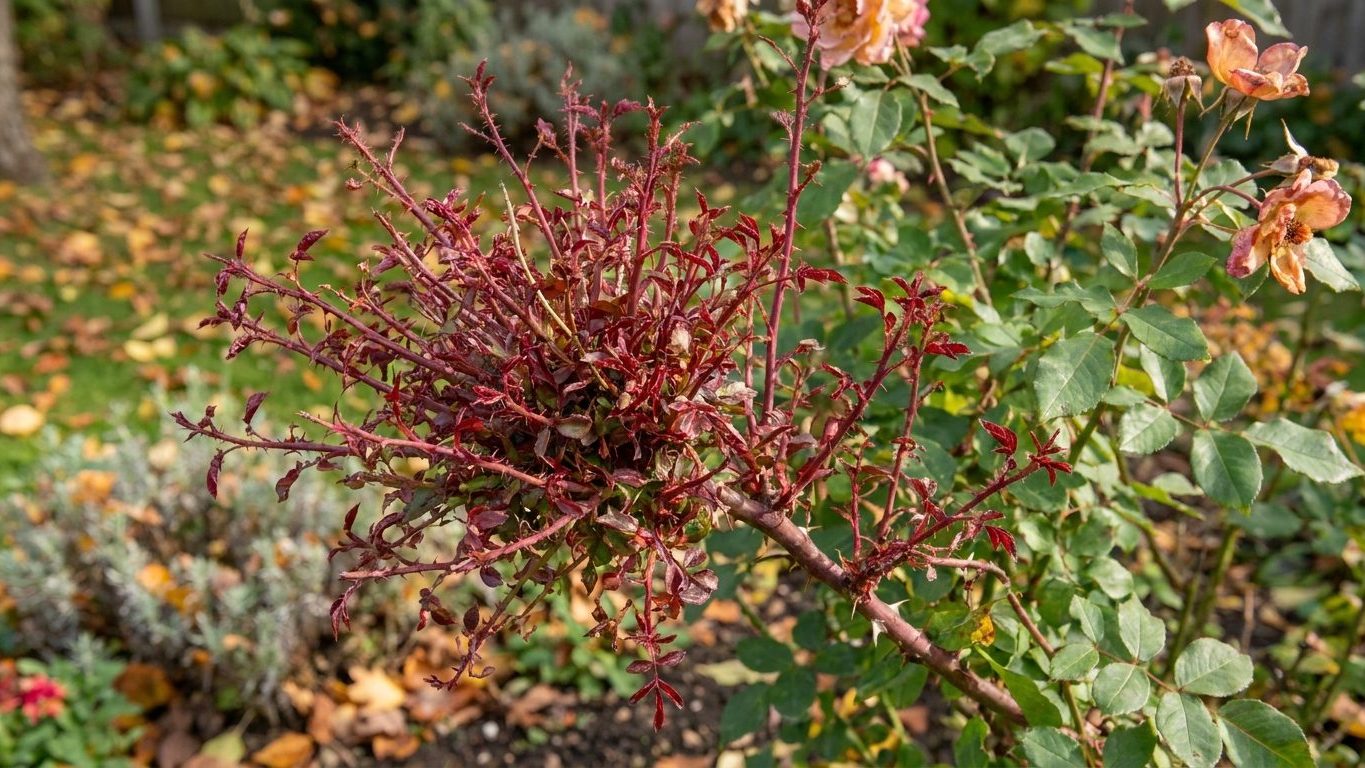

Yes, it’s serious, and yes, the plant needs to come out. Rose rosette disease produces the odd, tufted “witches’ broom” growth that gardeners search for by name, and there’s no spray or pruning cut that reverses it. The virus lives inside the plant’s vascular tissue permanently. Once you’ve confirmed the diagnosis, the only responsible move is to dig up the entire rose, roots included, and get rid of it before the microscopic mite that spreads it moves to the roses next door.
What you are looking at
Rose rosette disease usually announces itself at a single cane tip or one section of new growth before spreading through the rest of the plant over a season or two. The changes are not subtle once you know what to look for: growth that should be reaching out normally instead bunches into tight, brush-like clusters, thorns multiply well beyond what’s normal for the variety, and new leaves come in oddly narrow, crinkled, and stained red or purple in a way that doesn’t fade as they mature. The infection moves systemically through the plant’s phloem, so it doesn’t stay contained to the spot where you first noticed it.
Witches’ Broom Clusters
Dense bunches of thin, short stems erupt from a single point, packed together like the bristles of a broom rather than spreading out the way healthy rose canes do. The clustered stems are noticeably weaker and thinner than the rest of the plant’s growth.
Excessive Thorn Proliferation
Thorns crowd together along affected canes in numbers far beyond the plant’s normal pattern. They often look soft, pliable, and unusually bright red or pink compared to the woodier, duller thorns on unaffected canes of the same bush.
Red Pigmented New Growth That Won’t Green Up
New shoots and leaflets emerge deep red or purplish and stay that color well past the point where healthy new growth would harden off to green. The pigment sits across the whole leaf and stem rather than fading in patches.
Distorted, Narrow Leaflets
Leaflets on affected stems come in smaller, asymmetrical, and puckered, often with a strap-like or fern-like narrowness that doesn’t match the rest of the plant’s foliage. Flowers on these same stems, when they form at all, tend to be smaller, off-color, or malformed.
What it is not
Three look-alikes send gardeners chasing the wrong problem every year, and getting the call wrong has real consequences. Mistake rosette for something temporary and you’ll dig up a rose that would have recovered on its own. Mistake something temporary for rosette and you’ll leave an infectious reservoir standing, spreading mites to every rose within reach of the wind.
Herbicide Drift Damage
Cupped, strapped, or twisted leaves that show up on a rose right after nearby mowing, spraying, or lawn treatment usually point to drift from a broadleaf herbicide, not a virus. The telltale sign is that the damage often shows up on other nearby plants too, in the direction the wind was blowing that day, and it doesn’t come with the thorn proliferation or tight broom clustering rosette produces. Drift-damaged growth typically recovers in the next flush, while rosette growth never does.
Normal New Growth Flush
Most roses put out reddish new growth as a normal part of their cycle, and that color is completely healthy. The distinguishing detail is timing: normal flush growth turns green as the leaves mature over the following couple of weeks. If the red or purple color persists past that window, along with distorted leaflets and clustering, that’s the signal to stop assuming it’s a routine flush.
Rose Mosaic Virus
Rose mosaic produces yellow chevron or wavy line patterns across otherwise normal-shaped mature leaves. It doesn’t cause witches’ broom clustering and it doesn’t cause the thorn explosion rosette does. It’s also spread through grafting rather than by a wind-borne mite, so an infected plant is mostly a cosmetic issue rather than an active threat to the roses around it. Pulling a mosaic-affected rose because it was mistaken for rosette wastes a plant that posed little risk to its neighbors.
| Condition | Growth pattern | Thorn count | Color resolves? | Spreads to nearby roses |
|---|---|---|---|---|
| Rose rosette disease | Tight witches’ broom | Greatly increased | No, stays red/purple | Yes, via wind-borne mite |
| Herbicide drift | Cupped, strapped leaves | Normal | Recovers next flush | No |
| Normal new growth | Normal shape | Normal | Yes, greens within weeks | No |
| Rose mosaic virus | Normal shape, chevron pattern | Normal | Pattern persists but stable | Only via grafting |
Where it comes from and when it strikes
The culprit is Rose rosette virus, an emaravirus that lives exclusively inside rose tissue. It doesn’t survive in soil, in fallen leaves, or on garden tools the way many fungal pathogens do. What carries it from plant to plant is a mite so small it’s invisible without magnification, Phyllocoptes fructiphilus, which feeds on rose tissue and picks up the virus in the process, then rides wind currents to the next available rose.
Because the mite is wingless, wind is its main transportation. It can move well beyond a single planting bed on a stiff breeze, which is part of why rosette shows up in isolated backyard roses with no infected plant visibly nearby. Infected nursery stock is the other common entry point, since a plant can carry the mite or an early, unnoticed infection home from the garden center.
Wild multiflora rose, an invasive species that grows unmanaged along fence lines, roadsides, and field edges across large stretches of the eastern and central United States, acts as a massive, ever-present reservoir for both the virus and the mite. Warm, dry conditions favor mite reproduction and movement, which is why rosette symptoms tend to show up and spread more actively during the warmer stretches of the growing season, while mite populations decline in cold weather even though the virus itself persists inside any infected plant year-round.
What to do about it now
There is no cure. That’s the honest starting point, and it’s more useful than any suggestion that a spray or a hard pruning will fix it. The virus is systemic in the plant’s vascular system, so cutting off the visibly affected canes doesn’t remove the infection, it just delays the next round of symptoms while the mites already on that plant keep working their way to your other roses.
Once you’ve ruled out the look-alikes above and you’re confident it’s rosette, dig up the entire plant, root system included. Bag it and dispose of it in the trash rather than composting, since any surviving root or cane fragment can resprout and keep harboring both the virus and the mites that spread it. Don’t wait for a “worse” symptom to justify the decision. The longer an infected rose stays in the ground, the longer it seeds mites onto the roses around it.
For the roses you’re keeping, improve spacing and airflow so wind-carried mites have less of a bridge between plants, and consider a preventive miticide application on nearby healthy roses at the time you remove the infected one, since that’s the window when disturbed mites are most likely to relocate. Roses are grown as ornamentals rather than a food crop, so there’s no harvest to worry about losing; if you do collect rose hips from a rosette-affected plant, it’s simplest to skip them and let the whole plant go rather than sort out which parts might be fine.
Keeping it out next season
Start outside your own garden bed. Wild multiflora rose growing along nearby fence lines, ditches, or field edges is the single biggest reservoir for both the virus and its mite, and removing it within reach of your cultivated roses does more to reduce reinfection risk than almost anything else on this list.
Space new roses generously rather than planting them in a dense hedge, since tight spacing gives wind-borne mites an easy path from one plant to the next. Inspect any new rose closely before it comes home, checking new growth for early clustering, excessive thorns, or persistent red coloring, and buy from nurseries with a track record of clean stock. It’s worth keeping a new rose separated from your established bed for part of a season before planting it in among the others, simply to watch for symptoms with nothing else nearby to infect.
On resistant cultivars, the honest answer is that no rose variety currently sold carries documented genetic resistance to rose rosette disease, the way some vegetable seed packets carry letter codes for resistance to specific pathogens. Breeding programs are actively working on resistant lines, but nothing on the market today should be planted with the expectation that it’s immune. Sanitizing pruning tools with alcohol or a diluted bleach solution between plants is a reasonable precaution, since mites can occasionally hitch a ride on a blade or on clothing, even though wind remains the dominant way this disease travels.
Common questions
Can rose rosette disease spread to other plants, like fruit trees or other shrubs?
No. Rose rosette virus infects roses and their close wild relatives exclusively. It doesn’t move into fruit trees, other flowering shrubs, or unrelated ornamentals, so there’s no need to inspect non-rose plants in the yard for this particular problem.
How far can the mite that spreads this disease actually travel?
Far enough that an isolated backyard rose with no obviously infected plant nearby can still come down with it. The exact distance figures vary by study and aren’t settled here, but wind-borne movement well beyond a single yard is the accepted explanation for why the disease shows up in scattered, seemingly unconnected locations.
Should I disinfect pruning tools after cutting on a rose with rosette disease?
It’s a reasonable precaution even though tools are a minor route of spread compared to wind. Wiping blades with rubbing alcohol or a diluted bleach solution between cuts, especially before moving to a different rose, costs nothing and closes off one more possible path for the mite.
Is it safe to plant a new rose in the same spot after removing an infected one?
Generally yes, since the virus doesn’t survive independently in soil the way some fungal pathogens do; it needs living rose tissue to persist. Just make sure every root fragment from the removed plant is out of the ground, and keep in mind that whatever wind-borne mite pressure infected the original rose is likely still present in the surrounding area.