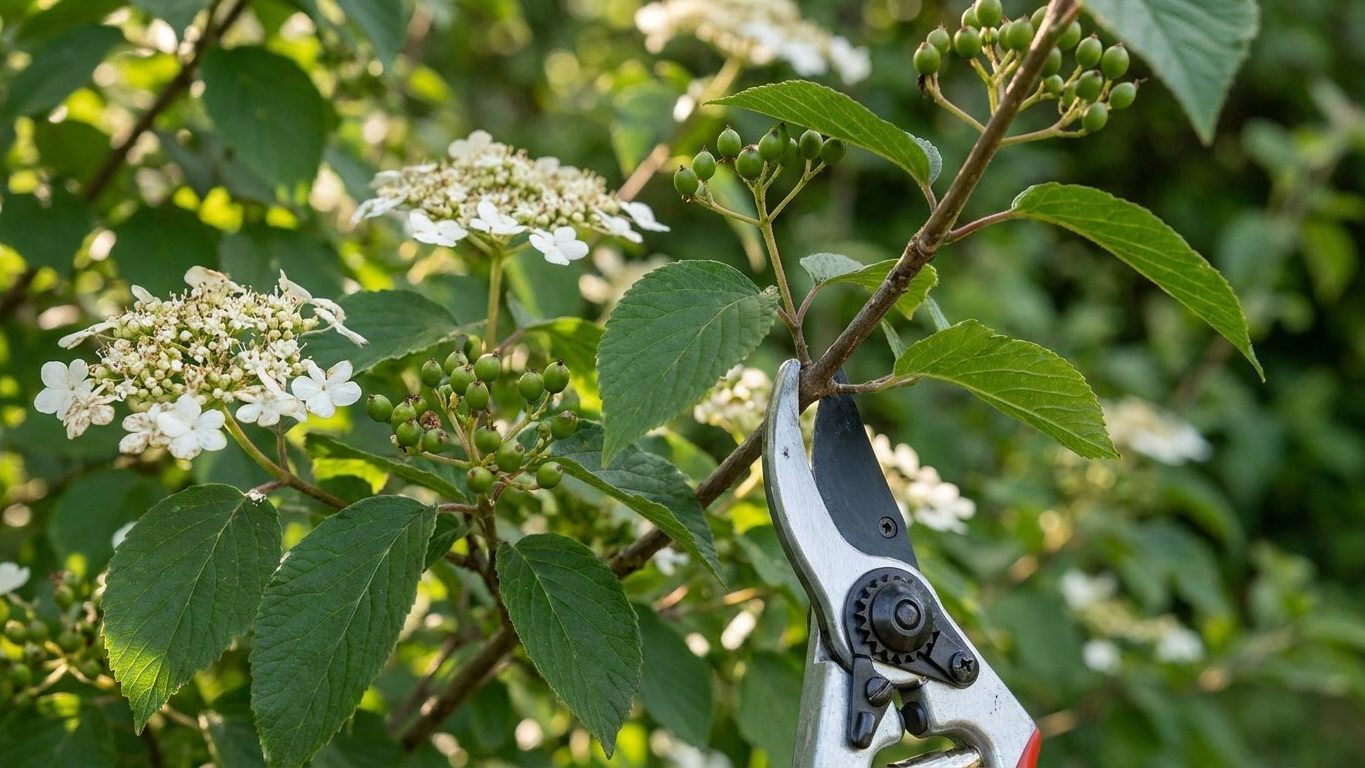

Prune arrowwood viburnum right after the blooms fade, once the flat white flower clusters have dropped their petals and started forming green berries. That’s the plant’s own signal, not a date on a calendar. Cut too early and you lose the flower show; wait until fall and you’ll cut off next year’s buds along with this year’s growth.
When to prune arrowwood viburnum
Arrowwood viburnum sets its flower buds on the current season’s wood almost as soon as blooming ends. That narrow stretch right after flowering is the only time you can shape the plant without sacrificing next spring’s display. Cut in early summer, while the shrub is still pushing new growth, and the pruning cuts get folded into that flush; by fall you can barely find where you made them. Cut the same stems in September or October instead, and the wound sits open through freezing nights with no new tissue coming to seal it, which is exactly the kind of stress that invites cane borers and dieback in a shrub this size.
Timing also has to answer to geography. A shrub in coastal North Carolina finishes flowering weeks before one planted in Vermont, so the pruning window slides with it. Arrowwood viburnum grows across USDA zones 3 to 8, which covers most of the continental country, and the safest way to pin down your local date is to call your state’s extension horticulture line rather than guess from a national calendar.
Growth rate matters here too. This shrub adds 12 to 24 inches a year, fast enough that a hedge left unpruned for two seasons can gain three or four feet of width it never had before. That pace means the annual after-bloom trim isn’t optional maintenance, it’s the only thing keeping a hedge in bounds before it swallows a walkway or a fence line. Skip one year and you’re not just delaying the job, you’re adding a season’s worth of new wood to whatever you eventually have to remove.
Homeowners who plant arrowwood viburnum as a privacy screen at its mature 6 to 10 foot hedge height often find the after-bloom window lines up conveniently with early summer yard work, before the heat of July slows everyone down. Doing the cut then, rather than waiting for a cooler fall day that feels more comfortable, is what keeps the plant covered in flowers year after year instead of thinning out.
How hard you can cut it back
Most pruning advice floating around online was written with narrow-leaf evergreens in mind, and it doesn’t apply here. Cut a juniper or arborvitae back into bare brown wood and it stays bare forever, because those conifers carry no dormant buds under the old bark. Arrowwood viburnum is built differently. It holds dormant buds along its older stems, which means a hard cut into wood that looks dead and gray will still push new shoots the following season. That single fact is what makes this shrub the right answer for an overgrown hedge that a conifer could never recover from.
The technique for bringing back a hedge that’s gotten leggy, gapped at the bottom, or simply too tall is renovation pruning spread across two or three seasons rather than one brutal cut. Taking everything down to a stump in a single afternoon shocks the root system and leaves the yard staring at bare sticks for a year. Staged renovation avoids that while still getting the job done.
| Season | What to remove | What it accomplishes |
|---|---|---|
| Year 1 | Oldest, thickest third of the stems, cut to 6-12 inches from the ground | Opens the center, forces new shoots from the base |
| Year 2 | Next oldest third, same low cut, after the first year’s new growth has filled in | Continues the reset without leaving the hedge bare all at once |
| Year 3 | Remaining old stems, plus a shaping trim on the new growth from Years 1 and 2 | Finishes the renovation with a hedge entirely on new wood |
Each stage should happen in that after-bloom window, not scattered through the year. Skipping the staged approach and taking the whole hedge down at once costs you at least one full season of privacy screening and flowers while the shrub regrows from scratch instead of rebuilding gradually behind the older stems still in place. Given the shrub’s growth rate of 12 to 24 inches a year, most renovated hedges are back to a presentable hedge shape within two growing seasons of finishing the last stage.
The shape that keeps the bottom alive
A hedge cut with straight vertical sides, or worse, sides that lean inward toward the top, shades out its own lower branches. Leaves need sunlight to stay productive, and a top-heavy hedge blocks that light from ever reaching the bottom two or three feet. Over a season or two those lower branches thin out, then drop their leaves entirely, and you’re left with the classic problem gardeners call going bald at the bottom, a shape that no amount of pruning can fix without cutting the whole hedge down to rebuild it.
The fix is a taper: the base of the hedge should be visibly wider than the top, sloping inward as it rises so sunlight can angle down and reach the lower foliage instead of hitting a flat wall of leaves. Picture the silhouette of an A-frame roof rather than a rectangle, and prune to that outline every time you’re out there in early summer.
The other number that decides whether a hedge stays healthy through a hard prune is the one-third rule: never remove more than a third of the plant’s total live growth in a single pruning session. Arrowwood viburnum tolerates renovation cuts into old wood, but that tolerance applies to staged, planned removal, not to stripping most of the canopy in one pass. Take more than a third off healthy, actively growing wood in one session and the shrub responds by pushing a flush of weak, whippy growth all at once instead of a balanced set of new branches, leaving it more vulnerable to wind damage and slower to fill back in.
Combine the taper with the one-third limit and a single hedge trim does two jobs at once: it keeps light reaching the base, and it keeps the plant from overreacting to the cut. Skip the taper and even a well-timed, correctly sized cut still leaves the bottom in shade, so the shape matters as much as the calendar does.
What actually kills arrowwood viburnum
Pruning changes more than the shape of this shrub, it changes how much disease pressure it carries. A hedge left unthinned traps humid air between its branches after rain or dew, and that trapped moisture is what fungal leaf spots and stem cankers need to take hold. Opening the interior during the after-bloom prune lets air move through the plant and dry the leaves faster, which is a bigger factor in the shrub’s long-term health than most people give it credit for.
The threat that actually ends arrowwood viburnum plants, though, isn’t a fungus. It’s the viburnum leaf beetle, an insect that skeletonizes leaves down to their veins and can kill a mature shrub in two or three seasons of repeated defoliation. A plant stripped of its leaves every summer has no way to store the energy it needs to push new growth the following spring, and the decline compounds year over year until the shrub simply doesn’t leaf out.
Identification matters more than treatment here, and this is one case where a phone call beats a search engine. State extension services, Penn State Extension and NC State Extension among them, publish photo guides showing the beetle’s larvae and the distinctive skeletonized leaf damage side by side with look-alike problems, so a homeowner can confirm what they’re looking at before deciding on any control approach. If you suspect leaf beetle activity, contacting your local Cooperative Extension office for identification is the first step, not the last.
Common questions
Can I prune arrowwood viburnum in late winter instead of after flowering?
A late winter cut removes the flower buds that formed the previous summer, so the shrub will leaf out fine but skip blooming that year. It’s not harmful to the plant’s health, just costly to that season’s flowers.
How far apart should I space cuts during a renovation?
Space the staged cuts across three separate after-bloom windows rather than compressing them into one year, giving the root system time to recover between each round of removal.
Will cutting the hedge shorter than 6 feet stunt it permanently?
No. Arrowwood viburnum regrows readily from lower cuts and will climb back toward its natural 6 to 10 foot hedge height over subsequent growing seasons if left unpruned.
Does a healthy pruning routine prevent viburnum leaf beetle?
Pruning improves airflow and reduces fungal disease pressure, but it doesn’t stop the beetle itself. Watch for skeletonized leaves each summer and confirm any suspected infestation with your local extension office.