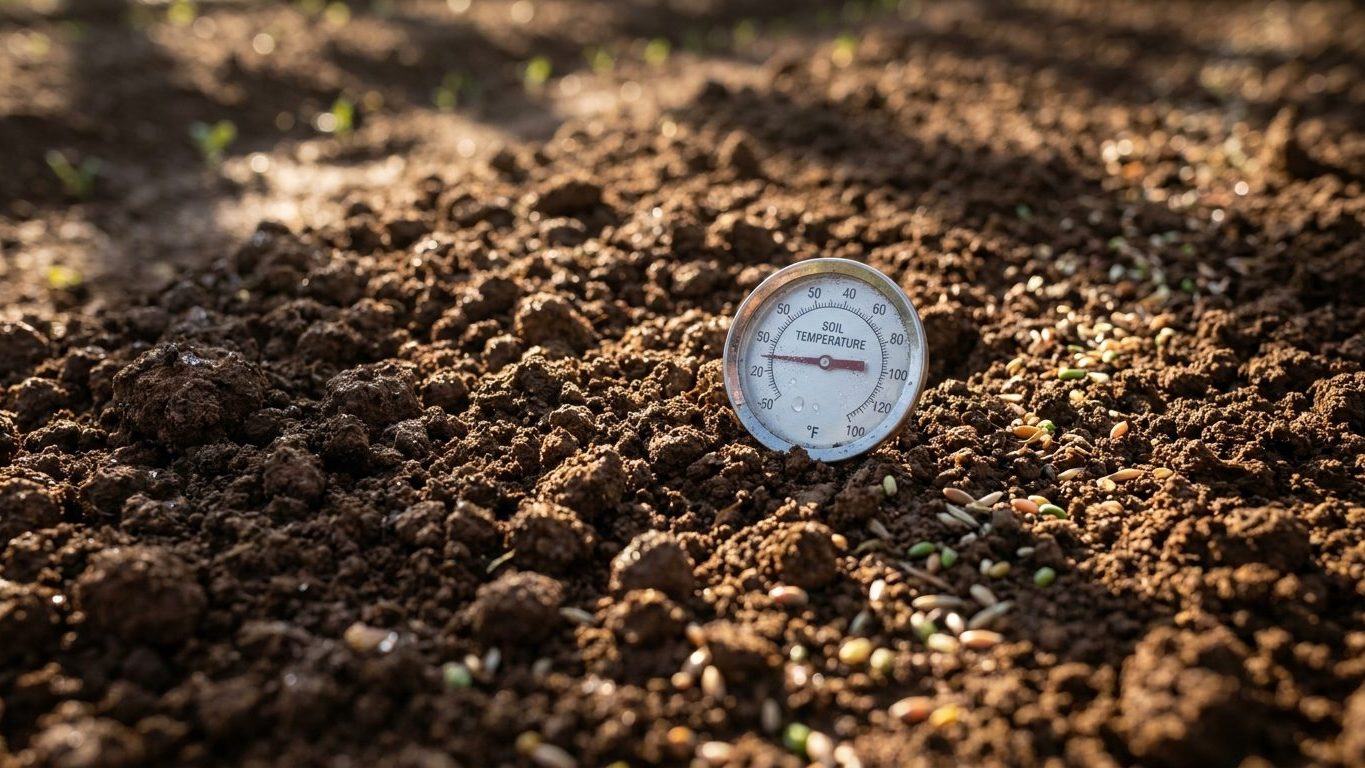

Anchorage’s cover-crop window opens once the soil itself warms, which lags a week or two behind the last frost date. That gap matters more than the calendar does: a frost-free morning on bare, cold ground still won’t sprout much. In this cluster, that lag between air and soil is the first thing to understand before sowing anything.
When the soil is warm enough in Alaska
NOAA’s 1991-2020 Climate Normals put the last spring frost at station USW00026451 (Anchorage) somewhere between May 3 and May 12, based on the 30-70% probability band for a 32°F freeze. That’s a range, not a single date, and it’s a probability, not a promise. Frost can still show up outside that window in a cold year.
Frost, though, is only a proxy. Cover crop seed doesn’t respond to air temperature; it responds to soil temperature, and Anchorage soil typically needs another one to two weeks past that last-frost window to shake off winter. Sow into cold, wet ground before then and you’ll get slow, patchy germination at best, rot at worst. The safer read is to treat the May 3-12 window as the earliest the risk of a killing frost drops off, then wait for the soil itself, not the thermometer at head height, to tell you it’s ready.
What actually decides how much seed goes down
Seeding rate isn’t a single number you can carry around in your head. It shifts with the species (a fine-seeded legume behaves nothing like a coarse cereal grain), the method (broadcast seed needs a heavier hand than drilled seed), and the source of the seed itself, since germination rates vary by lot and by year. Getting this wrong wastes an already short season, so the honest answer is to bring your species choice and your planting method to the University of Alaska Fairbanks Cooperative Extension Service, which can give a rate calibrated to your soil and your equipment.
Termination follows the same local logic. This site works with mechanical methods only: mowing, crimping, cutting, or letting a hard frost do the job for you. In Anchorage’s climate, that last option carries real weight, because the growing season is short enough that many cover crops are still standing when the first fall frost arrives anyway. That timing, not a chemical spray, is often what ends the crop’s growth here.
A legume’s nitrogen contribution to next year’s bed depends on how much biomass it built and when it was terminated, not on a number you can look up and apply everywhere. A legume cut down early, before flowering, releases nitrogen faster than one left to mature and dry. Alaska’s compressed season tends to push termination earlier than gardeners in warmer states are used to, simply because there’s less calendar to spare.
How long the season lasts here
Subtract May 3-12 from September 22 to October 1, and Anchorage’s frost-free window runs roughly 133 to 151 days, landing NOAA’s own figure at about 143 frost-free days on average. That’s short by national standards, but not as short as Alaska’s reputation suggests, since long summer daylight partly makes up for the compressed calendar by pushing growth harder during the hours the sun is up.
What that length allows is the real question for a gardener planning cover crops rather than just admiring the math. A window just over four months gives room for one full cover-crop cycle between a spring vegetable harvest and a fall planting, but it rarely stretches far enough for the kind of two-round succession that gardeners in the Lower 48’s warmer zones can pull off. In Anchorage, the first sowing after an early crop comes out is usually the only sowing that season, not the first of two.
That single-shot reality changes a decision many gardeners don’t think about until it’s too late: whether to direct-seed a cover crop or start it as transplants indoors first. With roughly 143 days to work with, and a chunk of that already claimed by the vegetable crop preceding it, a transplanted cover crop (started a few weeks early under cover) can buy back time that direct-seeding simply doesn’t have. It’s worth checking, before committing seed to soil, whether the species on hand tolerates a root check from transplanting at all, since not all cover crops handle being moved as young plants.
Gardeners weighing whether their own site can support more than one round, or whether a second planting even makes sense given local frost timing, should look at the site’s succession sowing guide for the mechanics of stacking cover crops within a single season. Anchorage’s window sits at the shorter end of what makes that kind of planning worthwhile, but every yard’s microclimate differs enough that it’s worth working through rather than assuming.
Heat and water in Alaska
Anchorage doesn’t have a heat problem. Days above 90°F at the reference station are effectively a non-issue here, unlike in much of the Lower 48 where cover crop planning has to account for heat stress on germinating seed or scorched foliage in midsummer. That absence changes what actually threatens a cover crop planted in this climate: it’s cold, not heat, that decides which species survive and which don’t.
The number that carries the real weight is the coldest month’s mean daily minimum, which sits at 11.0°F in Anchorage per NOAA’s Climate Normals. That’s not the record low and not the average for the whole month, just the mean of the daily lows during the coldest stretch of winter, and it’s exactly the figure that separates a cover crop that survives to be worked in the spring from one that’s already dead and flattened by December. In a place with a mean minimum that cold, plants rated for winter survival in warmer zones simply don’t make it through without snow cover doing some of the insulating work.
USDA’s Plant Hardiness Zone Map (2023 edition, built on 1991-2020 normals) lists Alaska across a startling range, 1a to 8a, which says more about the size and geographic spread of the state than about any single garden. A dated recommendation has to anchor to a reference point, and for this page that’s Anchorage, sitting toward the milder end of that statewide range. A gardener anywhere else in Alaska, from the Interior to the North Slope, is working with a genuinely different winter and should treat this page’s figures as a starting comparison, not a substitute for their own local data.
Where a warmer, humid state has to worry about mildew and rot from summer rainfall, Anchorage’s short, cool growing season brings a milder version of the same risk: slow ripening and sluggish disease pressure rather than the fast-moving fungal problems that show up further south. It’s a different kind of caution, not a bigger one, and it changes what a gardener watches for more than it changes how much they need to worry.
Which cover crops suit Alaska
Given a mean winter low of 11.0°F and a season that runs about 143 frost-free days, the crops that make sense here fall into a fairly narrow band of behavior, described by type rather than by any specific variety.
| Type | Fit for Anchorage’s climate | Winter behavior |
|---|---|---|
| Cool-season cereal grains | Strong match; germinate and grow well in short, cool summers | Most winterkill reliably at 11.0°F mean lows, leaving a mulch by spring |
| Cool-season legumes | Good match if sown early enough to build biomass before fall frost | Winter survival varies by species; some winterkill, others need mechanical termination in spring |
| Brassicas grown as cover | Fast growers well suited to the short window | Typically winterkill early, breaking down before spring planting |
| Warm-season species | Poor match; the season rarely runs warm or long enough to establish them | Not applicable in this climate |
That table describes tendencies, not guarantees, and it’s exactly why this page stops short of naming a cultivar. The varieties that actually get trialled and recommended in Anchorage, tested against local soil, local seed sources, and the specific microclimate of a given valley or hillside, are the only recommendation that means anything on the ground. That work is done by the UAF Cooperative Extension Service, which tracks what performs locally in a way no general article can replicate.
The same caution applies to commercial seed mixes sold under a brand name: what’s in the bag is a blend of species, and how that blend performs depends entirely on which species dominate it and how those species behave in an 11°F winter with a 143-day growing season. Reading the species list on the label, then checking each one’s cold tolerance and season length against Anchorage’s numbers, tells a gardener more than the marketing on the front of the bag ever will.
Termination, again, stays mechanical here: a hard fall frost handles a good share of the work on its own, given how early winter arrives relative to a longer-season state, and whatever survives into spring gets mowed, crimped, or cut down by hand before the next planting goes in.