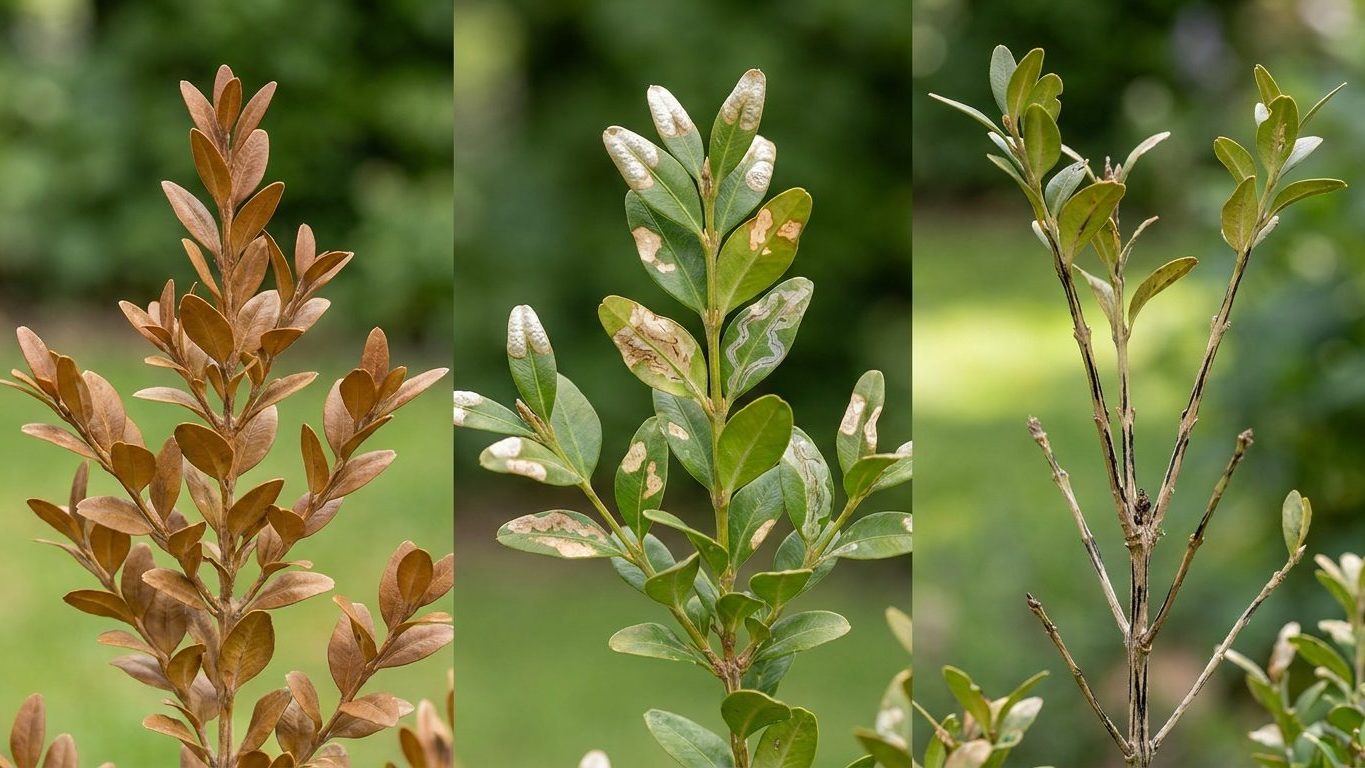

Three things turn boxwood brown, and only one of them is dangerous. Winter bronzing is cosmetic and fades by late spring. Leafminer damage stays contained to blistered leaf tips. Boxwood blight is the one that spreads, kills, and lingers in the soil for years. The pattern of the browning, not the color itself, tells you which one you’re looking at.
Telling apart what makes boxwood turning brown
Start at the base of the shrub, not the top. Boxwood blight defoliates from the bottom up, so the first brown leaves show up near the soil line while the crown still looks green. Pull back a few of those lower branches and look for thin black streaks running along the stems underneath the leaves. That streaking is the single most reliable field test a homeowner can run today, and it’s the detail that separates blight from every other cause of browning. If the stems are clean and only the leaf surface looks blotchy or tunneled, you’re dealing with something else entirely.
Leafminer damage shows a different signature. The leaves develop pale blisters or tan patches, usually in spring, and if you hold a damaged leaf up to the light you can sometimes see the outline of the larva feeding inside the tissue. It rarely kills a shrub outright, but heavy infestations year after year weaken plants and make them more vulnerable to everything else on this list.
Winter bronzing is the least worrying of the three and the easiest to rule out. It shows up uniformly across the whole plant, including the top, and it tracks with cold exposure rather than location on the shrub. A boxwood planted on the south side of a house, catching winter sun and wind, bronzes harder than one tucked against a north-facing wall. The color is a stress pigment the plant produces in response to cold and light, not dead tissue, and it disappears with new spring growth.
Volutella blight behaves more like a crowding problem than a disease that jumps between well-spaced plants. It shows up in the interior of dense, unthinned shrubs where air can’t move, producing salmon-pink spore masses on the undersides of dying branches during humid weather. Untangle a few interior branches and check for that pink coating before assuming it’s blight.
| Cause | Where it starts | Key sign | Season |
|---|---|---|---|
| Boxwood blight | Bottom of plant | Black streaks on stems | Warm, humid weather |
| Leafminer | Individual leaves | Blisters, tan blotches | Spring |
| Winter bronzing | Whole plant, evenly | Uniform color, no dead tissue | Winter |
| Volutella blight | Interior, dense growth | Salmon-pink spore masses | Humid weather |
Will it come back?
Yes, in most cases, because boxwood carries dormant buds under its bark and regrows from wood that looks completely dead. That single trait is why boxwood tolerates hard renovation pruning that would kill a conifer outright. Cut a boxwood back to bare brown stems and, given the right season and a plant that’s otherwise healthy, it pushes new green growth from buds you can’t even see on the outside of the branch.
The exception is when the cause has already killed the root system or the crown. Boxwood blight, left untreated, can girdle stems and eventually take down the whole plant from the base. Once the crown is dead, there are no dormant buds left to push from, and no amount of pruning brings that section back. Winter bronzing and leafminer damage don’t reach that point on their own. Bronzed foliage is cosmetic, so the plant was never actually injured underneath, and it greens up the following season without any pruning at all. Leafminer-damaged leaves may drop, but the stems underneath stay alive and produce new foliage from the same dormant buds that make renovation pruning possible.
The mechanism is what makes this answer transfer to any boxwood, not just the one in front of you: recovery depends on whether the vascular tissue under the bark is still alive, not on how bad the browning looks from the outside. Scratch a small patch of bark with a fingernail on a suspect branch. Green tissue underneath means the branch is alive and will likely regrow. Brown, dry tissue underneath means that branch is done, and cutting it out now costs you nothing compared to waiting and watching it spread further into the plant.
Order matters here. Cutting back a boxwood before addressing whatever caused the browning just produces a fresh flush of growth for the same problem to attack again. Diagnose first, stop the cause, then prune. Skip a step and the regrowth you’re counting on never gets the chance to establish.
Stopping the cause
Boxwood blight spreads through splashing water and survives in fallen leaves for years, which means sanitation does more work here than any other single change. Rake up and remove every dropped leaf from around an infected plant rather than composting it on-site, and avoid overhead watering that splashes spores from the soil back onto clean foliage. Switching to drip irrigation or a soaker hose at the base of the plant removes the main transmission route.
Spacing and airflow are what volutella blight actually responds to. Boxwood planted too close together, or left unthinned for years, creates the still, humid microclimate the fungus needs. Thinning out interior branches to let air move through the shrub, and spacing new plantings wide enough that mature canopies don’t touch, addresses volutella directly. It does nothing for blight, which spreads by water contact rather than crowding, so treat these as two separate fixes rather than one general rule about airflow.
Leafminer responds to a completely different lever: timing. The adult flies emerge and lay eggs in spring, so the pruning window matters most here, and pruning during late spring, after the last frost, removes egg-laying sites before larvae tunnel deep into new leaf tissue. Prune too early and you miss the window. Prune too late and the damage is already done for the season.
What none of these fixes will do is repair tissue that’s already dead. Watering changes, spacing, sanitation, and pruning timing all work on stopping new infection or damage, not on reversing existing brown leaves. New growth has to come in to replace what’s lost.
For a positive identification before committing to any of these changes, contact your state’s cooperative extension service. Extension horticulture agents can confirm boxwood blight through lab testing, something a homeowner can’t do reliably from stem streaking alone, and they can flag whether volutella or another secondary problem is compounding the issue.
- Blight: remove fallen leaves, switch to drip irrigation, avoid overhead watering
- Volutella: thin interior branches, space new plants for mature canopy width
- Leafminer: prune in the late-spring window, after the last frost
- Any suspected disease: send a sample to your state extension service for identification
What to do with what is left
Living with cosmetic damage is the right call for winter bronzing and light leafminer scarring. Neither one threatens the plant, and pruning them away just removes healthy tissue for no gain. Give it one growing season and most bronzing and blister damage grows out on its own.
Where the cause has been stopped and the crown is still alive, renovation is the honest next step. Boxwood tolerates being cut back hard, down to bare brown wood, because of those dormant buds under the bark, and a hedge kept between 2 to 6 feet can be cut back significantly and still refill. Growth is slow, 3 to 6 inches a year, so a hard renovation cut means a shrub that looks bare for one to two full seasons before it reads as a hedge again. That’s the honest timeline, not a quick fix.
Interplanting works when only a section of a long hedge run is dead while the rest is healthy. Filling a gap with a new boxwood of the same variety blends in eventually, though the new plant grows at that same 3 to 6 inch annual rate, so it takes several years to catch up in height to established neighbors on either side.
Replacement is the realistic answer once blight has killed the crown or has been confirmed present in the soil around the planting site. Boxwood blight persists in fallen leaf litter and soil for years, and replanting boxwood in the same contaminated spot risks reinfecting a new plant before it’s established. In that situation, a different species suited to the same hedge role, rather than another boxwood in the same soil, is the option that actually holds up.
Common questions
Can a boxwood recover from being completely brown?
It can, provided the stems underneath are still green when scratched with a fingernail and the cause of the browning has been stopped first. Boxwood regrows from dormant buds under the bark even on branches that look fully dead from the outside.
How do I know if it’s boxwood blight and not just winter damage?
Check where the browning started. Blight begins at the bottom of the plant and comes with black streaks on the stems underneath the leaves. Winter bronzing appears evenly across the whole shrub and shows no streaking on the stems at all.
Should I remove fallen boxwood leaves from around the plant?
Yes, especially if blight is suspected. The fungus survives in fallen leaf litter for years and spreads through splashing water, so leaving dropped leaves on the ground around an infected plant keeps reinfecting it season after season.
What is the best time of year to prune boxwood?
Late spring, after the last frost in your area, is the standard window recommended by university extension guidance. Local frost dates vary by several weeks across regions, so check with your state’s cooperative extension service for the exact timing where you garden.