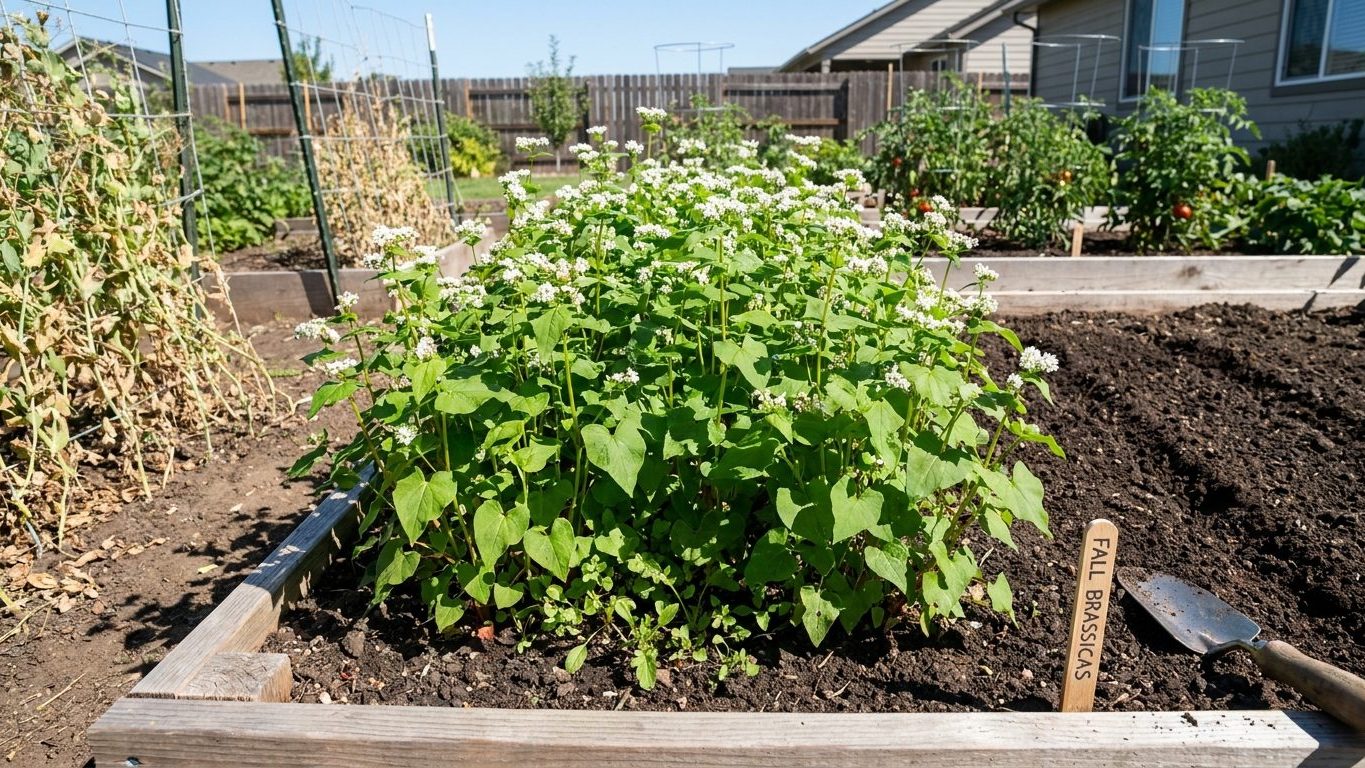

Buckwheat earns its spot in the vegetable garden by doing one thing extremely well: covering bare soil during the hottest, slowest weeks of summer. Sow it after you pull spring peas or before you plant fall brassicas, and within days it’s up, growing, and shading out weeds. Then the first frost ends it. No lingering roots, no cleanup fight in October.
What is actually going on
The thing to understand about buckwheat is that its entire life cycle is compressed into a window most gardeners would call “too short to bother.” Seeds germinate in three to five days in warm soil. The plant can be flowering within a month. That speed is the whole point. Buckwheat isn’t trying to build a deep root system or survive a winter. It’s racing to cover ground, bloom, and set seed before something stops it, usually a gardener with a mower or the first cold snap of fall.
That racing habit explains why buckwheat works so well as a gap-filler and so poorly as anything else. Its canopy closes fast, often within two to three weeks, which starves emerging weed seedlings of light before they get a foothold. Underneath that canopy, buckwheat’s root system does something different from grasses or legumes: it’s efficient at scavenging phosphorus that’s tied up in forms most vegetable roots can’t reach, then releases it back into the soil as the tissue breaks down. It doesn’t fix nitrogen the way clover or vetch does. Buckwheat belongs to a completely different plant family (it’s related to rhubarb and sorrel, not peas), so its main contribution is fast organic matter and a temporary nutrient loan, not a nitrogen deposit.
The other half of the mechanism is frost sensitivity. Buckwheat has essentially no cold tolerance. A light frost, the kind that barely dents a kale plant, will collapse buckwheat foliage within a day. Gardeners in warm climates sometimes treat this as a flaw. It isn’t. It means buckwheat self-terminates on a schedule you don’t have to manage if your goal is simply “die before winter crops go in.” The tradeoff is that this same plant offers zero winter cover. If you need something holding soil through December and January, buckwheat has already finished its job and left the bed bare again, which is exactly why it gets paired with a fall-planted cover rather than asked to do that work itself.
Because rates depend on whether you’re broadcasting by hand, drilling, or overseeding into an existing bed, and because local seed sources package buckwheat at different germination rates, there’s no single seeding number that holds up across gardens. Your county extension office or land-grant university’s extension service can give you a rate suited to your soil prep and equipment.
In the garden
Using buckwheat well comes down to timing two moments correctly: when you sow it, and when you cut it down. Miss either one and the plant either fails to establish or turns into next year’s weed problem. Here’s how the sequence typically breaks down, and what tends to go wrong at each stage.
| Stage | What to do | What happens if you get it wrong |
|---|---|---|
| Sowing window | Broadcast into warm, moist soil after your last frost date, ideally into a bed that’s between crops for four to eight weeks. | Sow too early into cold soil and germination is spotty; you end up with a thin, weedy stand instead of a smothering canopy. |
| Establishment | Keep the bed lightly watered until the canopy closes, usually within two to three weeks. | Let it dry out during that first week and germination rates drop sharply, leaving bare patches weeds will find first. |
| Flowering | Watch for the first white flower clusters, typically four to six weeks after sowing depending on heat. | Ignore this stage and the planting looks fine right up until it isn’t; flowering is the signal that the clock on termination has started. |
| Termination | Mow, cut, or crimp the stand within a week to ten days of first flowering, before seeds harden. | Wait too long and buckwheat sets viable seed fast; those seeds will germinate in future seasons as a weed you now have to manage by hand. |
| Residue | Leave cut material on the surface as a mulch, or lightly work it in a few days before the next planting. | Turn in a heavy, still-green stand right before sowing seeds and the fresh residue can tie up nitrogen briefly and crowd tiny seedlings. |
Notice that nothing in that sequence involves a chemical burn-down. Buckwheat is soft-tissued and shallow-rooted, which makes it one of the easiest cover crops to terminate mechanically. A string trimmer, a mower on a high setting, or even hand-pulling on a small bed will finish it off well before seed set, as long as you’re watching the calendar instead of waiting for a convenient weekend. Frost will finish the job for you if timing runs long into fall, but relying on frost as your termination plan only works if you’re confident cold arrives before the seed heads do.
What it depends on where you are
Everything above holds true nationally: buckwheat germinates fast, flowers fast, and dies at the first real frost, no matter which state you’re gardening in. What changes by region is how long a window you actually have to use it, and that’s driven by three local factors: how many frost-free weeks separate your spring crop from your fall crop, how hot your summers run, and how much rain falls during that stretch without irrigation.
A gardener with a long, humid growing season might slot buckwheat into a six-week gap between early lettuce and fall broccoli with room to spare. A gardener in a shorter or drier season might find the honest window is closer to three or four weeks, tight enough that timing the cut before flowering matters even more. Extreme summer heat can also push flowering earlier than the “four to six weeks” range mentioned above, which means the mow-before-seed-set deadline arrives sooner than a calendar guess would suggest. None of that is something a national article can pin down accurately, because it depends on your specific frost dates, your soil’s moisture-holding capacity, and whether you’re irrigating.
This is exactly the kind of detail worth checking against your own state’s growing calendar rather than a generic rule. The state-specific cover crop guides on this site walk through typical frost windows and season lengths by region, and your local extension service can confirm current-year conditions, since drought or an unusually cool summer can shift the timing in either direction from one year to the next. Treat the national mechanism as fixed and the calendar as local.
The mistake that costs the most
The single most common and costly mistake with buckwheat is letting it flower too long before cutting it down. It’s an easy trap. The flowers are genuinely useful, pollinators show up for them within days, and a blooming stand looks a lot more finished than a plain green cover crop. So gardeners let it go another week, then another, telling themselves they’ll cut it “this weekend.” Buckwheat doesn’t wait. Seed set follows flowering fast, and once seeds harden, mowing or cutting the plant just scatters them across the bed instead of stopping them.
The fix isn’t complicated, but it does require treating flowering as a deadline rather than a milestone. The moment you see the first flower clusters open, mark a date roughly a week to ten days out and cut the stand down by then, whatever else is going on that week. Mowing, hand-cutting, or crimping all work fine since buckwheat’s stems are soft and shallow-rooted; there’s no need for anything more aggressive. If you genuinely want the pollinator benefit for longer, cut most of the bed on schedule and leave a small strip flowering a bit longer, accepting that the strip may reseed and need pulling as seedlings next season.
Get this one timing decision right and buckwheat behaves exactly as advertised: a fast, self-limiting cover that fills the gap and disappears. Get it wrong, and you’ve traded one season’s weed suppression for several seasons of buckwheat volunteers coming up in beds where you didn’t plant them, which is a far bigger cleanup job than the plant was ever meant to cause.