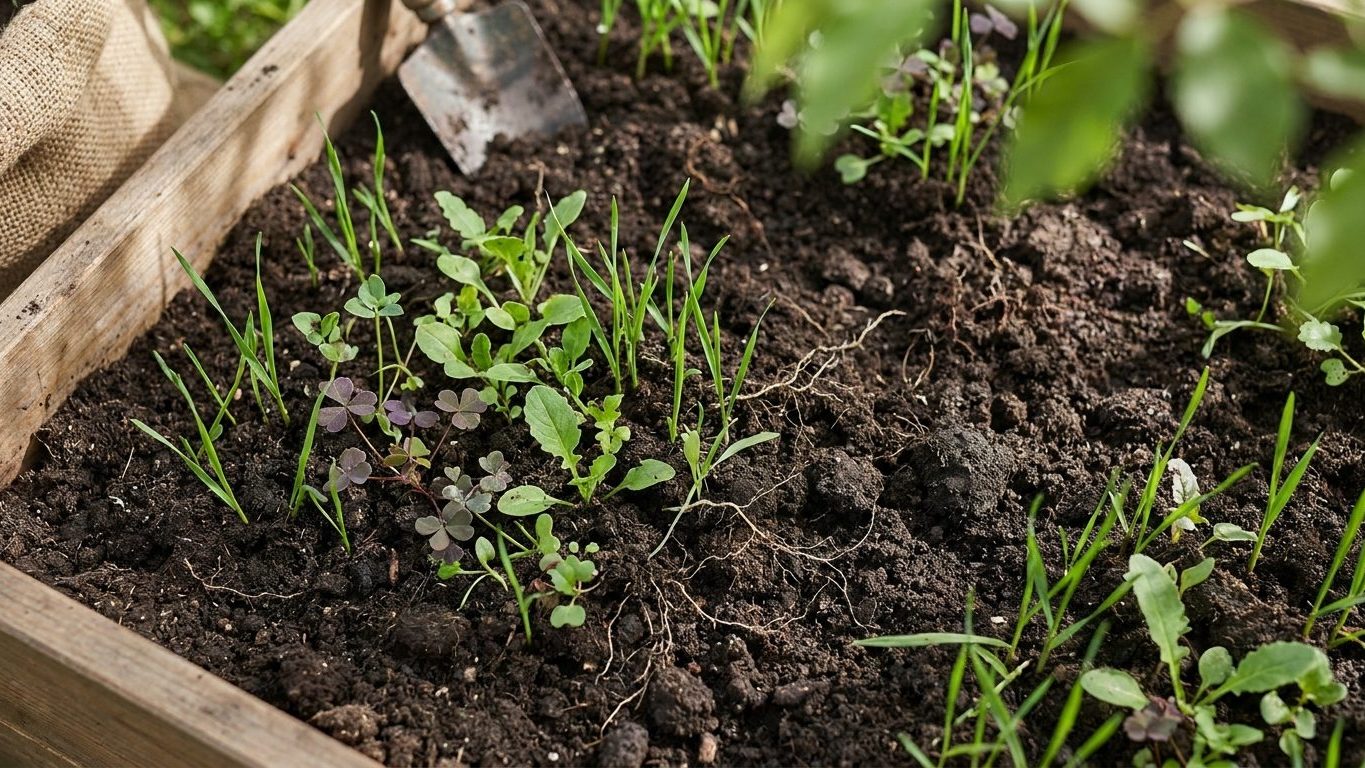

A cover crop mix pays off when the species chosen actually complement each other: a grass to scavenge nutrients and hold soil, a legume to fix nitrogen and lean on that structure, sometimes a broadleaf to break up compaction. Two or three species done right beat five done carelessly, because the harder question isn’t what to plant together, it’s how you’ll terminate the whole stand later.
What is actually going on
The thing to understand here is complementarity. A grass like winter rye or oats builds a dense, fibrous root system that grabs nitrogen and other nutrients before they wash out of the soil over winter. That’s useful, but a grass growing alone just holds onto what’s already there. It doesn’t add anything new. A legume changes that equation. Clovers, vetches, and field peas host bacteria in their root nodules that pull nitrogen out of the air and convert it into a form plants can use later. Grown by itself, though, a legume often flops over in wind and rain, or gets outcompeted by weeds because it doesn’t build much structure early on.
Put the two together and each one covers the other’s weak spot. The grass gives the legume something to climb or lean against, which keeps it upright and gets more leaf surface into the sun. The legume, in turn, feeds nitrogen back into the system as its tissue breaks down, nitrogen the grass can eventually use, though that transfer happens gradually and depends heavily on how much biomass the legume produced and when you terminate the stand. This isn’t a simple average of two plants’ traits. It’s closer to a partnership where the whole stand does something neither species does solo.
Where a third species fits
Some gardeners add a brassica, radish or turnip greens, for a different job entirely: a fast, aggressive taproot that punches through compacted soil layers a grass and legume can’t reach. That root leaves a channel behind it when it decomposes, which can improve drainage and let the next crop’s roots follow the same path. Brassicas grow fast and often die back on their own after a hard frost, which simplifies termination compared with species that stay green all winter.
The tradeoff is timing. Each species in a mix has its own growth curve, its own point of peak biomass, and its own tolerance for cold or heat. A mix that looks balanced on paper can end up lopsided in the field if one species races ahead and shades out the others before they’ve done their job. That’s the real complexity behind “just sow a mix,” and it’s also why the right combination and the right seeding rate depend on your soil, your climate, and your goals rather than a one-size formula. Your local Cooperative Extension office can help translate general principles into numbers that fit your plot.
In the garden
Some pairings show up again and again in home gardens because they’re forgiving. Others look good in theory but create headaches at termination time, usually because the species mature at different rates or one grows so aggressively it swallows the rest of the bed. The table below walks through common combinations and what tends to go wrong when the balance tips.
| Pairing (by species type) | Why it works | What goes wrong if mismanaged |
|---|---|---|
| Winter grass + winter legume (for example, cereal rye with a clover or vetch) | The grass anchors the stand and scavenges nutrients; the legume climbs it and fixes nitrogen through winter and early spring | If the grass is sown too thick or too early, it shades out the legume before it establishes, leaving you with mostly grass and little nitrogen benefit |
| Fast brassica + slower legume | The brassica punches through compaction quickly while the legume takes its time building nitrogen-fixing nodules | The brassica bolts and dies back on its own timeline, sometimes weeks before the legume is ready to terminate, leaving an uneven, patchy-looking bed that’s easy to mistake for a failed planting |
| Oats + field pea (common in shorter-season gardens) | Both grow fast and die back with hard frost, so termination often happens naturally without any mechanical work | In a mild winter where frost doesn’t fully kill the stand, gardeners are caught off guard needing to mow or crimp material they expected to already be dead |
| Three or more species mixed together | Diversity can spread root depths and growth habits across the bed for broader soil coverage | Termination gets harder with every added species, because mowing or crimping at The Right Stage for one species is often the wrong stage for another, so you end up terminating some too early and some too late |
That last row deserves a plain warning. A mix of many species is appealing because it sounds thorough, but every species you add is another growth curve you have to track and another point where your mower or crimper timing might miss the mark. Two well-matched species, chosen because their growth habits and termination windows line up, will usually outperform a five-species mix that nobody in the bed actually thrives in equally.
Termination itself stays mechanical on this site regardless of the mix: mowing, crimping, cutting the stand down, or simply letting a hard frost finish the job for tender species. The mix you choose should be one you can terminate that way without a fight, which usually means picking species that mature within a similar window rather than stretching across the whole season.
What it depends on where you are
Everything above about complementarity and pairing logic holds true no matter where you garden. What doesn’t hold true everywhere is timing, and timing is most of what makes a cover crop mix succeed or fail. Season length changes how much growth a legume gets before winter shuts things down, which directly affects how much nitrogen it has to offer later. Summer heat changes which species can even survive through the warm months versus which ones need cooler shoulder seasons to thrive. Summer rainfall, or the lack of it, changes whether a deep-rooted brassica is solving a drainage problem or barely surviving drought stress itself.
This page can’t know which of those conditions applies to your yard. A mix that performs well with a long, mild fall and wet winters behaves differently in a region with a short, sharp freeze and dry summers. The species logic transfers everywhere. The specific window for sowing, the specific pairing that thrives in your soil type, and the specific point at which frost will do your termination work for you, those are local questions.
The most useful next step is checking the state-level guide on this site for growing conditions closer to yours, and pairing that with a call to your local Cooperative Extension office, which tracks frost dates, typical rainfall patterns, and which species perform reliably in your specific county. Extension agents see the same pairing questions from other home gardeners in your area every season, and they can flag a combination that sounds good nationally but struggles locally for reasons that only show up in soil test data or years of local trial plots.
Treat the general mechanism here as the map and your local extension office as the compass. One tells you why a grass-legume pairing works. The other tells you whether this particular fall, in this particular yard, that pairing has enough time to do its job before conditions change.
The mistake that costs the most
The single error that costs gardeners the most with mixes isn’t picking the wrong species. It’s picking species with mismatched growth habits and then having no plan for how to terminate them together. Someone sows a fast, sprawling grass alongside a slow-establishing legume, expecting both to mature at roughly the same pace. They don’t. By the time the legume has finally built enough biomass to be worth terminating, the grass has often already gone to seed or grown so tall and dense that mowing it knocks the legume flat without actually cutting through the thicker grass stems.
The result is a bed that looks like a cover crop failure rather than a successful one. Gardeners end up either terminating too early, cutting the grass down before the legume has fixed meaningful nitrogen, or too late, wrestling with a tangled, overgrown mat that’s far harder to mow or crimp than either species would have been alone. Either way, the whole point of pairing species, getting more benefit than either would deliver solo, gets lost because the timing never lined up.
What to do instead is simple in principle, even if it takes a season of observation to nail down locally. Pick two species, occasionally three, whose growth habits and maturity windows are close enough that a single mowing, crimping, or frost event can terminate the whole stand at once. Before committing a full garden bed to an unfamiliar pairing, test it in a small section first and watch how the species actually behave together, not just how they’re described separately. And when in doubt about which combinations mature in sync in your specific climate, that’s exactly the kind of question your local Cooperative Extension office answers from real trial data rather than general assumptions. A mismatched mix wastes an entire season’s worth of soil-building potential, and that’s a cost worth avoiding before the seed ever goes in the ground.