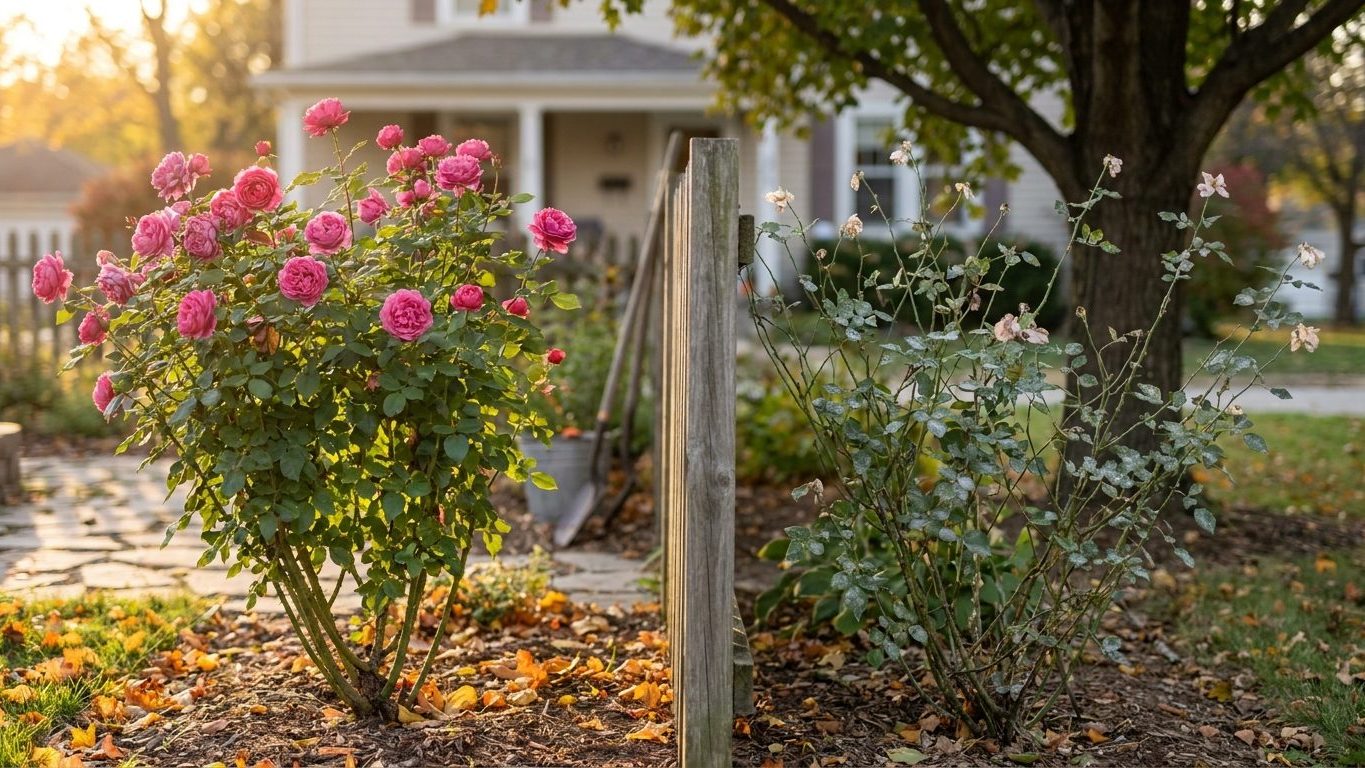

Roses need at least six hours of direct sunlight a day to bloom well, according to NC State Extension’s Plant Toolbox. Less than that, and the plant doesn’t die outright, but it trades flowers for survival: fewer blooms, weaker stems, and a much easier target for fungal disease.
Why this matters
Light is what a rose spends on flowers. A plant photosynthesizing at full capacity puts sugars toward buds, petals, and the cane strength to hold them up. Cut that supply, and the plant reroutes what little it has toward basic survival first. Flower count drops, individual blooms shrink, and the intervals between flushes stretch out. A rose that would rebloom every six weeks in full sun might struggle to push a second flush at all in partial shade.
Shade also changes the plant’s physical structure in ways that aren’t obvious until you compare two roses side by side. Stems stretch and thin as the plant reaches for available light, a pattern sometimes called etiolation, and thinner canes support less weight and snap more easily in wind or rain. Leaves stay wet longer in shaded, less airy spots, which is exactly the condition that favors powdery mildew and black spot, both documented diseases on roses. So the plant that gets less sun isn’t just flowering less. It’s also more vulnerable to the diseases already common in the genus, at the same time it has fewer resources to fight them off.
When to do it
Sun requirements aren’t a task you schedule by date. They’re a site condition you assess before you plant, and re-check whenever something around the rose changes, a fence goes up, a tree canopy fills in, a neighboring shrub grows tall enough to cast a shadow across the bed by midafternoon.
The plant itself will tell you when light has become the limiting factor. Watch for canes that lean or stretch noticeably toward one direction, for flowering that’s sparse compared to a rose of the same cultivar planted elsewhere, or for foliage that stays damp well into the morning because the sun doesn’t reach that spot until late. If a rose that used to bloom heavily starts producing fewer, smaller flowers over a couple of growing seasons, and nothing else has changed, the trees or structures around it are worth a second look before you blame soil or feeding.
The right moment to correct a shade problem is also plant-driven rather than calendar-driven. If you’re moving a rose to a sunnier spot, that transplant is best timed the way any transplant is, while the plant is dormant or just breaking dormancy, not in the middle of active growth or bloom. That timing depends on your USDA hardiness zone, which for roses spans 5a through 11b, so the actual window is a question for your state’s growing guide rather than this page.
How to do it
Assessing sun exposure for an existing rose bed takes an hour of actual observation, not guesswork. Pick a clear day and check the bed at three points: mid-morning, solar noon, and mid-afternoon. Note whether the spot is in direct, unobstructed sun or dappled/full shade at each check. Six or more hours of direct sunlight, tallied across the day, is the threshold the plant needs. A bed that gets bright morning sun until 10 a.m., full sun from noon to 2 p.m., and dappled shade the rest of the day may only be logging four hours of real direct light, well under what the rose wants.
Fixing an existing planting
If the shortfall comes from a nearby tree or shrub, the first option is thinning rather than removal. Selectively pruning lower branches or thinning a canopy can open up two or three additional hours of direct light without taking down a mature tree. This works best done while the tree itself is dormant, and it’s worth doing gradually over a season or two rather than all at once, since a sudden change in light can scorch foliage that’s adapted to shade.
If thinning isn’t enough, or the obstruction is a structure rather than a living plant, relocating the rose is the more reliable fix. Dig a generous root ball, roughly matching the spread of the canopy above ground, and move the plant to a site you’ve already confirmed gets six-plus hours of sun using the same three-check method. Replant at the same depth it was growing before, water it in thoroughly, and expect a season of reduced vigor while the root system reestablishes.
Choosing a new site correctly the first time
For a rose you haven’t planted yet, do the light check on the empty site before you dig, ideally across more than one day if the site is borderline. Account for seasonal changes too: a spot that’s fully sunny in June, when deciduous trees are bare, can drop to partial shade once neighboring trees leaf out in spring. South-facing beds, or those open to the west for afternoon sun, tend to be the most reliable bets in most yards. Once the site is confirmed, the rest of the planting follows standard practice for the genus: clay or loam soil, pH somewhere in the acid-to-neutral range documented for roses, below 6.0 up to 6.0-8.0, and enough room for the cultivar’s mature spread, which on this genus runs anywhere from 1 to 6 feet wide depending on the plant.
Container roses have one advantage worth using deliberately: you can chase the sun. If a patio spot turns out to only get five hours of light, moving the pot to the sunniest available corner, even seasonally, closes that gap without any digging at all.
What goes wrong
The most common mistake is underestimating how much shade a “mostly sunny” spot actually casts. A bed that looks bright at noon can still be logging only four or five hours of direct sun once morning and evening shadows are counted, and gardeners rarely do the hour-by-hour check before planting. The plant then spends years quietly underperforming, and the cause gets blamed on soil, fertilizer, or pests instead of light.
The mistake that looks like extra care but isn’t is compensating for low light with more fertilizer or more water. A shaded rose doesn’t need more feeding, it needs more light, and pushing nitrogen at a plant that can’t photosynthesize enough to use it just produces soft, weak growth that’s even more prone to the fungal problems shade already encourages, including botrytis and the leaf spots documented on roses. The same goes for overwatering a shaded plant: damp soil combined with damp, slow-drying foliage is close to ideal conditions for black spot and powdery mildew both.
Another failure pattern shows up after a rose has been correctly sited for years: gradual shading as surrounding trees mature. Because the change happens slowly, over several seasons, it’s easy to miss until flowering has already dropped off noticeably. A yearly light check, even a casual one, catches this before it becomes a multi-year decline.
Doing it differently
Container-grown roses are the easiest to correct for insufficient sun, since the whole point of a pot is that it isn’t fixed in place. A rose that’s underperforming on a shaded porch can simply be moved to a sunnier stretch of patio or driveway apron for the season, then moved back if the space is shared with other uses.
Raised beds don’t change the sun math directly, but they’re often built in spots chosen for drainage rather than light, so it’s worth running the same hour-by-hour check on a raised bed as on any in-ground planting rather than assuming the elevated soil solves everything.
Greenhouse-grown roses face the opposite problem more often: too much heat buildup rather than too little light, especially in summer, and shading cloth or ventilation becomes the relevant fix rather than chasing more sun.
Across the eleven main groups this genus is split into, hybrid tea, Floribunda, grandiflora, shrub, climbing, rambling, miniature, ground cover, old garden, rugosa, hybrid musk, and polyantha among them, sun tolerance isn’t documented as varying by group in any way that would justify treating one type as shade-tolerant. The six-hour threshold applies across the genus, and a claim that any particular group handles less sun better isn’t backed by the source data here.
Common questions
Do rose thorns get worse with less sun?
Not in any documented way, and they aren’t technically thorns to begin with. The sharp structures on rose canes are prickles, growing from the outer skin of the stem rather than being a modified woody stem the way a true thorn is, which is why they can be rubbed off. Sun exposure affects flowering and disease pressure, not prickle density.
Can a shaded rose still produce hips?
It can, though fewer flowers generally means fewer hips too. The hip is an accessory fruit holding the plant’s achenes, edible, and it shifts from green to red in fall regardless of how much sun the plant got, since fruit color change follows its own ripening process rather than being a signal tied to dormancy.
Is morning sun as good as afternoon sun for roses?
The documented requirement is simply six or more hours of direct sunlight a day, without a distinction between morning and afternoon light. A site combining several hours of each, adding up past that threshold, meets the requirement the same as one long unbroken block would.
Will more fertilizer make up for a shady spot?
No, and it can make things worse. A rose that isn’t getting enough light can’t use extra nutrients efficiently, and pushing fertilizer on a shaded plant tends to produce soft growth that’s more susceptible to the fungal diseases documented on roses, including powdery mildew and black spot, not less.