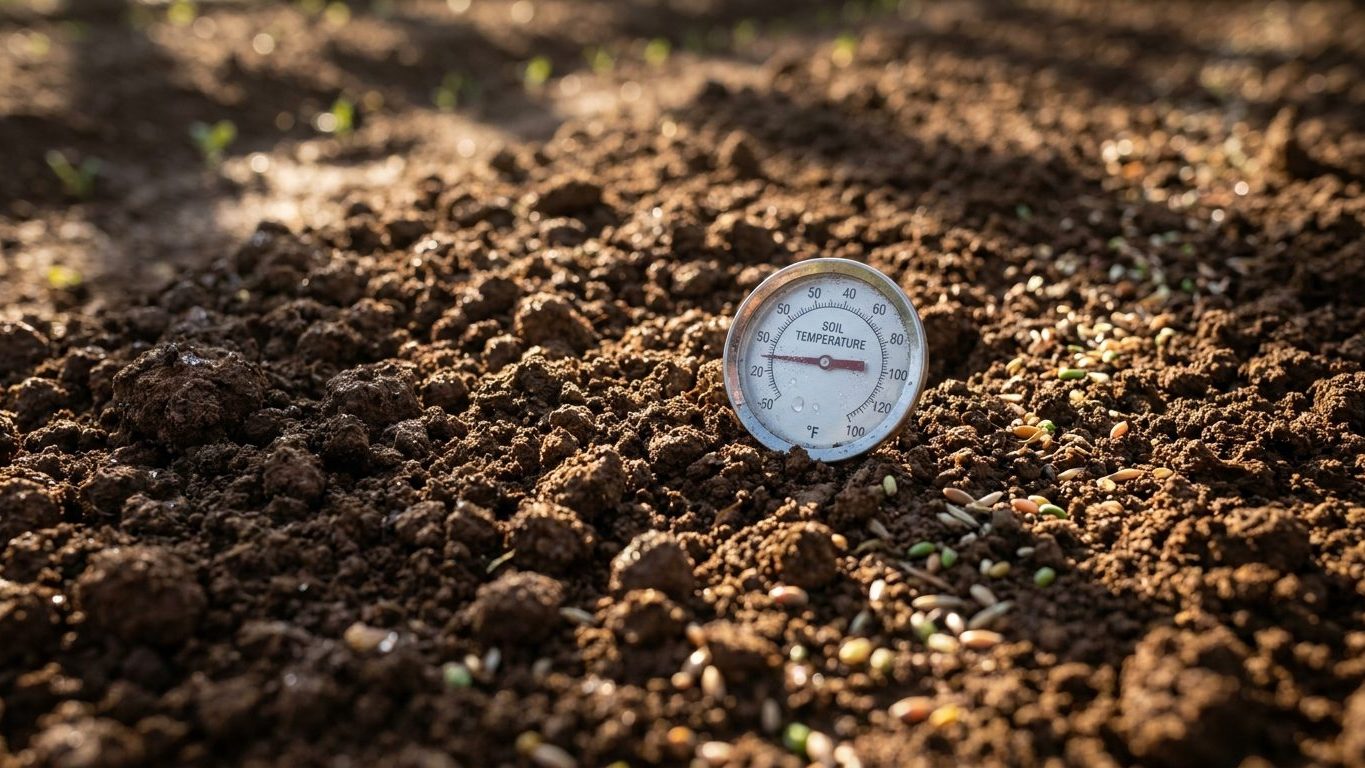

Soil temperature, not the calendar, decides when a Missouri garden is ready for cover crops. Statewide, that window runs from roughly mid-April to late October, bounded by a spring frost range of April 6 to April 20 and a fall frost range of October 18 to October 29 at the Kansas City reference station. Everything else, species pick, timing, termination, follows from those two windows and from how cold the coldest month runs.
When the soil is warm enough in Missouri
The question everyone asks first is a date. But the honest answer is a temperature, and the date is just how we approximate it. NOAA’s 1991-2020 Climate Normals put the last spring freeze at the Kansas City station (USW00003947) somewhere between April 6 and April 20, the 30 to 70 percent probability band for a 32°F event. That’s a real, sourced figure, not a rounded guess, and it should stay that way when you plan around it.
Here’s the catch: frost date and soil-ready date are not the same thing. Air can clear of frost risk while the top few inches of ground are still cold and slow to germinate seed. Cover crop species meant for spring seeding, oats, field peas, spring-planted clovers, want soil that has actually warmed, which in practice trails the last frost by one to three weeks depending on how wet the spring has been. A raised bed warms faster than a low, poorly drained corner of the same yard. That’s not a contradiction of the NOAA figure; it’s the reason the figure is a starting point and not a finish line.
One more caution belongs here. The Kansas City airport station sits well north of downtown, and its spring dates run measurably later than the city center, roughly five days later at the airport than downtown. Head south toward the Ozarks or the Bootheel and the frost-free window opens earlier still. A gardener in Springfield or Cape Girardeau working from the Kansas City figure alone would be planting later than necessary. And whatever number you land on, treat it as a probability. A 30 to 70 percent band means frost after that window still happens in some years, just not most of them.
Species, not products
What actually goes in the ground once soil warms depends on what you’re solving for: a grass like oats for fast, cheap biomass and easy winterkill, a legume like field peas or clover for nitrogen fixation, a brassica like tillage radish for breaking up compaction. This site sticks to species names rather than named seed mixes, because a mix sold nationally rarely reflects what performs in a specific region, and blending ratios change year to year. Seeding rate is the same story: it shifts with the species, whether you’re broadcasting or drilling, and the source of the seed, so the only number worth trusting is the one your local extension office gives for your county. Termination here means mowing, crimping, cutting, or letting winter cold do the work, never a chemical.
How long the season lasts here
Subtract the two frost windows and Missouri’s frost-free stretch runs roughly six months, from the latest realistic spring frost date around April 20 to the earliest realistic fall frost around October 18, about 181 days at the Kansas City reference point. Both numbers come from the same NOAA station and the same 30 to 70 percent probability band, so the subtraction holds together, and it’s the single most useful planning number a home gardener gets from climate data.
A six-month window is generous by cover crop standards. It’s long enough to grow and terminate a full-season legume before frost, and still leave room for a second, shorter-season cover afterward, something a three- or four-month window in a colder territory simply doesn’t allow. That’s the practical payoff of a wide frost-free stretch: it turns cover cropping from a single event into a rotation. A gardener who clears a spring cover crop by early June has roughly four and a half months left before the fall frost window opens, plenty for a summer vegetable planting followed by a fall-sown cover, or for two consecutive short-cycle covers back to back.
Where the season runs shorter, the calculation changes in a way worth naming even though it doesn’t apply to most of Missouri: a narrow window forces a choice between one cover crop cycle or a food crop, not both, and it makes transplanting rather than direct seeding worth checking against root disturbance risk, since there’s no slack to replant if a transplant stalls. Missouri’s six-month window mostly avoids that bind, but the far northern edge of the state, closer to the shorter-season Territories, runs closer to it than the southern half does.
For the mechanics of stacking a spring cover, a summer crop, and a fall cover into that same six months, the site’s succession sowing guide walks through the sequencing in more detail than fits here.
Heat and water in Missouri
For a vegetable crop, summer heat and rainfall drive the story. For a cover crop, the season that actually decides success or failure is winter, and the two figures that matter most are the first fall frost date and how cold the coldest month runs. The fall frost window, October 18 to October 29 at Kansas City, sets the last date a fall-sown cover crop has any real chance of establishing before growth stops. Sow much past that window and the seed sits ungerminated until spring, if it survives at all.
The coldest month’s mean daily minimum in this territory runs 19.5°F, per the 1991-2020 Climate Normals for Kansas City. That single figure is the one that separates a species that dies back into a protective mulch from one that keeps growing, however slowly, and has to be terminated by hand come spring. It also maps onto USDA hardiness zone 5b-7b for the state, a range built on average annual extreme minimum temperature rather than a typical winter, and worth citing by reference city rather than as one number, since the southern Bootheel and the northern border of Missouri don’t share a winter.
That 19.5°F figure matters more than it looks. A species that reliably winterkills in a colder territory, oats being the textbook case, can survive an unusually mild Missouri winter in the southern part of the state and come back the following spring as an unplanted weed instead of a tidy, frost-killed mulch. In the colder northern counties, closer to zone 5b, that same oat crop is close to a sure thing to die back on schedule, which is exactly why oats are often called the easiest cover crop there is, in territories cold enough to make good on that promise.
Rainfall and heat-day counts for a Missouri summer aren’t part of the sourced data behind this page, and rather than estimate them, the honest move is to point at what the sourced numbers actually govern: winter survival, not summer stress. A gardener weighing summer heat tolerance for a specific cover crop species is better served checking current-season conditions through University of Missouri Extension than relying on a statewide average that may not describe their county at all.
Which cover crops suit Missouri
Reasoning from what the numbers above actually show, three things narrow the field. A six-month frost-free window and a wide hardiness range mean species that mature quickly or that die back cleanly at 19.5°F both have a place, so there’s no single best answer, only a best answer for a given goal. A short remaining window late in the season, once you’re within a few weeks of the October fall frost, favors the fastest-establishing species over anything that needs a long run to build biomass. A humid Missouri summer, common through much of the state, raises the odds of foliar disease in dense, low-growing covers, which makes disease tolerance a real selection criterion rather than an afterthought.
None of that points to a specific cultivar, and this page won’t name one. Cultivar performance is trialed locally, county by county, and a variety that resists mildew in a research plot in one state can behave differently in a Missouri summer with different humidity and soil. The only recommendation that means anything for a specific address comes from Missouri Extension‘s current trial data, not from a generic gardening article. Refusing to name one here isn’t a gap in the page; it’s the accurate answer to a question that doesn’t have a single correct cultivar in the first place.
What’s safe to say by type: grasses handle a shortened fall window better than most legumes because they establish faster from seed. Legumes contribute nitrogen through root nodules as they grow, with the actual amount depending on species, how much biomass they put on, and when they’re terminated, not a fixed number worth quoting. Brassicas break up compacted soil and tend to winterkill reliably once the coldest month drops below freezing overnight, which the 19.5°F figure suggests happens routinely here. Termination for all of them stays mechanical: mowing, crimping, cutting at flowering, or simply letting a hard winter do it. Seeding rate, like cultivar choice, is a local extension question, because it shifts with method, species, and seed source in ways a general article can’t responsibly quantify.