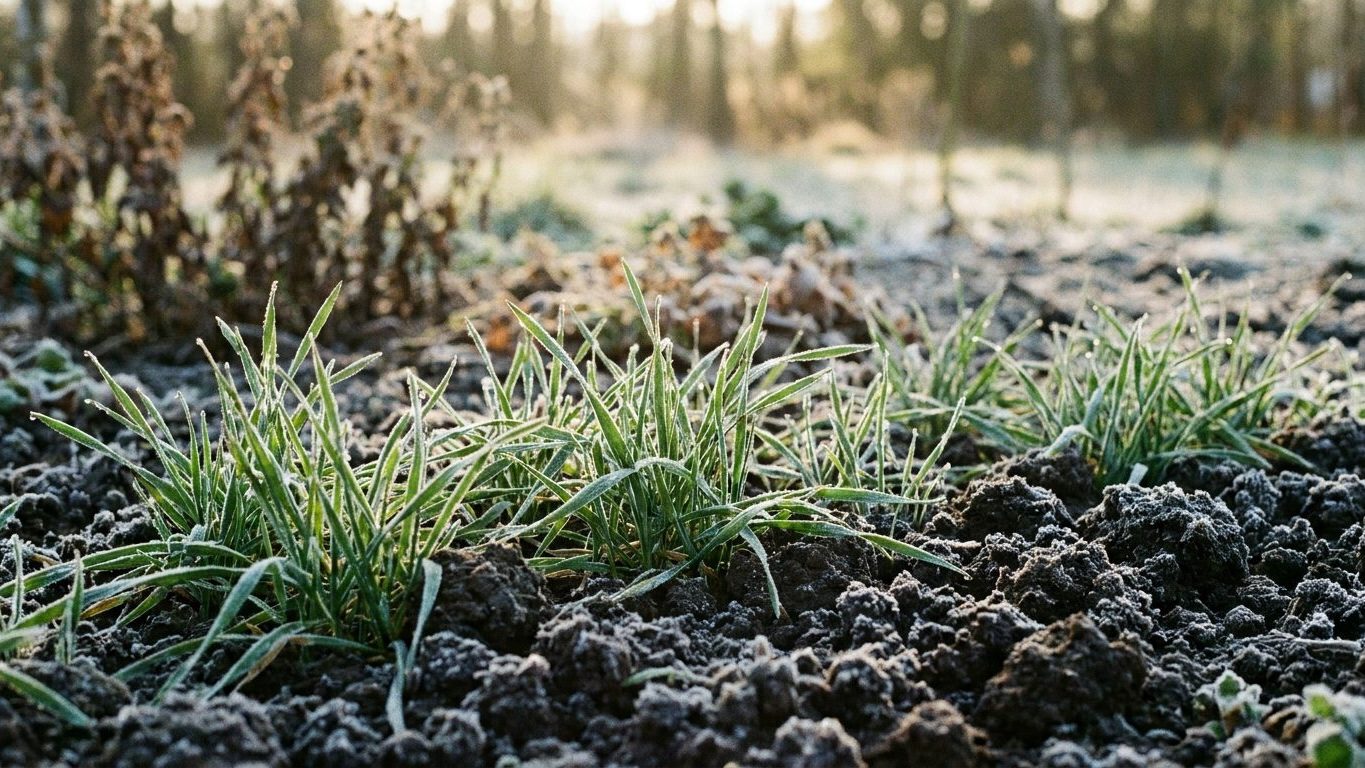

Winter rye cover crops are the cold-hardiest, fastest-growing option for keeping soil covered over winter, which makes them excellent at holding ground and choking weeds and genuinely difficult to terminate on schedule in spring. That trade-off, more than any other feature, decides whether rye is the right choice for a given garden.
What is actually going on
Rye (Secale cereale) germinates in soil that’s still cold by most crop standards, often in the low 40s Fahrenheit, and it keeps building roots and a little top growth right up until the ground freezes hard. Most other cover crop species either stop growing or die back at that point. Rye doesn’t. It sits through winter with living tissue, and the moment soil temperatures climb back into the high 30s or 40s in spring, it resumes growth before almost anything else in the garden, including the weeds it’s supposed to be smothering.
That early restart is the whole reason gardeners plant rye in the first place. A few weeks of head start translates into a dense root mat that holds soil against spring rain, a canopy that shades out early weed seedlings, and a root system that can reach several feet down, pulling up nutrients that would otherwise leach out of the topsoil over winter. The vigor is real, and it’s not a marketing claim, it’s a consequence of how the plant’s cell chemistry handles cold.
Here’s the part that catches people off guard: unlike oats, which winterkill in most of the country once temperatures drop into the teens or lower, rye does not reliably die from cold. It survives winters that would flatten almost every other small-grain cover crop, which is exactly why gardeners in colder regions reach for it. But that survival trait means frost isn’t a termination tool for rye the way it is for oats or many varieties of field peas. If you plant rye expecting winter to do the killing for you, you’ll be standing over a thriving stand of grass in April with no plan.
Why timing gets harder as spring goes on
Once rye starts bolting, it doesn’t stay in an easy-to-manage state for long. The stems begin to stiffen and lignify as the plant shifts energy toward producing a seed head, and a plant that was soft and mat-forming three weeks earlier can turn into a tough, fibrous stand that resists mowing and shrugs off a light pass with a string trimmer. Rye also releases compounds into the soil as it breaks down that can suppress germination of small seeds, useful against weeds, a real problem if you’re planning to direct-seed carrots or lettuce into that same bed a few weeks later. Termination timing isn’t a minor detail with rye. It’s the difference between a cover crop that helps and one that becomes the next month’s weed problem.
In the garden
Rye earns its place in specific situations, and it creates specific headaches in others. The pattern is consistent enough to lay out plainly, including what tends to go wrong when the timing or the site doesn’t match.
| Garden situation | Why rye fits | What goes wrong if mistimed |
|---|---|---|
| Vegetable bed that won’t be planted until late spring | Long window lets rye build maximum biomass and root mass before you need the ground back | If spring planting creeps earlier than expected, gardeners end up mowing tall, stiff rye at the worst possible moment, right before they need bare soil |
| Perennial beds or orchard alleys | No conflict with a spring seeding date, since nothing needs to go into that soil right away | Left unmown for a full season, rye reseeds itself and becomes a permanent, unwanted grass understory |
| Sloped or erosion-prone ground over winter | Dense root network holds soil through freeze-thaw cycles and heavy spring rain better than almost any alternative | Terminating too early, before the root mass has developed, gives up most of the erosion benefit the crop was planted for |
| Bare soil after a fall harvest with an early-spring crop planned next | Fast fall establishment covers ground quickly with little management | Rye’s aggressive spring regrowth can outcompete an early direct-seeded crop for moisture and light if termination lags even a week or two |
The common thread in the failure column isn’t bad luck. It’s a mismatch between how long the gardener has before that bed is needed and how much lead time rye’s spring growth actually requires to terminate cleanly. A gardener who wants a quick, tidy cover crop for a bed going into tomatoes in three weeks is almost always better served by a species that winterkills or one with a shorter, more predictable growth curve. Rye rewards patience and a firm termination plan, and it punishes anyone who treats it as a set-it-and-forget-it option.
On the mechanical side, this site’s approach is consistent: mowing, crimping, or cutting rye down at the right growth stage, not spraying it out. Crimping only works while the stems are still succulent, generally around the point the seed head first emerges but before it fills, which is a narrow window measured in days, not weeks. Miss it, and a mower becomes the only realistic option, sometimes more than one pass of it.
What it depends on where you are
Some of what governs rye’s behavior is fixed no matter where you garden: it germinates in cold soil, it survives freezing winters, and it bolts and toughens as day length and temperature increase in spring. That part of the story is national.
The part that isn’t national is timing, and timing is most of what makes rye easy or hard to manage. Season length decides how much fall growth the plant puts on before dormancy, which affects how much spring growth you’re dealing with later. Summer heat and rainfall patterns, oddly enough, matter too, because they shape what’s planted before and after the rye, which in turn sets the planting and termination windows on both ends. A gardener with a long, mild fall gets a much bigger rye stand by winter than a gardener whose ground freezes solid in early November, and that difference carries straight through to how aggressive the spring regrowth will be.
This page can’t tell you the week to seed or the week to terminate, because that week moves by hundreds of miles and by elevation, and guessing at it defeats the purpose of using rye at all. What it can do is point you toward information that’s actually local. This site’s state-level cover crop guides break down realistic fall seeding windows and spring termination timing by region, and your local Cooperative Extension office, run through the land-grant university system in every state, keeps current recommendations based on actual soil temperature data and field trials in your area, not national averages. That office is free to call, and for a crop with as narrow a termination window as rye, it’s worth the five-minute conversation before you plant.
The mistake that costs the most
The single mistake that costs gardeners the most with winter rye is letting it go past the point where mowing or crimping can still take it down cleanly. It happens for an understandable reason: spring gets busy, other beds need attention, and a stand of green rye doesn’t look urgent until it suddenly is. By the time someone notices the seed heads have filled out and the stems have gone woody, mechanical termination stops being a quick job and turns into a fight, sometimes requiring repeated mowing over several weeks while volunteer rye seed is already dropping into the soil for next year.
What should happen instead is tracking the plant’s growth stage, not the calendar. Rye needs to come down at or just before the point the seed head emerges from the stem, while the tissue is still soft enough for a mower or a crimper to actually break it down rather than just knock it over. That stage arrives on the plant’s schedule, driven by accumulated warmth, and it can shift by two or three weeks from one spring to the next depending on how the season runs. Walking the bed weekly once temperatures start climbing, and terminating the moment the seed heads start to show rather than waiting for a convenient weekend, is the difference between a cover crop that improves the soil and one that turns into a season-long weeding project.
The fix costs nothing but attention. Rye doesn’t punish gardeners who plant it. It punishes gardeners who forget it’s there.