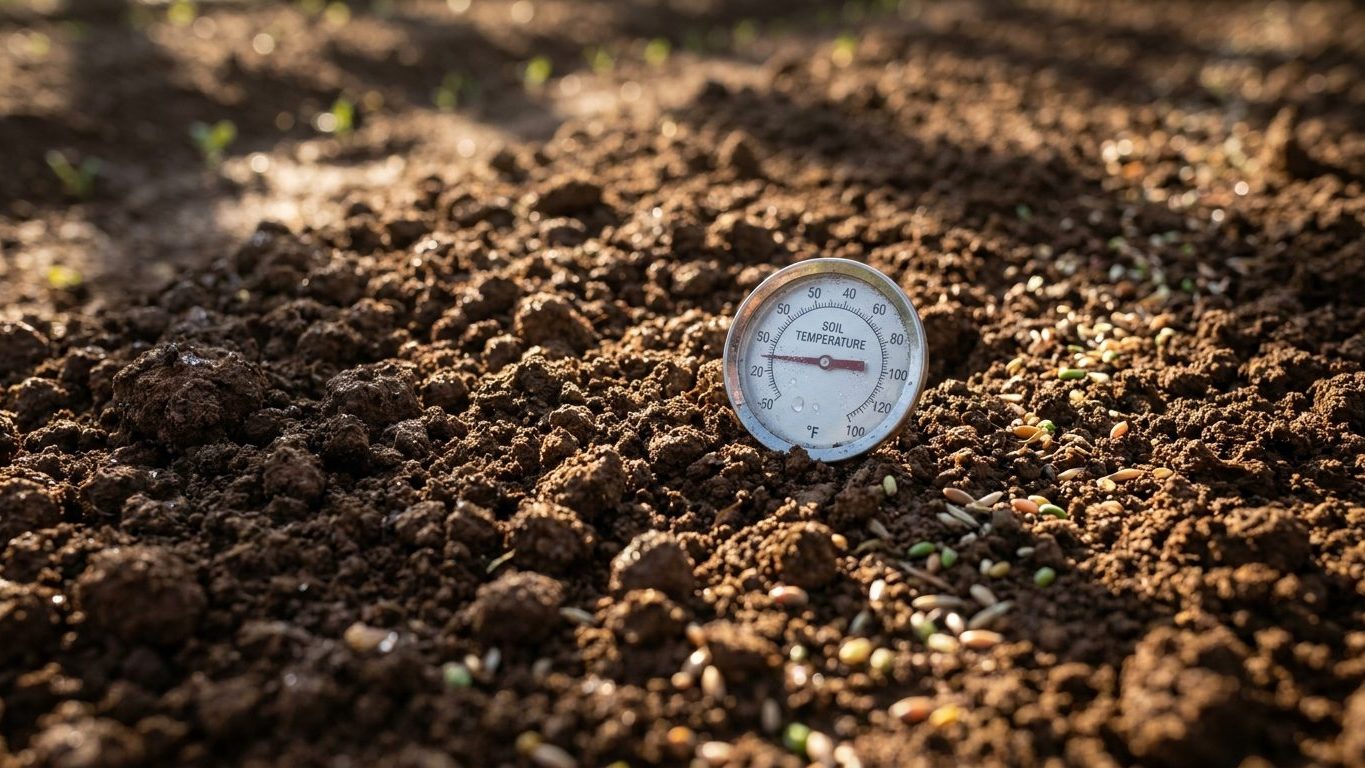

New Hampshire gardeners get two windows to Sow Cover Crops: a short one in spring that closes almost as soon as it opens, and a longer one in fall built around the first hard freeze. Soil temperature decides the start date, not the calendar, and the state’s short, cold winter narrows the list of species that actually pull their weight here to a handful of dependable performers.
When the soil is warm enough in New Hampshire
The question every gardener asks is “when,” and the honest answer starts with frost, then moves past it. According to NOAA’s 1991-2020 Climate Normals for the Manchester station (USW00014710), New Hampshire’s last spring frost falls somewhere between April 16 and April 27, based on the 30-70% probability band for a 32°F freeze. That’s a wide window, and it’s a probability, not a promise: some years the risk clears earlier, some years it lingers past the last date on the chart.
Frost is a proxy, not the real trigger. Cover crop seed doesn’t care what the thermometer read on the morning of the last freeze; it cares whether the soil a few inches down has actually warmed up, and soil lags behind air temperature by days, sometimes weeks. A garden bed that’s still cold and heavy in mid-April, even after the frost risk has technically passed, will sit on cover crop seed without germinating it. Waiting for the soil to warm, rather than counting days from a frost date on a chart, is the more reliable approach.
What actually governs when you seed
Species matters more than any single calendar date. Cool-season legumes and brassica-family cover crops tolerate cooler soil and can go in earlier than warm-season grasses, which stall in cold ground no matter how carefully you time them. Method matters too: broadcasting into a rough seedbed behaves differently than drilling into a smooth one, and soil moisture at planting changes how fast anything comes up.
This is also where seeding rate questions belong, and this page won’t guess at one. Rates shift by species, by planting method, and by the seed source itself, and a rate pulled from the wrong context can waste a whole season’s growth. The University of New Hampshire Extension (extension.unh.edu) publishes current guidance tuned to New Hampshire conditions, and that’s the source worth checking before buying seed.
Termination deserves the same plain talk. Nothing here gets killed with a herbicide. Mowing, crimping, cutting, or simply letting a hard frost finish the job are the tools that matter for a home garden cover crop, and which one you use depends on the species and how much biomass it’s put on by the time you need the bed back.
How long the season lasts here
Stack the two frost windows together and you get the shape of New Hampshire’s growing season. The last spring frost runs April 16 to April 27, and the first fall frost runs October 13 to October 26, both from the same NOAA Climate Normals for the Manchester station. Depending on where those dates fall in a given year, the frost-free window stretches anywhere from about 169 days, in the tightest case, to about 193 days, in the most generous one. That’s roughly five and a half to six and a half months of workable ground.
| Scenario | Last spring frost | First fall frost | Approximate window |
|---|---|---|---|
| Shortest likely season | April 27 | October 13 | ~169 days |
| Longest likely season | April 16 | October 26 | ~193 days |
Those figures come from an airport weather station, and airport stations tend to run milder than the suburban yards and rural valleys most New Hampshire gardeners actually plant in. Expect the real last frost to land later, and the real first fall frost to land earlier, often by one to two weeks, more if you’re at elevation or in a low-lying frost pocket. Check your own county’s pattern before locking in a date.
What that window allows, and what it doesn’t
Six months is enough room to run two cover crop cycles in a lot of years, planting a quick-growing species after an early spring harvest, terminating it, and following with a fall-sown crop that carries the bed into winter. Closer to the 169-day end of the range, that second cycle gets tight, and the spring sowing becomes the one shot you get before summer vegetables need the space. In a short-window year, transplanting vegetables into a terminated cover crop, rather than direct-seeding, buys back a week or two and is worth the extra step of checking root systems before you set plants in.
Anyone stacking two or more cover crop cycles into a single season, or timing a cover crop between two vegetable plantings, will get more out of the site’s succession sowing guide, which walks through the timing math in more detail than fits here.
Heat and water in New Hampshire
New Hampshire doesn’t put much heat stress on a garden. NOAA’s normals for the region don’t show the kind of long, punishing stretches above 90°F that gardeners further south have to plan around; a truly hot day here is the exception, not a weekly event, across most of the state’s valleys and hill towns. Summer rainfall tends to arrive as regular, moderate showers rather than the long dry spells that make irrigation scheduling a constant chore in drier climates.
That combination, cool and reasonably damp, brings its own problems. Mildew shows up on legume foliage in humid stretches, ripening slows in a cool, cloudy July, and dense stands that don’t get airflow can hold disease longer than they would in a drier, hotter place. None of that is the hot-climate story of heat-stressed roots and bolting; it’s a cooler, wetter set of headaches, and worth planning around on its own terms.
Why winter, not summer heat, is the real question for cover crops
For cover crops specifically, the growing-season heat barely matters next to what happens after the leaves die back. Two numbers do the real work. The first fall frost, October 13 to October 26 at the Manchester station, sets the last useful date to get a fall cover crop established before growth stops for the year. The second is the mean daily minimum of New Hampshire’s coldest month, 17.1°F, from the same NOAA Climate Normals record. That figure, not the growing-season heat, decides which species survive the winter standing and which get killed by the cold on their own.
USDA places New Hampshire across hardiness zones 3b to 6a on the 2023 Plant Hardiness Zone Map, a range built entirely on average extreme annual minimum temperature. That’s a wide spread for one state, and it means a cover crop that overwinters reliably near the coast or in the Merrimack Valley might winterkill outright in the colder northern counties or at elevation. A species that dies back into a mulch layer on its own, in a territory this cold, isn’t a failure. It’s often the plan.
Which cover crops suit New Hampshire
Three facts about this territory point toward three types of cover crop, and none of them require a brand name or a cultivar to make the point. A tight growing window, as short as 169 days in some years, favors the fastest-establishing types: quick cool-season grasses and legumes that can put on real growth before the ground closes for winter. A cold winter, with that 17.1°F coldest-month minimum and a hardiness range running down to zone 3b in parts of the state, splits cover crops cleanly into two groups: hardy cereal grains that can overwinter standing, and tender legumes or broadleaf species that reliably winterkill and leave a dead mulch behind, which is often the easier bed to work in spring since there’s nothing left to mow or crimp.
The cool, humid summer common across the state makes disease resistance the practical first filter within any of those groups, since mildew and slow drying favor whichever variety shrugs off moisture best in a given year and location.
Why no variety gets named here
This page stops short of recommending a specific cultivar, and that’s deliberate, not an oversight. Variety trial results are local by nature; a legume or grain that performs well in a university trial plot in one county can behave differently forty miles north or at a different elevation, and the varieties that actually get tested against New Hampshire conditions are the ones worth trusting. The University of New Hampshire Extension (extension.unh.edu) tracks that local performance data and current seeding guidance, and that’s the source that can put a real name, and a real rate, next to your specific garden.
Termination stays mechanical here too, whichever type ends up in the bed: mowing a stand before it sets seed, crimping it flat, cutting it back at the base, or simply letting the New Hampshire winter finish a tender species on its own. No herbicide step, and no nitrogen figure attached to any legume, since what a legume actually contributes depends on how much biomass it built and when it got terminated, not a number that would mean the same thing in every garden.