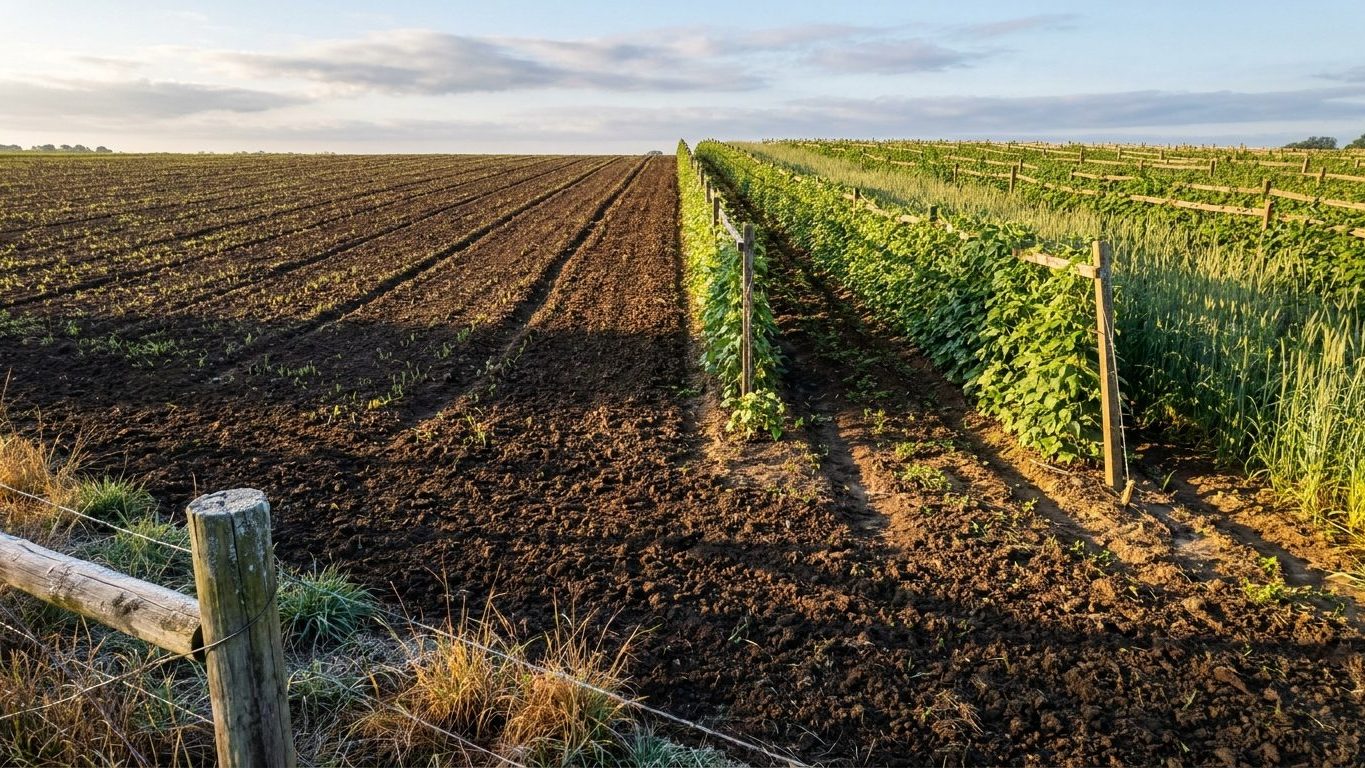

Connecticut‘s fall cover-crop window falls between roughly six and eight weeks before the first fall frost, which lands between October 28 and November 10 at the state’s mildest weather station. Spring-sown covers go in after the last spring frost, April 2 to April 12. Those dates are probability bands, not guarantees, and they shift by county.
The short answer for Connecticut
Start with the frost dates themselves. NOAA’s 1991-2020 Climate Normals put Connecticut’s last spring frost between April 2 and April 12, and the first fall frost between October 28 and November 10, both measured at station USW00094702 in Bridgeport. These aren’t fixed calendar days. They mark the window where the odds of a 32°F freeze sit between 30% and 70%, meaning frost is a real possibility on either side of that band, not a hard stop.
For fall-sown covers, that first-frost window is the anchor. Legumes like crimson clover and hairy vetch need roughly six to eight weeks of growth before a hard freeze to build enough root mass to survive winter, which pushes the sowing target into early September through early October for most of the state. Winter rye is more forgiving. It germinates in cooler soil than the legumes and can go in as late as mid-to-late October and still establish before the ground locks up, since it doesn’t rely on the same window of active fall growth.
Spring-sown covers, oats, field peas, and frost-tender options like buckwheat, follow the other frost date. Buckwheat in particular has zero tolerance for a 32°F night, so it waits until after the April 2-12 window has passed, and often a week or two beyond that for insurance, since the band only reflects a 30-70% freeze probability rather than a clean cutoff.
One number changes how confident a gardener should be in any of this: Bridgeport is a coastal station on Long Island Sound, the mildest reporting point in the state. Every date above describes that location specifically. Inland and northwest Connecticut freeze earlier in fall and later in spring, sometimes by weeks, which is covered in more detail further down this page. If your garden sits away from the shoreline, treat these dates as a starting reference, not a fixed schedule.
What will not work here
Connecticut’s coldest month has a mean daily minimum of 24.4°F. That figure, not the state’s record low, is what decides whether a cover crop actually overwinters, because it reflects the typical cold a plant sits through night after night, not a rare extreme. Crimson clover, a legume many gardeners lean on for nitrogen, sits right at the edge of reliable winter survival in this range. In an exposed bed with no snow cover, it can winterkill here even in a normal year, which means treating it as a guaranteed overwintering crop in Connecticut is a bet, not a plan.
Warm-season covers are a clearer miss. Sunn hemp, sorghum-sudangrass, and cowpeas need a long run of consistent heat to put on the biomass they’re grown for, and Connecticut’s frost-free stretch, roughly the gap between the April and late-October/early-November windows, simply doesn’t hand over enough hot, humid summer for these to pay off the way they would farther south. They’ll grow. They won’t reach the scale that makes them worth planting in the first place.
Timing mistakes compound the cold problem. Sowing hairy vetch or clover in late October, after the first-frost window has effectively closed, leaves the plant with too little top growth and too shallow a root system heading into a Connecticut winter with that 24.4°F baseline chill. It won’t die immediately. It dies slowly, thinning out over winter and leaving patchy stands by April, which is often blamed on the seed rather than the sowing date.
On the other side, buckwheat sown before the last frost window has closed is a near-certain loss. A single night anywhere close to 32°F flattens young buckwheat, and since the April 2-12 band already carries meaningful frost odds, jumping the gun by even a week or two in a cool spring is enough to wipe out a seeding.
What changes across Connecticut
Connecticut spans USDA Hardiness Zone 6a to 7b under the 2023 map, a range built on one measurement, the average annual extreme minimum temperature. That’s a wide spread for a state this size, and it means there’s no single sowing date that fits the whole state accurately. The Bridgeport reference station used for the frost dates above sits at the milder end of that range, closer to zone 7b territory near the Sound. The northwest corner of the state, up toward the Litchfield hills, sits at the colder 6a end.
That difference isn’t cosmetic. A garden at the colder end of Connecticut’s range typically sees its first fall frost arrive earlier than the October 28-November 10 band recorded at Bridgeport, and its last spring frost linger later than April 2-12. For fall-sown legumes, that argues for moving the sowing target earlier, into late August rather than early September, to bank the same six-to-eight weeks of pre-frost growth. For spring seeding of frost-tender covers like buckwheat, it argues for waiting longer past mid-April rather than treating that date as safe statewide.
Elevation plays into this too, even within a single county. Valley bottoms and low-lying fields collect cold air on clear, calm nights and frost earlier than a slope or hilltop a mile away, sometimes by a week or more, regardless of what zone the map assigns to the region.
This page can’t tell an individual reader which zone their own garden falls into. Connecticut’s 6a-7b range covers everything from Sound-side towns to inland hill country, and the only way to know where a specific address lands is to check the USDA Plant Hardiness Zone Map directly rather than guess from a county name.
Where to check this for your own county
The University of Connecticut’s Cooperative Extension System, at extension.uconn.edu, is the state’s land-grant extension service and the right next stop for anything more specific than what this page can offer. State-level frost dates and hardiness zones describe averages across a territory that runs from the coast to the northwest corner. A county office works from local trial data and local growing conditions, which is a meaningfully different level of detail.
Two things are worth asking for specifically. First, a local planting calendar, if the county office publishes one, will reflect the actual frost pattern of that area rather than the Bridgeport-anchored dates used here, which matters most for anyone gardening away from the immediate coastline. Second, ask about varieties trialled in that county. Cover crop performance, especially winter survival for legumes near that 24.4°F cold-month threshold, varies enough locally that a variety recommended for one part of Connecticut can underperform in another with a different microclimate.
Treat this page as the state-level layer of the picture, useful for understanding the mechanics behind the sowing windows and why they shift, but not a substitute for a county-specific answer. A recommendation built on local trial rows and a local frost record will always outrank a statewide average, because it’s already accounted for the exact kind of local variation described in the section above. That’s true even when the two sources happen to agree.
Checking this against your own garden
Frost dates and hardiness zones describe averages. A specific garden rarely matches the average exactly, and three simple checks tell more about that garden’s actual timing than any calendar date.
Soil warmth by feel is the first. Cold, damp soil that feels chilly to the bare hand in spring means germination will lag even after the calendar says it’s safe to sow, particularly for buckwheat and other frost-tender covers that also need warmth to get going, not just frost-free air. A gardener who waits for the soil itself to feel workable and mild, rather than sowing strictly by the April date, usually gets a faster, more even stand.
Watching how quickly self-seeded plants or early weeds put out true leaves is the second. A fast flush of true leaves on volunteer seedlings signals that the soil has warmed enough to support active growth, a useful cross-check against the frost-date window, especially in a garden that runs cooler or warmer than the county norm because of shade, slope, or soil type.
The first light frost of fall, visible as a thin white film on grass or a car windshield at dawn, is the third and most useful for fall-sown covers. That first frost, not the calendar date, is the real signal that the countdown to the first hard freeze has started, and it’s the moment to make sure fall legumes are already established rather than just going into the ground. A garden that gets that first light frost consistently earlier than the state’s October 28-November 10 window is running colder than the Bridgeport reference, and future fall sowings should move earlier to match.