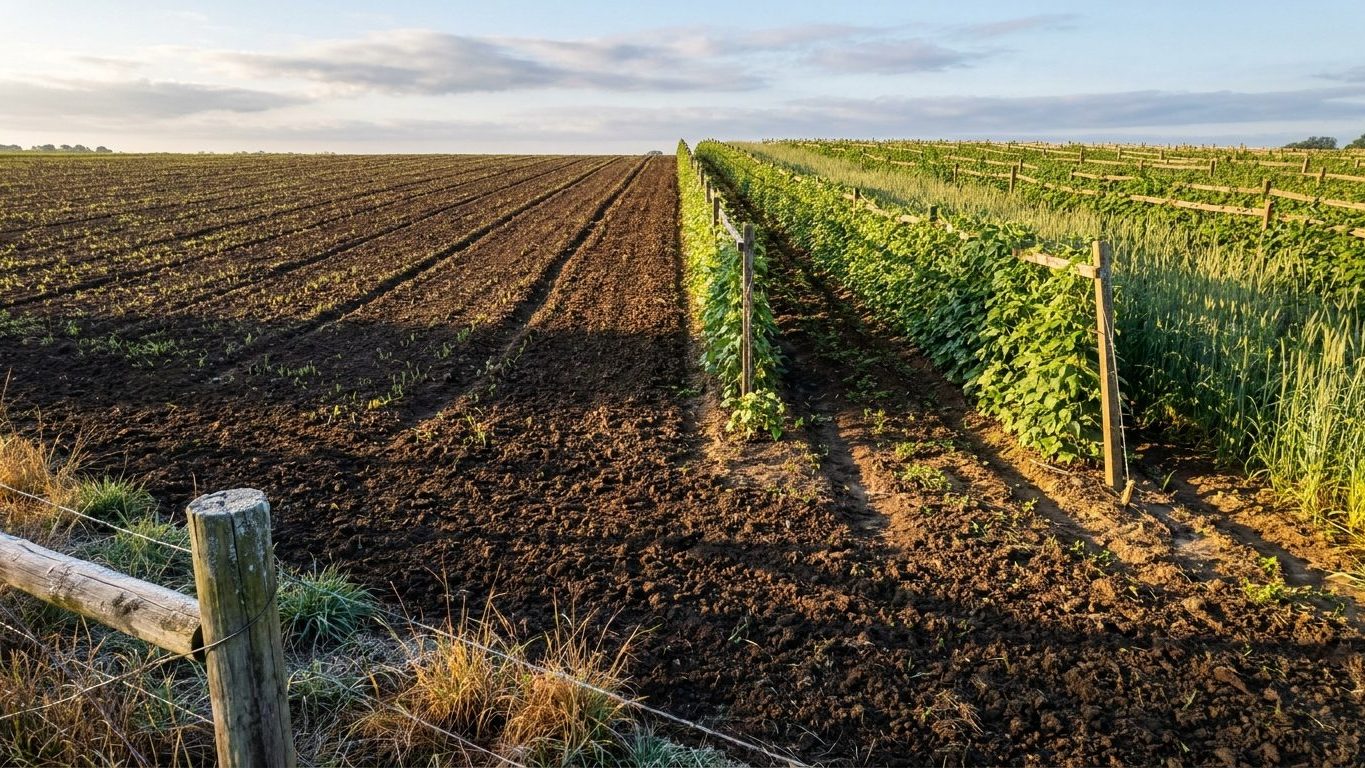

Cool-season cover crops like cereal rye, hairy vetch, and Austrian winter peas go into New Mexico ground after the first fall frost risk clears the way for planting, roughly October 29 to November 9 depending on where you are relative to Albuquerque. Warm-season options such as cowpeas, buckwheat, and sorghum-sudangrass wait until soil has shaken off the last spring frost, March 31 to April 12 at the reference station. Everything past that intro depends on elevation and which side of the state you’re on.
The short answer for New Mexico
Those frost dates, March 31 to April 12 for spring and October 29 to November 9 for fall, come from NOAA’s 1991-2020 climate normals at the Albuquerque airport station. They mark a 30-to-70 percent freeze probability window, not a guarantee. In plain terms: on March 31, there’s still roughly a 70 percent chance of a freeze; by April 12, that risk has dropped to about 30 percent. Somewhere in that stretch, most years, the last damaging cold snap happens. The same logic runs backward in fall.
For a legume or grass cover crop meant to overwinter, like hairy vetch, winter rye, or Austrian winter peas, sowing four to six weeks before that October 29 to November 9 window gives roots time to establish before hard freezes lock up the topsoil. Wait past early November at the reference station and germination slows to a crawl, leaving seedlings too small to survive winter stress.
Spring-sown, frost-tender covers work the opposite direction. Buckwheat, cowpeas, and sun hemp need soil that’s genuinely warmed, not just air that’s cleared the freeze line. Waiting until the tail end of the spring window, closer to April 12 than March 31, is the safer bet for anything in the warm-season category, since a late cold snap can wipe out a stand of buckwheat in a single night.
Cool-season spring covers, oats, field peas, and some clovers, tolerate a light frost and can go in earlier, right around March 31 if the ground isn’t waterlogged. That’s the practical split: cool-season and frost-tolerant species lean toward the early edge of the window, warm-season and frost-tender species lean toward the late edge. Neither date is a promise. It’s a probability drawn from thirty years of one weather station’s records, and your own soil will tell you more than any calendar once you’re standing in it.
What will not work here
New Mexico’s frost-free season, bookended by those spring and fall dates, runs roughly six and a half months at the reference station, shorter at elevation. That rules out cover crops bred for long, humid growing seasons, slow-maturing legumes that need four or five months of mild weather to flower and fix meaningful nitrogen before frost cuts them down. A cover crop that needs 150 frost-free days to do its job on the East Coast may only get a partial season here before a hard freeze ends it early.
Heat is the other filter. Much of New Mexico runs hot and dry through summer, and any cover crop that expects weekly watering to survive July and August is fighting the climate, not working with it. Species that thrive in humid, rainfall-fed regions, dense clover stands or tightly spaced ryegrass, tend to struggle here without irrigation they were never designed to need. Wide spacing and drought-tolerant species like cowpeas or sorghum-sudangrass handle the dry stretch far better than anything bred for a wetter state.
Winter cold is the third wall. The coldest month at the Albuquerque reference point averages a daily minimum of 26.4°F, and that’s the number that decides which perennial or overwintering cover crops actually make it through, not the occasional record low everyone remembers, but the average nightly cold of January. A species marginally hardy in warmer states can die back completely here even in a typical winter, well before any unusual cold snap arrives. That’s a different failure mode than a short season or a dry summer: it’s a plant that simply can’t take an ordinary New Mexico January night.
Put those three limits together, short season, dry heat, ordinary winter cold, and you get a rough filter: slow legumes, moisture-hungry species, and marginally hardy perennials are the three categories most likely to underperform or fail outright across most of the state.
What changes across New Mexico
New Mexico spans USDA hardiness zones 4b through 9a, under the USDA Plant Hardiness Zone Map’s 2023 update, which is built on one measure: average annual extreme minimum temperature. That’s a five-zone spread inside one state’s borders, and it means there’s no single sowing date or species list that fits both ends. A cover crop surviving comfortably in zone 9a lowlands can die outright in a 4b mountain valley the same winter.
The Albuquerque reference figures used above sit closer to the middle of that range. Gardeners farther north, or up in elevation in places like the northern mountains, should expect both frost dates to shift: spring frost risk lingering later into the season, fall frost arriving earlier. That compresses the frost-free window on both ends, which matters most for warm-season covers that already need the full stretch between spring and fall dates to mature.
Southern and lower-elevation parts of the state, closer to zone 8b or 9a, get the opposite adjustment: a longer frost-free season, milder winter minimums, and more room to experiment with covers that would struggle farther north. A grower there might sow warm-season species earlier than the state-level window suggests, or push a fall-sown cover crop later into November with less risk.
None of this tells you which zone applies to your own yard, and that’s not something a state-level article can answer responsibly. Elevation, local terrain, and even which side of a valley you’re on can shift the effective zone by a full step or more. The USDA’s interactive map is built precisely for that kind of drill-down, and it’s worth checking against your own address rather than assuming the state average applies to your particular patch of ground.
Where to check this for your own county
New Mexico State University’s Cooperative Extension Service, at aces.nmsu.edu, is the source built for exactly this next step. State-level frost dates and hardiness zones give a useful starting frame, but they average out real differences between, say, a high desert county and a river-valley county two hours south.
Once there, look specifically for two things. First, a county-level planting calendar, if your local extension office publishes one, which will reflect actual observed frost patterns and soil conditions in your area rather than a single reference airport’s thirty-year average. Second, look for variety trial results or recommended cultivar lists specific to your county’s climate. Extension offices often run field trials on cover crop varieties, testing how different legumes, grasses, and brassicas actually perform under local soil and water conditions, information no state-wide calendar can capture.
A county recommendation will always outperform a state one for the simple reason that it’s built on data closer to your actual growing conditions. This page works from statewide averages and a single reference weather station. That’s useful for understanding the broad pattern, cool-season versus warm-season timing, the general risk window, the reasons certain crop types struggle here, but it isn’t a substitute for what your local extension agent knows about your specific county’s soil, elevation, and microclimate. Treat what’s here as the frame, and treat the county-level extension information as the fine print that actually applies to your garden.
Checking this against your own garden
Calendars and averages get you in the right season. Your own soil and plants tell you when conditions are actually ready, and that observation beats any date on this page.
Start with soil warmth by feel. Push a finger a few inches into the bed in early spring: cold, damp soil that feels almost numb to the touch means it’s still too early for warm-season covers like buckwheat or cowpeas, regardless of what the calendar says. Soil that feels merely cool, not cold, is closer to ready.
Watch for the first flush of male flowers on anything in the squash or cucurbit family growing nearby, including volunteer plants. That first bloom is a reliable local signal that the soil has crossed a real warmth threshold, since flowering is driven by accumulated heat, not the calendar date.
Finally, track how fast a test patch of your intended cover crop pushes past its seed leaves to true leaves. Quick, sturdy true-leaf growth within a week or two of germination suggests conditions are matched to that species. Slow, stretched, pale growth is the plant telling you the timing or the site isn’t quite right yet, information no frost-date table can give you.