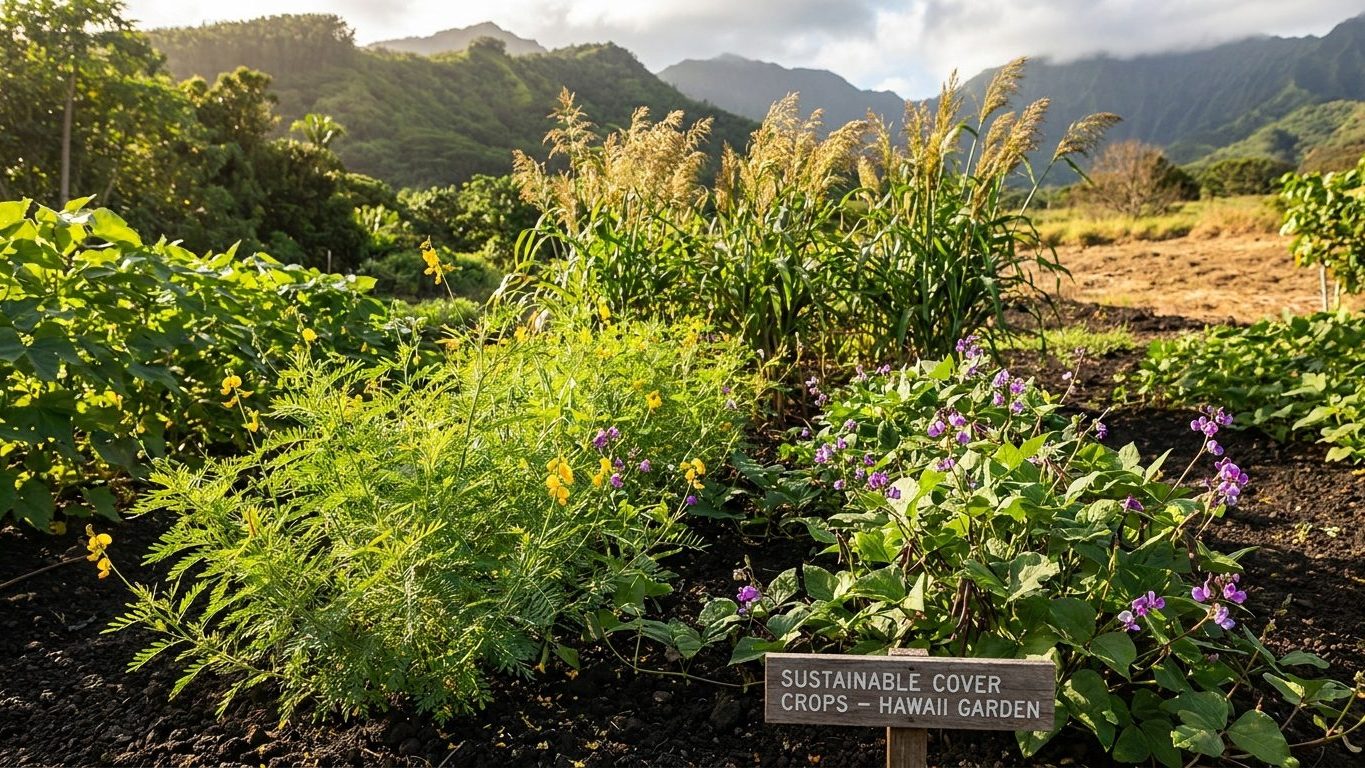

New Mexico’s Best Cover Crops split by elevation and season length, not by a single statewide pick. Cold-hardy legumes and cereal grains (hairy vetch, Austrian winter pea, cereal rye) work as the fall-to-spring default almost everywhere in the state, while heat-loving summer legumes like sunn hemp only pay off in the long, hot low desert stretch along the southern Rio Grande.
The short answer for New Mexico
Start with the numbers that actually decide this. At the Albuquerque reference station, the last spring frost falls somewhere between March 31 and April 12, and the first fall frost arrives between October 29 and November 9. That leaves a frost-free stretch of roughly 200 days at that one location, a season long enough to run both a cool-season cover and a short warm-season filler in the same year. The coldest month’s average daily minimum there sits at 26.4°F, which is the figure that decides whether a cover crop survives winter, not the record low everyone remembers from a bad January.
Those two facts point to a straightforward hierarchy by type. Nitrogen-fixing legumes rated hardy to USDA zone 4b or colder (hairy vetch, Austrian winter pea, common vetch) will ride out a 26.4°F average winter minimum without protection, which makes them the safest fall-sown default across most of the state. Cereal grains (cereal rye, winter wheat, triticale) are even tougher and add the kind of fibrous biomass that helps sandy, low-organic-matter New Mexico soils hold together against wind erosion over winter.
Quick, frost-tender fillers like buckwheat only make sense inside that roughly 200-day frost-free window at Albuquerque’s elevation, planted after the spring frost risk has passed and terminated well before the first fall frost date arrives. Heat-loving summer legumes such as sunn hemp or cowpeas need a longer run of genuinely hot weather than the mid-elevation valley gets reliably, so they belong further south, where the growing season stretches longer and hotter than the reference figures above.
| Cover crop type | Best window | Why it fits |
|---|---|---|
| Hairy vetch, Austrian winter pea | Fall through spring | Hardy well below 26.4°F winter average |
| Cereal rye, winter wheat | Fall through spring | Extreme cold tolerance, erosion control |
| Buckwheat | Short summer gap only | Frost-tender, needs the frost-free window |
| Sunn hemp, cowpea | Long hot season, southern low desert | Needs sustained heat this crop can’t get everywhere |
What will not work here
The clearest failure in New Mexico gardens is a cover crop that expects steady moisture and gets none. White clover and crimson clover both want consistent water to establish, and a New Mexico summer with a single weekly watering simply won’t keep up once daytime heat climbs past 90°F for weeks at a stretch. Crimson clover has the added problem of marginal cold tolerance, it’s often rated only to about zone 6, which puts it at real risk of winterkill in the colder pockets of this state’s 4b-9a range.
Slow, biomass-heavy warm-season covers run into the opposite problem at elevation. Sorghum-sudangrass, for instance, needs a long run of sustained heat to bulk up before it gets cut or terminated. In the shorter, cooler seasons found at higher elevations within the state, that crop simply doesn’t finish its cycle before the first fall frost shuts it down, leaving thin, half-grown stands that did little for the soil.
Warm-season legumes like sunn hemp and cowpea will not overwinter anywhere in New Mexico, full stop. A 26.4°F average winter minimum is well below what either species tolerates, so they have to be treated strictly as warm-season annuals and terminated ahead of the first fall frost window, not left in the ground hoping for a mild winter.
There’s also a water-competition failure that’s easy to miss because it doesn’t look like a disease problem. In humid states, planting a cover crop too densely invites fungal trouble. New Mexico’s dry air mostly sidesteps that, but a thick, closely spaced stand of a thirsty species still competes hard with itself for scarce soil moisture. The fix isn’t fungicide, it’s a lower seeding rate or a blend with a drought-tolerant cereal that doesn’t need every drop the legume does.
What changes across New Mexico
USDA hardiness zones across the state run from 4b up to 9a, a five-zone spread that’s wider than in most states and comes straight from the elevation range packed inside New Mexico’s borders, from high mountain terrain down to low desert river valleys in the south. There is no single answer to “which cover crop zone am I in” for this state, because the range itself is the point.
The Albuquerque figures used above (the 200-day frost-free window, the 26.4°F winter minimum) describe a mid-elevation valley climate. A garden higher up in the mountains sits in a colder slice of that 4b-9a range, with a shorter frost-free season and a lower winter minimum than Albuquerque sees. That shifts the practical advice: favor the fastest-establishing legumes (Austrian winter pea over slower-growing alternatives), sow the fall cover earlier rather than later, and skip warm-season fillers that need a long hot run to finish.
A garden down in the low desert stretch along the southern Rio Grande sits in the warmer end of that same range, closer to zone 8 or 9. There, the growing season runs longer and hotter than the Albuquerque numbers suggest, which is exactly the setting where sunn hemp, cowpea, and other heat-loving summer legumes actually get to finish their cycle and deliver real biomass before termination.
None of this tells you which zone applies to your own yard, and it shouldn’t. The USDA Plant Hardiness Zone Map is built for that lookup, and elevation changes fast enough within New Mexico that two gardens 20 miles apart can land in different zones. Check the map for your own location rather than assuming the state figure applies where you garden.
Where to check this for your own county
New Mexico State University runs the state’s Cooperative Extension Service, and its main directory sits at aces.nmsu.edu. That’s the right next stop, because everything above this point is state-level guidance built from one reference station’s frost dates and one statewide hardiness zone range, not a recommendation tuned to any particular county.
Once there, look for two specific things. First, a county-level planting calendar, since county offices typically publish sowing windows adjusted for local elevation rather than the airport-station dates used statewide. Second, look for any cover crop variety trial results run through that county office or a nearby agricultural experiment station, since those trials show which specific vetch, pea, or cereal varieties actually performed well in soils and conditions close to yours, not just which ones are theoretically hardy enough on paper.
A county recommendation beats a state one every time, because it accounts for the local elevation, soil type, and microclimate quirks that a statewide page like this one has to generalize away. Treat this page as the starting framework, the “why” behind the choice between a legume, a cereal, and a warm-season filler, and treat your county extension office as the source for the specific “when” and “which variety” that applies to your actual garden.
Checking this against your own garden
Frost date ranges and hardiness zones are averages built from decades of weather station data, and they were never meant to override what’s actually happening in your own soil on a given week. Three things worth watching outrank any date on this page.
Soil warmth by feel is the first and most useful check. Before sowing a warm-season legume like cowpea, push a finger a few inches into the bed in the morning. If the soil still feels cool rather than mildly warm to the touch, the ground hasn’t caught up to the calendar yet, regardless of what the frost-free window suggests, and seed sown into cold soil will simply sit and rot rather than germinate.
Watch for the first true leaves on any volunteer weeds or self-seeded plants already growing in the bed. Their emergence timing is a rough biological thermometer for your specific microclimate, since they’re responding to the same soil temperature threshold your cover crop seed needs, not to a station reading from miles away.
Third, notice the first flush of flowers on any nitrogen-fixing legume already established nearby, whether it’s your own overwintered vetch or a neighbor’s. Flowering on a legume like that generally signals the plant has moved past its cold-stressed early growth into active production, which is a fair sign that hard frost risk has genuinely passed in that particular corner of the yard, not just on the regional calendar.