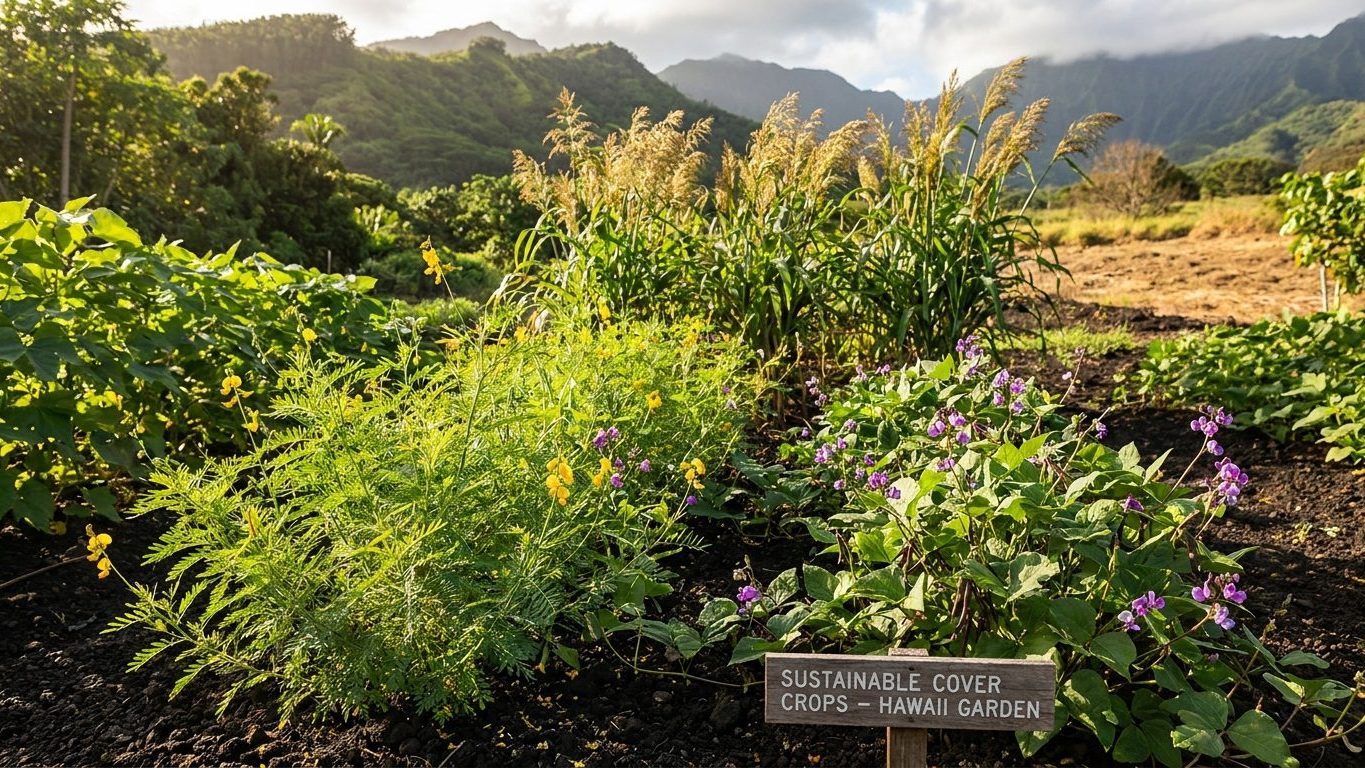

The short list for Yukon gardens is short on purpose: cereal rye, oats, field peas, and forage radish are the covers that actually finish what they start here. Buckwheat, hairy vetch, and anything bred for a long warm season simply run out of daylight and warmth before they’ve done any good.
The short answer for Yukon
Yukon’s growing window sits between an average last spring frost of June 5 and an average first fall frost of August 25 at the Whitehorse A station. That’s roughly 81 days on paper, and it’s the number that should shape every cover crop decision you make here, but it’s a mean, not a promise. In half the years on record, frost arrives later than June 5 in spring or earlier than August 25 in fall, which means the real planting window is often shorter than the calendar suggests.
Against that backdrop, the crops that work are the ones that don’t need the whole season to pay off. Cereal rye is the standout: it germinates in cool soil, tolerates a hard frost without blinking, and can be sown in late summer to overwinter and resume growth the following spring, sidestepping the short-season problem entirely by working on both sides of winter. Oats behave differently but usefully: they grow fast in cool conditions and winterkill cleanly, so you get a flush of biomass and root activity before the ground freezes, with no live plant material to manage come spring.
Field peas fit the same logic. They germinate in cold soil, fix nitrogen quickly, and can be seeded as soon as the ground is workable rather than waiting for reliable warmth. Forage radish (sometimes sold as tillage radish) is worth planting for root penetration and quick surface cover, even though it rarely reaches full size in a Yukon summer. None of these four depend on a long stretch of warm nights, which is the resource this territory simply doesn’t have. Anything marketed as a warm-season cover, or anything that needs eight to ten weeks of steady heat to flower and set seed, should be crossed off the list before you even open the seed packet.
What will not work here
Buckwheat is the crop people reach for because it’s fast almost everywhere else, maturing in six to eight weeks under normal conditions. In Yukon it fails for the same reason it succeeds elsewhere: it wants warm soil to germinate and it dies at the first light frost. With a growing season bookended by frost dates that are themselves only 50-50 odds, buckwheat is gambling on a warm stretch this territory can’t guarantee.
Hairy vetch and crimson clover run into a different wall. Both are marketed as winter-hardy cover crops in milder regions, but that hardiness is rated against winters nowhere near as severe as this one. The coldest month here averages a daily minimum of -19.2°C (-2.6°F), and that’s the mean, not the record low. Vetch and crimson clover are not rated to survive that kind of sustained cold without snow cover deep enough to insulate the crown, and Yukon’s snowpack is inconsistent enough that betting on it is a poor plan for a whole planting.
Sorghum-sudangrass, cowpeas, and any of the tropical or subtropical legumes sold as summer covers belong in the same pile as buckwheat: they’re built for heat this territory doesn’t produce. Even in a warm Yukon July, soil temperatures rarely climb into the range these plants need to grow vigorously, so what little season you have gets spent waiting rather than growing. And annual ryegrass, while fast to establish, is only marginally frost-tolerant and tends to die back well before the last useful growing days of a Yukon September, leaving bare soil at exactly the time you wanted cover.
The pattern across all of these failures is the same: they were bred and tested for a season two or three times longer than the one Yukon actually delivers, and no amount of careful watering or spacing fixes a plant that fundamentally needs more warm days than the calendar has to offer.
What changes across Yukon
Whitehorse sits in Canadian hardiness zone 1b, but that number describes one river valley, not the whole territory. Yukon stretches from settled valley bottoms up into subarctic plateau and mountain terrain, and the hardiness system NRCan uses is built from seven separate climate variables, not one, so a shift in elevation or latitude can move a garden into noticeably harsher territory even over a short distance.
Gardens north of Whitehorse, or at meaningfully higher elevation, should expect a colder, later spring and an earlier fall frost than the Whitehorse A normals describe, which shrinks that already-tight window further. A gardener working a sheltered south-facing slope near a river, on the other hand, may pick up extra warm days the regional average doesn’t capture. There is no single number that covers a territory this size, and this page can’t tell you which end of that range your own yard sits on.
The practical shift, wherever you garden in Yukon, is to lean harder on the crops that don’t need precision timing. Cereal rye’s ability to be sown late and finish its job the following spring makes it more forgiving of local variation than anything that has to complete a full life cycle inside one compressed summer. If you’re gardening at altitude or well north of Whitehorse, treat the frost dates on this page as optimistic and give even more weight to species that tolerate an early fall frost and a late spring one without failing outright.
For the actual zone your property falls into, Natural Resources Canada’s plant hardiness map is the tool built for that job, not a state or territorial average.
Where to check this for your own county
This page describes the territory as a whole, built from a single reference station in Whitehorse, and that’s its limit by design. A recommendation built for your own district, with its own frost record and its own soil, will always beat a territory-wide average, the same way a local weather forecast beats a seasonal outlook.
Yukon’s own agricultural department has occasionally been unreachable through automated checks, so the reliable starting point right now is Agriculture and Agri-Food Canada. From there, look specifically for two things: a planting calendar built around your local frost record rather than the Whitehorse normals, and any cover crop or forage variety trials run in your part of the territory. Trial results matter more than marketing claims, because a variety that performed well in a controlled trial near your own soil type has already survived the exact conditions you’re planting into.
If your community has a local agricultural extension office, a farmers’ cooperative, or a territorial agriculture representative, that contact will usually know more about your specific microclimate than any web page can, including this one. Ask them directly which cover crops other growers nearby have had success with, and in what month they actually got seed in the ground, not just what the calendar says is theoretically possible. That on-the-ground answer, built from actual local seasons rather than a 1981-2010 average, is the one worth planning around.
Checking this against your own garden
No date on this page beats what your own soil is telling you, because the Whitehorse normals are an average built from thirty years of very different individual springs. Your own yard has its own microclimate, and three simple observations will tell you more than any calendar.
Start with soil warmth by feel. Push a bare hand into the top few inches of your planting bed; if it still feels cold and slightly wet rather than merely cool, seeds like peas and oats will sit and rot rather than germinate, regardless of what the date says. Second, watch for the first true leaves on any self-seeded volunteers or early perennials nearby, since that’s a sign the soil has warmed enough to support active root growth, not just survival. Third, track how long snow cover lingers on your specific plot compared to open ground nearby; a slow-to-clear patch is telling you it runs colder than the rest of your property, and it will likely run colder in fall too.
None of that requires a soil thermometer or any other tool you don’t already own. It just requires paying attention for a week or two before you commit seed to the ground, and treating the June 5 average on this page as a starting guess to test against your own dirt, not a date to circle on the calendar.