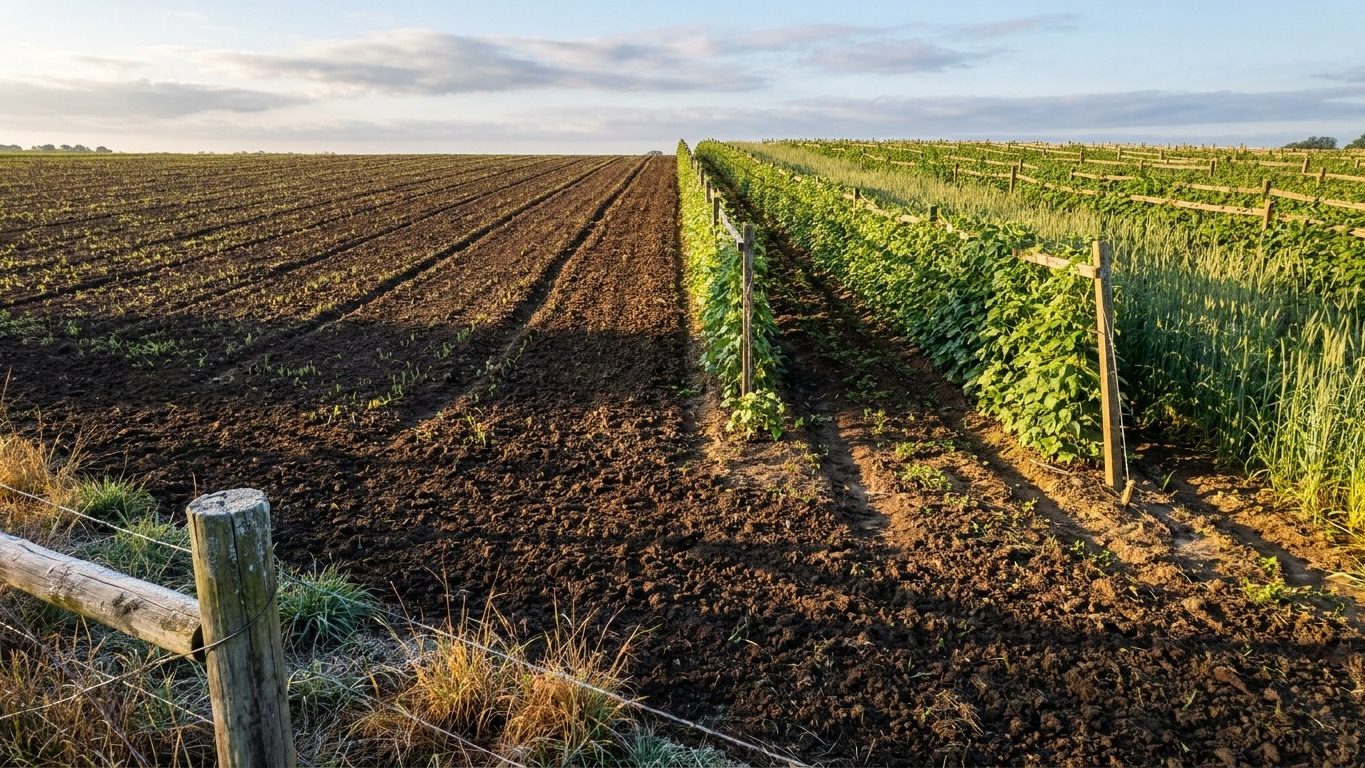

In Yukon, cover crops have one narrow lane to work with: the space between the average last spring frost, June 5, and the average first fall frost, August 25. That’s roughly 81 days of frost-free ground, and it is the whole growing season, not a bonus round on top of one. Pick species built for cold soil and quick maturity, get seed in as soon as the ground works, and plan to terminate before the nights turn sharp again.
The short answer for Yukon
Sow cover crops in Yukon starting right after the average last spring frost date of June 5, and plan to have them established or already terminated before the average first fall frost on August 25. That gives a working season of about 81 days, and in this territory that number does the heavy lifting: it decides which species even qualify for the job.
Reading the frost dates correctly
Both dates come from Environment and Climate Change Canada’s 1981-2010 climate normals for the Whitehorse A station, and they describe averages, not safe bets. A mean date means frost has landed later than June 5 in roughly half the years on record, and earlier than August 25 in the other half. Treat June 5 as the middle of a window that can shift weeks in either direction, not a date to circle on the calendar and trust without a backup plan.
That uncertainty carries more weight here than in most of Canada. Whitehorse sits in Canadian hardiness zone 1b, one of the coldest zones the country’s plant hardiness system recognizes, and winters here are long enough that a cover crop needing 90 or 100 frost-free days to finish its work is gambling against a season that, on paper, offers about 81.
Which crops fit the window
Species that mature fast and tolerate cool soil are the realistic short list for this territory:
- Oats, which build usable biomass in roughly 50 to 60 days and winterkill cleanly on their own
- Field peas, fast enough to fit the window and useful for adding some nitrogen back to the soil
- Fall rye sown in spring, tolerant of cool soil at germination and quick to establish ground cover
Buckwheat can work too, but only if sown well after frost risk has genuinely passed, since a planting made right at the June 5 average leaves it exposed on both ends of an already tight season.
What will not work here
Slow-maturing legumes are the first casualty of Yukon’s calendar. Hairy vetch and crimson clover typically need 90 to 120 frost-free days to build meaningful biomass or fix real nitrogen, and this territory’s frost-free window runs to only about 81 days between June 5 and August 25. Sow either one at the start of June and there is a real chance the first fall frost arrives before the plant has done much more than send up a few thin stems.
Warm-season crops are a mismatch
Sorghum-sudangrass, cowpeas, and other warm-season cover crops bred for long, hot summers don’t fit a territory where the coldest month averages a daily minimum of -19.2 °C and even the growing season itself stays cool. These species need warm soil to germinate reliably, something Yukon’s short summer rarely delivers in the volume they want, and a cool, cloudy July here can stall them for weeks they don’t have to spare.
Fall-sown winter cover crops carry their own trap. Winter rye or winter wheat planted in September to overwinter can work in milder parts of Canada, but in a zone 1b climate, survival depends almost entirely on snow cover arriving early and staying put. A snow-free stretch in November, with lows near that same coldest-month average, can kill a stand that would have sailed through the winter under a foot of insulating snow. Anyone relying on a fall-sown overwintering crop here is really relying on the snowpack, not the plant itself.
And close, dense spacing borrowed from gardening advice written for milder regions asks for trouble in a short season: it slows soil warming in spring, the one resource a Yukon gardener can least afford to waste. Wider rows that let sun reach bare soil in early June buy back days that a slow-to-warm, tightly sown bed simply gives away.
What changes across Yukon
Whitehorse’s Canadian hardiness zone of 1b describes the reference station only, and Yukon is nowhere near a single climate. The Canadian system rates a location across seven variables, including winter minimum, snow depth, and length of frost-free period, and a territory this size, stretching from the Alaska border to the Northwest Territories and from boreal river valleys to alpine tundra, can’t be reduced to one figure.
Communities farther north, or at higher latitude generally, typically see a shorter frost-free season than the Whitehorse average, while settlements at higher elevation lose growing days from both ends, a later spring thaw and an earlier fall chill. A garden in a low, south-facing valley bottom near Whitehorse can run weeks ahead of one on a shaded slope not far away, even though both sit nominally in the same broad region of the territory.
None of this means guessing. Natural Resources Canada’s Plant Hardiness site maps the country zone by zone, built on 1991-2020 normals, and it’s designed to be searched by municipality rather than assumed from a territorial average. A reader gardening outside Whitehorse should check that map for their own community rather than borrow the 1b figure used on this page, since the spread across Yukon runs colder than that in several northern and high-elevation areas the reference station simply doesn’t capture.
Where to check this for your own county
This page describes Yukon’s average frost dates and one reference hardiness zone, but it can’t tell a reader in Dawson City, Haines Junction, or Watson Lake what actually thrives in their own soil. That’s what agriculture services exist for, and the two things worth hunting for there are a local planting calendar built from real station data and a list of cover crop varieties already trialled nearby.
The federal Agriculture and Agri-Food Canada site at agriculture.canada.ca/en is the standing reference for this territory. It’s cited here in place of a Yukon-specific provincial page because that page currently blocks the kind of automated check that would confirm it’s live, and a link that works beats one that might not.
Once there, look for a regional or territorial planting calendar if one exists for Yukon specifically. It would list sowing windows narrower and more accurate than the territory-wide range used on this page, along with any notes on varieties tested through a Yukon research station or community garden program. A recommendation tied to a specific community always beats a territory-wide average, for the simple reason that this page is the territory-wide average, built from one weather station covering one city.
Checking this against your own garden
No date on this page beats what’s actually happening in the dirt. Yukon’s frost dates are averages pulled from one station in Whitehorse, and a reader’s own soil, slope, and shade will always know more about their specific patch of ground than a climate normal can.
Start with soil warmth felt by hand rather than a thermometer. Push fingers a couple of inches into a garden bed in late May or early June: soil that still feels cold and slightly stiff isn’t ready for seed no matter what the calendar says, while soil that crumbles easily and feels closer to room temperature is a sign the microclimate is running ahead of the June 5 average.
Watch for the first true leaves on any early test patch, the second set that follows the initial seed leaves. Their appearance means a plant has moved past the fragile seedling stage and into active growth, a better sign of a settled season than any date on a chart.
Pay attention, too, to what the wild plants nearby are doing. Local aspen or willow leafing out, or fireweed pushing new shoots along a roadside, are old, reliable markers that the ground has genuinely warmed, not just that the calendar has flipped to June. When those signals show up earlier or later than expected for the area, that’s the real, local version of the frost date this page can only average out.