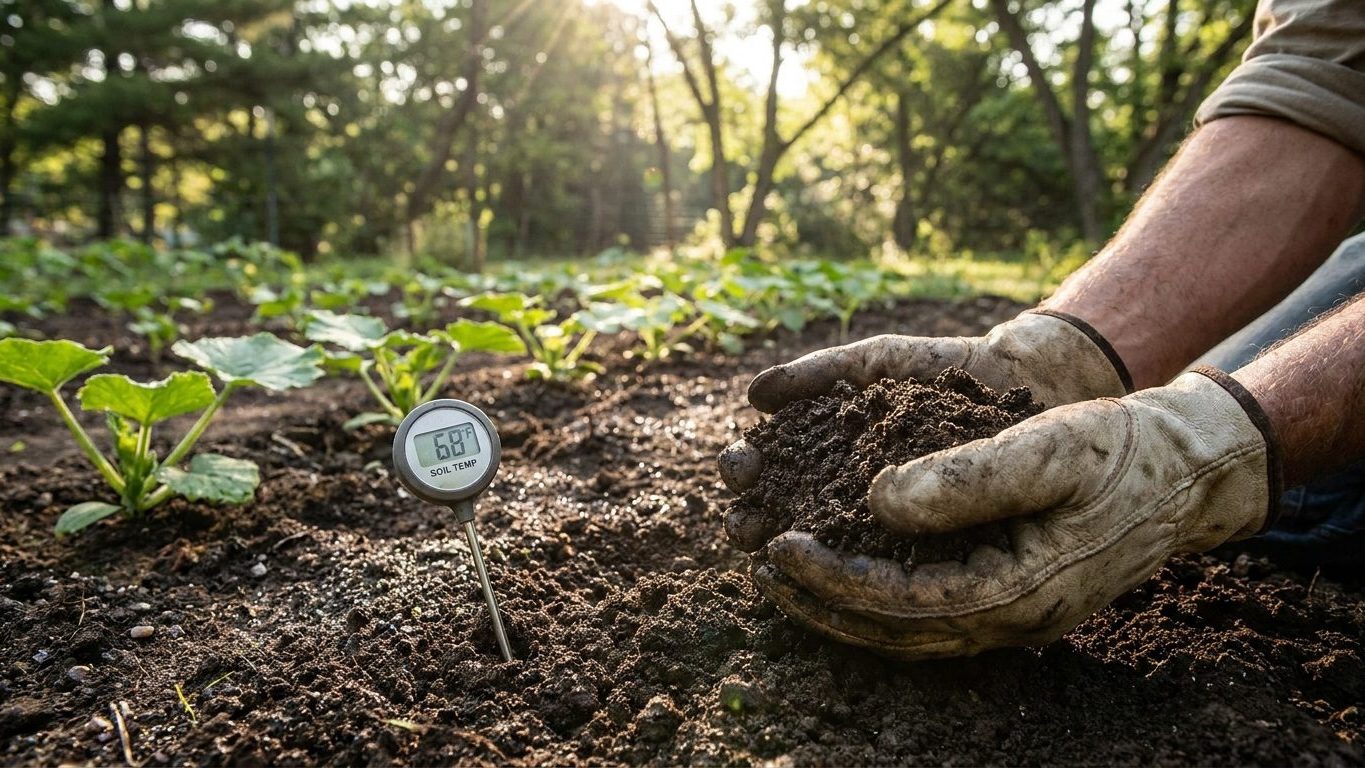

In the Toronto-area climate that anchors Ontario’s growing data, winter squash goes into the ground as transplants around the last week of May, or direct-seeded in the first week of June, once the soil has warmed past 60°F. That window falls between an average last spring frost of April 30 and an average first fall frost of October 16, and both of those dates are means, not guarantees, from a single reference station.
The short answer for Ontario
Winter squash is frost-tender from the moment it germinates, so the calendar starts with the frost dates and works backward. The Toronto Lester B. Pearson station puts the average last spring frost at April 30 and the average first fall frost at October 16, a stretch of roughly 169 frost-free days in a typical year. That sounds generous for a crop that usually needs somewhere between 80 and 110 days to mature, depending on the type. The catch is in the word “average.”
Two mean dates, not two safe dates
A mean frost date from Environment and Climate Change Canada’s 1981-2010 normals is the midpoint of a spread, not a cutoff. Half the years on record saw frost land later than April 30, sometimes well into May. Treat the mean as the center of a probability window, not the day you’re cleared to plant. That’s why most Ontario gardeners hold off on direct seeding until the first week of June and, if they want a head start, raise transplants indoors starting in early May instead of trusting the calendar date alone.
Matching squash type to the season
Faster winter squash, acorn and delicata types running 80 to 100 days, fit comfortably inside even a shortened version of this season. Slower types, the big storage squash and some hubbards running past 100 days, eat into the cushion fast once you subtract a slow, cool spring and the two or three weeks most growers hold in reserve before the fall frost mean. The practical rule: count backward from October 16, subtract two to three weeks for safety, and compare what’s left against the days-to-maturity on the seed packet before choosing a variety.
What will not work here

The Toronto reference station recorded zero days a year at or above 90°F over the 1981-2010 period. That single number rules out a category of mistake before it happens: this is not a climate that pushes winter squash hard through a long, scorching stretch of summer. Varieties bred for baking heat, the kind that need weeks of high temperatures to build sugar and finish their rind, will limp through an Ontario summer and still be soft-skinned when frost shows up.
Long-season types run out of clock
The math that works in the short answer above turns against a grower who picks a 110- to 120-day hubbard or a giant storage type and direct-seeds it in early June. Even in a favorable year that variety is cutting the fall frost close; in a year where the spring frost holds on into mid-May, as it does in roughly half the years on record, the same seed loses two extra weeks it never gets back.
| Squash type | Typical days to maturity | Fit for this frost window |
|---|---|---|
| Acorn, delicata | 80-100 | Comfortable margin most years |
| Butternut | 90-110 | Workable, tight in a late-frost spring |
| Hubbard, large storage types | 100-120 | Little to no margin; transplants recommended |
Crowding invites mildew in a rainy summer
Toronto’s June through August normal is about 8.9 inches of rain, spread fairly evenly across the three months, with June the driest at 2.81 inches. That’s not a drought climate, and treating it like one, watering on a fixed weekly schedule regardless of what’s already fallen, tends to push soil past what the plant needs. The bigger failure mode is spacing squash as if this were a dry region: close rows trap humidity after rain, and winter squash foliage in a summer with this much regular moisture needs airflow to keep powdery mildew off the leaves.
What changes across Ontario
The 7a hardiness zone cited for this page belongs to the Toronto reference city alone, and it’s built on Natural Resources Canada’s seven-variable system, not the single-variable USDA scale used elsewhere on this site. The two systems don’t convert directly; NRCan itself notes that a single Canadian zone can overlap nine different USDA zones. Ontario is not one climate wearing one zone number. The province runs from the relatively mild shoreline zones near Niagara and the Great Lakes down through the far north, where growing seasons shrink dramatically and zones drop far below anything comparable to the Toronto reference.
One zone number for one reference city
There is no single answer for “when” that covers a gardener near Windsor and a gardener near Thunder Bay. The spread inside Ontario’s own borders is large enough that a planting date built for the Toronto station could be two or three weeks too early for a grower several hundred miles north, where both the last spring frost and the first fall frost push the safe window in from both ends.
What a northern grower should shift
A reader gardening north of the Great Lakes shoreline, or at higher elevation, should assume a shorter frost-free stretch than the 169 days used here, lean toward the faster-maturing squash types in the table above, and check their own zone before trusting any date on this page. Natural Resources Canada’s Plant Hardiness Zone map lets you look up the zone for your own municipality rather than borrowing Toronto’s.
Where to check this for your own county
Everything above comes from one weather station and one hardiness reference point. Ontario’s own agriculture ministry publishes region-specific guidance through the Ontario Ministry of Agriculture, Food and Rural Affairs, and that’s the source that beats this page every time there’s a conflict. A provincial planting calendar, however carefully built, still averages across a territory that stretches from Lake Erie’s shoreline to the edge of the boreal forest.
What to look for once you’re there
Look specifically for two things. First, any local or regional planting calendar published for your part of the province, since frost timing in Ontario’s south differs by weeks from frost timing farther north or at elevation. Second, variety trial results for winter squash grown in your own agricultural region; provincial trial data tells you which butternut, acorn, or storage type actually finished ripening in a climate close to yours, rather than in a lab or a warmer test plot elsewhere. A county or regional recommendation is built on local trial data and local frost records. This page is the provincial version, useful for the general shape of the season, but not a substitute for the number your own region publishes.
Checking this against your own garden
No frost date on this page knows what’s happening in your soil this particular spring. Three direct observations outrank the calendar every time.
Soil warmth by feel comes first. Push a bare hand two inches into the bed in the morning; if the soil still feels cold and damp rather than merely cool, winter squash seed will sit and rot before it germinates, regardless of what the date says. Squash wants soil that feels genuinely warm, not just frost-free.
The first flush of male flowers is the second signal. Winter squash produces male blooms before female ones, sometimes by a week or two, and their appearance tells you the plant has settled in and started reproductive growth. No fruit will set until female flowers follow, so an early run of male-only flowers isn’t a problem, just an early stage.
The first true leaves, the ones that show the plant’s actual squash-shaped foliage rather than the rounder seed leaves, tell you the transplant or seedling has moved past its most fragile stage. A slow appearance of true leaves in a year that otherwise matches the mean dates on this page is often the clearest sign that your own plot runs a little cooler, or a little slower, than the station this calendar is built on.
If you follow the almanac, here is when to plant winter squash by the moon. It is a tradition, not a proven method.