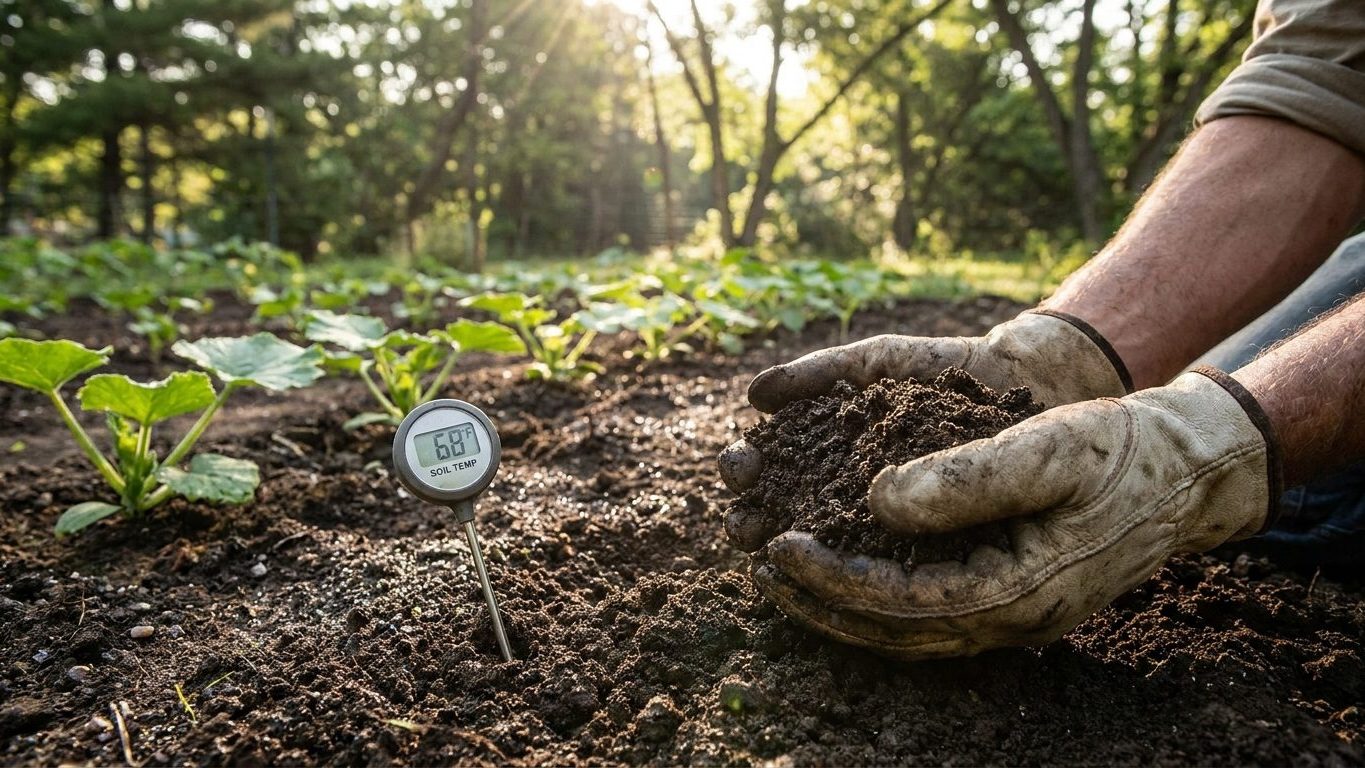

Winter squash goes into Prince Edward Island soil from late May through early June, timed to trail the average last spring frost of May 16, and needs to finish sizing up before the average first fall frost of October 17. That’s a mean window of roughly 154 days, but the real safe window is shorter, and which variety fits it depends on how fast it matures.
The short answer for Prince Edward Island
Start winter squash seeds indoors around mid-May, three to four weeks ahead of transplanting, or direct-sow once soil has warmed past the average last frost date of May 16. That date comes from Environment and Climate Change Canada’s 1981-2010 normals for the Charlottetown A station, and it’s a mean, not a guarantee. In one year out of two, frost arrives later than May 16. Treat it as the midpoint of a risk curve, not a green light, and push actual planting toward the very end of May or into the first week of June if the soil still feels cold underfoot.
On the other end of the season, the average first fall frost lands October 17, again from the same Charlottetown A record. Subtract the two dates and you get about 154 days of theoretical frost-free growing. Winter squash varieties run anywhere from 80 days (acorn, delicata, some smaller kabocha types) to well past 100 days (many hubbards, large butternuts, big pumpkins grown as winter storage squash). On paper, even the slower varieties fit inside 154 days.
But that math assumes both frost dates behave exactly as their averages, which they won’t every year. It also ignores a fact specific to this province: zero days a year reach 90°F at the reference station. Squash is a warm-season crop that speeds up with heat and stalls without it. A season with no heat spikes accumulates growing degree-days more slowly than the raw calendar suggests, which quietly eats into that 154-day cushion. The practical result: treat 100 days as the realistic ceiling for direct-sown seed, and reserve anything longer for transplants started indoors.
Rainfall over the growing months averages about 10.8 inches across June, July and August, with July running driest at 3.15 inches. That’s enough moisture in a normal year to carry squash through flowering and fruit set without constant irrigation, though a dry stretch inside that average still calls for supplemental watering at the vine’s base, especially once fruit start sizing.
What will not work here
The single biggest mismatch is planting a long-season winter squash and expecting it to finish. A variety rated at 110 or 120 days to maturity, sown even at the earliest safe date in late May, is racing a fall frost that arrives on average October 17, with zero hot days along the way to speed fruit development. Push the sowing date back by even two weeks, which happens whenever spring runs cold, and that same variety simply won’t harden its rind before frost cuts the vine down. Large hubbard types and the biggest pumpkin-style winter squash fall into this trap most often.
Succession sowing, a trick that works in longer, hotter growing regions, backfires here. Adding a second round of direct-seeded squash in mid-June to stretch the harvest sounds reasonable, but it shortens an already tight window even further. A second sowing has to finish inside roughly 120 days instead of 150, and with no 90°F days to accelerate ripening, that gap rarely closes in time.
Borrowing a watering routine built for a hot, dry climate doesn’t fit either. Some gardening advice assumes squash needs deep weekly watering because the ground bakes dry between soakings. Prince Edward Island’s summer rainfall of roughly 10.8 inches over three months, distributed across June, July and August rather than concentrated in one parched stretch, means a rigid weekly-only watering schedule can leave plants short during the driest patches inside July while also risking waterlogged roots right after a heavier rain event elsewhere in the season. Watch the soil, not the calendar.
Tight spacing is the other trap. Maritime summers here run cool and consistently damp rather than hot and arid, which is exactly the combination that favors powdery mildew and other fungal pressure on squash foliage. Vines planted close together, with leaves overlapping and little airflow between them, hold humidity right against the leaf surface. In a climate with zero days above 90°F to dry things out quickly, that damp air lingers longer than it would in a hotter, drier state. Give vining types real room, and consider bush-type winter squash where garden space is limited.
| Winter squash type | Typical days to maturity | Fit for PEI’s ~154-day mean window |
|---|---|---|
| Acorn, delicata, small kabocha | 80-95 days | Fits direct-sown, comfortable margin |
| Butternut (standard) | 90-105 days | Fits with transplants, tight if direct-sown late |
| Large hubbard, big storage pumpkins | 105-125 days | High risk, needs earliest possible transplant and a mild fall |
What changes across Prince Edward Island
Every figure in this article comes from one reference point, the Charlottetown A weather station, and the hardiness zone rating of 5b applies to that same reference city under the Canadian system. Canada’s plant hardiness model, published by Natural Resources Canada, is built from seven separate climate variables rather than the single minimum-temperature figure the USDA system uses, so this 5b number cannot be lined up against a USDA zone anywhere else on this site. Say that plainly: it isn’t the same scale, and NRCan itself publishes the comparison showing how much the two systems diverge.
A province the size and shape of Prince Edward Island, wrapped by the Gulf of St. Lawrence and the Northumberland Strait, does not sit at one climate everywhere. Coastal stretches tend to lag inland areas in spring warm-up because open water cools the air moving over it, while inland and slightly elevated ground can warm faster in spring but also cool faster once fall sets in. That means a garden a short drive from Charlottetown can easily see its own last frost run later than May 16, or its first fall frost arrive earlier than October 17, shifting the whole planting window in either direction.
None of this points to a single correction figure, because the province simply isn’t one climate zone. The right move for anyone gardening outside Charlottetown itself is to look up the hardiness zone for their own community rather than assume Charlottetown’s 5b applies uniformly, using Natural Resources Canada’s Plant Hardiness Site map, which reports zone by municipality. That map, not this article, is the tool for placing an individual garden.
Where to check this for your own county
This page draws entirely from one reference station and one reference hardiness zone, which makes it a province-level guide, not a county-level one. A county recommendation, built from local trial data and observations gathered closer to a specific garden, will always beat a province-wide average, and that’s exactly what a provincial agriculture office exists to provide.
Prince Edward Island’s own agriculture resources are published at princeedwardisland.ca/en/topic/agriculture. When checking that page, look specifically for two things: a local planting calendar that reflects on-the-ground frost timing rather than the 1981-2010 station average used here, and any listing of squash or vegetable varieties that have actually been trialled in island growing conditions. Provincial agriculture offices often maintain informal notes on which varieties performed well in local trial plots or extension demonstrations, and that kind of ground-level result carries more weight than any station-derived date.
It’s worth being direct about what this article can and can’t do. It gives the provincial picture, built from a single weather station and a single hardiness zone reading, and that picture is useful as a starting point and nothing more. A gardener in a coastal community with later springs, or an inland pocket with an earlier fall chill, should treat the provincial agriculture page’s own local calendar as the tie-breaker whenever it conflicts with the dates given here.
If you follow the almanac, here is when to plant winter squash by the moon. It is a tradition, not a proven method.
Checking this against your own garden
Every date in this article is a long-term average pulled from one weather station. A gardener’s own observation, made right in the bed where the squash is actually growing, beats any station average because it reflects the real microclimate of that specific plot, not a province-wide mean.
Three signs are worth tracking by hand and eye rather than by calendar. First, soil warmth felt with bare fingers a couple inches down, first thing in the morning before the sun has had a chance to warm the surface artificially: squash seed germinates poorly in cold soil no matter what the calendar says, so soil that still feels cool to the touch in late May is a real signal to wait, regardless of the average frost date having passed.
Second, the first flush of male flowers, the ones that open without a small swollen fruit behind them. Their appearance marks the plant shifting into active reproductive growth, and it typically shows up well before any female flowers set fruit. A garden running its own microclimate ahead of or behind the provincial average will show this stage correspondingly early or late.
Third, the first true leaves unfolding above the seedling’s initial rounded leaves. These are the leaves that actually resemble the mature plant’s foliage, and their timing after germination gives a rough read on how quickly the local soil and air are moving the plant through its early stages. A slow appearance of true leaves, stretched out over what feels like an unusually long stretch, often points to a cooler pocket than the provincial average would suggest, and that’s useful information for deciding how much of a head start next year’s seedlings might need.