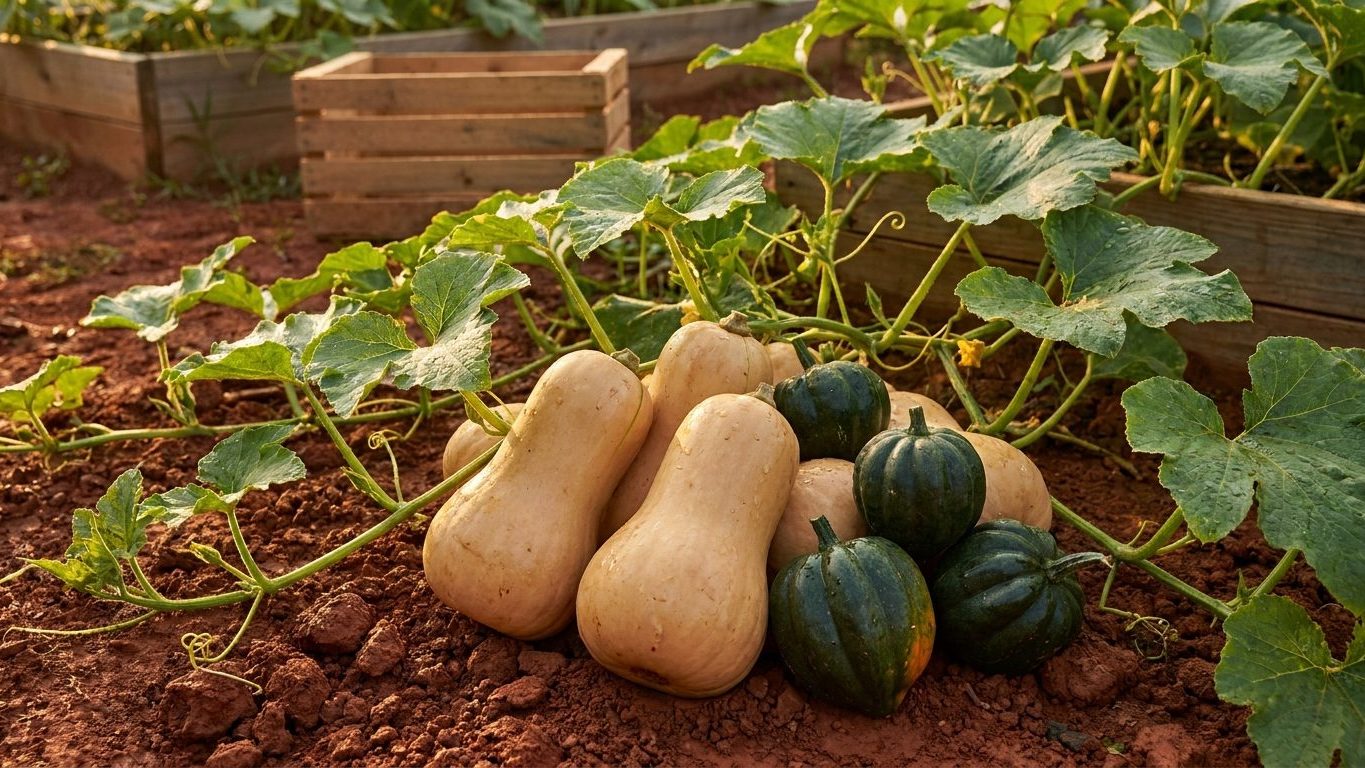

Short-season, cool-tolerant squash win in Prince Edward Island: think acorn, delicata, buttercup, and small pie pumpkins that finish in under 100 days. Long-season butternut types and giant storage Hubbards are the wrong bet here, because the province’s summers almost never deliver the sustained heat those varieties need to fill out and cure before frost.
The short answer for Prince Edward Island
The decision on which Winter Squash to plant in Prince Edward Island comes down to two numbers: how long the frost-free stretch runs, and how much heat shows up inside it. Between the average last spring frost on May 16 and the average first fall frost on October 17, the province gets roughly 154 days without freezing temperatures at the Charlottetown A reference station. That sounds workable on paper. The catch is that this window is a mean, not a guarantee, and heat inside it is scarce: the same station records 0.0 days a year at or above 90°F. Squash does not just need frost-free days. It needs warm nights to push sugars and starches into the fruit, and Prince Edward Island’s Atlantic-moderated summers rarely deliver them.
That single fact, zero days above 90°F, is what should steer variety choice more than anything else. Winter squash splits into three species groups, and they do not respond to cool summers the same way. Cucurbita pepo types, which include acorn, delicata, and most pie pumpkins, evolved in shorter, cooler seasons and typically mature in 80 to 100 days. Cucurbita maxima types, including buttercup, kabocha, and true Hubbard, run a bit longer but still tolerate cooler nights better than the third group. Cucurbita moschata, the species behind most butternut squash, wants sustained warmth to size up and sweeten, and it sulks in a summer that never cracks 90°F even once.
For a Prince Edward Island garden, that points toward acorn squash, delicata, and compact buttercup or kabocha types as the reliable core. Small sugar pie pumpkins fit the same profile. These varieties are bred or selected for northern growing seasons, they set fruit early, and they do not depend on a heat spike that this province’s climate data says will not come.
| Type | Typical days to maturity | Heat need | Fit for PEI |
|---|---|---|---|
| Acorn (C. pepo) | 75-90 | Low | Strong fit |
| Delicata (C. pepo) | 90-100 | Low | Strong fit |
| Buttercup/kabocha (C. maxima) | 90-100 | Moderate | Good fit |
| Large Hubbard (C. maxima) | 100-120 | Moderate | Marginal, needs an early start |
| Butternut (C. moschata) | 100-120 | High | Poor fit |
What will not work here

Butternut squash is the clearest failure case in this province, and the reason is not the calendar, it is the thermometer. Butternut is a moschata type, and moschata varieties are the most heat-hungry of the three squash families. With zero days a year reaching 90°F at the reference station, the plants can still grow vines and set fruit, but they routinely fail to finish curing a full crop of thick-walled, deep-orange squash before the average first fall frost on October 17. Gardeners who plant butternut here often end up harvesting pale, watery fruit that rots in storage within weeks instead of lasting through winter.
Giant storage Hubbards and other 110-to-120-day maxima varieties sit in the same danger zone, just less severely. The 154-day frost-free average sounds like enough room, but that figure is built on a mean last frost date, which by definition means frost arrives later than May 16 in roughly half of all years. Add a slow, cool spring on top of a slow-maturing variety, and a squash that needs 120 days can easily run out of season, especially in a year when the real last frost lands in late May or even early June rather than on the average date.
Direct-seeding any of the heat-loving types straight into cold spring soil is its own failure mode. Squash seed germinates poorly and seedlings sulk or rot when soil stays cool, and treating May 16 as a safe planting date, rather than the midpoint of a window, is how gardeners lose a first sowing and have to restart with a shorter runway to frost.
Dense, close spacing is a third trap, and it comes from the rainfall pattern rather than the temperature. Prince Edward Island gets a fairly even 10.8 inches of rain across June, July, and August, with July as the driest month at 3.15 inches. That is not a drought pattern. Combined with the humidity that comes with an island climate surrounded by the Gulf of St. Lawrence and the Atlantic, evenly spread summer moisture keeps foliage damp longer after rain or dew. Large-vine varieties planted tight together, the way a gardener might crowd them in a warmer, drier state, trap air and invite powdery mildew on the leaves well before the fruit has finished sizing.
What changes across Prince Edward Island
The hardiness zone figure available for this province, 5b in the Canadian system, is drawn from the Charlottetown reference station, not from a survey of the whole island. That distinction matters more here than it might elsewhere, because a Canadian zone is built from seven climate variables, not the single minimum-temperature measure the USDA system uses, and Natural Resources Canada is explicit that the two systems do not convert into each other. A single Canadian zone number for one city cannot be assumed to describe a coastal fishing community on the North Shore, a sheltered valley near a river, or an inland farm away from the moderating effect of the ocean.
Prince Edward Island’s geography makes this variation real rather than theoretical. The Gulf of St. Lawrence side tends to hold cooler spring temperatures longer into the season because sea ice can linger nearby into April, delaying soil warm-up. The Northumberland Strait side, facing the mainland, often warms a little sooner in spring and can hold heat a little later into fall. Low-lying frost pockets inland, away from any moderating water, can see damaging frost weeks before the provincial average date, while a garden right on the coast may get several extra frost-free days on either end of the season compared with what the reference station suggests.
None of this can be resolved from a province-wide page, and it should not be guessed at from a general description of coastal versus inland conditions. Prince Edward Island’s plant hardiness zone map, published by Natural Resources Canada, breaks the zone data down by municipality rather than treating the island as one block. A gardener trying to decide whether their own conditions run milder or harsher than the Charlottetown figures used above should check that map for their own community rather than assume the provincial reference applies unchanged.
Where to check this for your own county
Prince Edward Island’s government maintains an agriculture section at princeedwardisland.ca/en/topic/agriculture, and that page is the right next stop for anyone planting winter squash on the island. This article works from provincial and station-level averages, the kind of data that describes the island in broad strokes. A resource built around local trial results and regional planting timing will always beat a province-wide estimate, because it accounts for the coastal-versus-inland differences described above in a way a single reference station cannot.
Two things are worth looking for once there. First, any planting calendar specific to the island’s growing regions rather than a single averaged date range, since spring soil warm-up on the North Shore and the Northumberland Strait side does not track identically. Second, any list of squash varieties that have actually been trialled in Prince Edward Island conditions, since local trial results catch real-world performance, disease pressure, and maturity timing that a species-level description like the one in this article cannot capture.
This page has given the reasoning that applies across the whole province: short, cool-summer season favors pepo and compact maxima types, and heat-hungry moschata varieties like butternut are a poor match for a climate that averages zero days above 90°F. A provincial or local resource can narrow that further, down to named cultivars and adjusted dates for a specific part of the island, in a way a general territorial page is not built to do.
Checking this against your own garden
Every average date and station reading on this page describes Charlottetown, not any individual backyard, and the most reliable check available to a gardener is still what is happening in their own soil and plants. Three signs are worth watching before trusting a calendar date over what is actually in front of you.
- Soil warmth by feel: squash seed wants soil that feels warm to bare skin, not just frost-free air. If the ground still feels cold or damp-cold at wrist depth in mid-May, that garden is running behind the provincial average and direct-seeding should wait, regardless of the calendar date.
- The first flush of male flowers: male flowers typically open before female ones and signal the plant has shifted into active flowering. Their appearance timing, early or late relative to a neighbor’s garden, is a useful marker of how a specific plot’s microclimate compares with the general trend for the area.
- The first true leaves: the rounded seed leaves that emerge first do not indicate much on their own, but the appearance of the first true, lobed squash leaves marks the point where the plant is drawing real energy from photosynthesis rather than seed reserves. Slow true-leaf development after germination often points to a cooler-than-average pocket that will need extra time built into the harvest expectation.
None of these require any equipment beyond a hand in the soil and a bit of attention through the season, and together they tell a gardener more about their own plot’s timing than any single average date drawn from one weather station across the province.