
The safe window to direct-seed winter squash outdoors in Saskatchewan runs from about May 18, when the average last spring frost lifts, to a hard stop well before September 18, when the average first fall frost arrives. That’s a frost-free season of roughly 123 days, and it’s tight for most winter squash, so variety choice matters as much as the calendar date.
The short answer for Saskatchewan
Direct-seed winter squash outdoors around May 18. That date is the average last spring frost recorded at the Saskatoon SRC station under Environment and Climate Change Canada’s 1981-2010 climate normals. Harvest and get fruit off the vine before September 18, the average first fall frost at the same station.
Those two dates aren’t safety margins. They’re means, which means in roughly one year out of two, frost arrives later in spring or earlier in fall than the average suggests. Treat May 18 as the midpoint of a window, not a green light, and treat September 18 the same way in reverse. A gardener who plants on the average date and gets a late frost the following year isn’t unlucky; that’s just how averages work half the time.
| Milestone | Date (average) | What it means |
|---|---|---|
| Last spring frost | May 18 | Midpoint, not a guarantee, later half the time |
| First fall frost | September 18 | Midpoint, not a guarantee, earlier half the time |
| Frost-free window | ~123 days | Total days available for the whole crop cycle |
That 123-day span has to cover germination, vine growth, fruit set, sizing, and the curing that turns a hard-shelled squash into something that stores through winter. Most winter squash catalogs list “days to maturity” in the 80 to 110 range, counted from transplant, not from seed in the ground. Direct-seeded in Saskatoon on May 18, a 100-day variety is aiming for harvest around August 26, which leaves a buffer, but only if the season runs true to average. A 110- or 120-day variety pushes past September 18 more often than not.
The practical move most Saskatchewan gardeners land on is starting seed indoors three to four weeks before May 18, so late April, and setting out hardened transplants right around the frost date. That effectively buys an extra three or four weeks against the 123-day ceiling, which is often the difference between a squash that cures properly on the vine and one pulled green ahead of a frost.
What will not work here
Long-season, heat-loving winter squash is the first thing to fail here, and it fails for two separate reasons that both trace back to the same set of numbers. The first is the season length itself: anything rated past 110 days to maturity is racing a 123-day window that isn’t guaranteed to hold. The second is heat load. Saskatoon’s climate normals show 0.0 mean days a year reaching 90°F. That’s not a rounding error, it’s the actual measure of summer heat accumulation, and it means squash varieties bred for hot, long summers (think large Hubbards, some cushaws, and the biggest storage pumpkins) don’t get the heat units they need to finish fruit properly even when the calendar days are technically there. Vines can look lush all summer and still hand over a crop of undersized, thin-walled squash at frost.
Watering on a fixed weekly schedule is the second failure point, and it runs in the opposite direction from what gardeners in hotter regions assume. Summer rainfall here averages about 6.6 inches across June, July, and August, with August, the month when fruit is sizing and shells are hardening for storage, the driest of the three at just 1.68 inches. A gardener who waters once a week assuming rain will fill the gaps often finds the soil bone-dry under mulch right when the squash needs steady moisture to size up. The fix isn’t more water everywhere; it’s checking soil moisture directly through August rather than trusting the calendar or the sky.
Tight spacing built for humid, disease-pressured regions is the third mismatch. Because the rainfall total here is modest and August runs dry, powdery mildew and the fungal pressure that drives wide spacing recommendations in wetter climates is less of the limiting factor. The bigger risk in a Saskatchewan garden is a vine that’s stressed for water in a dry August, not one crowded into damp air. Spacing advice copied from a humid-summer state solves a problem this territory doesn’t have as often, while leaving the real one, water timing, unaddressed.
What changes across Saskatchewan
The hardiness zone figure available for this page is 3a, and it applies to the Saskatoon reference station, not to the province as a whole. That’s an important distinction to hold onto, because Saskatchewan stretches from northern boreal forest down to the southern prairie grain belt, and a province that size does not sit inside one climate. This page can only speak reliably to the numbers tied to its named reference station.
What that means practically: a gardener farther north or at higher elevation than Saskatoon should expect the frost-free window to be shorter than the 123 days used above, not the same. Spring frost risk lingers later into the season moving north, and fall frost arrives earlier. Both ends of the window close in, which squeezes an already tight season for winter squash even further. A gardener in a milder pocket closer to the southern border, meanwhile, may see a longer effective window than the Saskatoon average suggests.
None of that can be pinned to a specific number on this page, because the Canadian hardiness zone system covers seven climate variables, not one, and Natural Resources Canada is explicit that its zones don’t convert cleanly across the province or against the U.S. system. Saskatchewan is not a single zone, and the honest answer here is that the spread exists without a page like this one being able to name it county by county.
The move that actually resolves this is checking Natural Resources Canada’s Plant Hardiness Site, which maps zones by municipality using 1991-2020 normals. That’s the tool built to answer the question: what’s the frost-free reality where a specific reader’s garden actually sits, rather than at a weather station that may be a hundred miles or more away.
Where to check this for your own county
Saskatchewan’s provincial agriculture resource, run through the Government of Saskatchewan, is the next stop for anyone who wants numbers tied closer to home than a single reference station: saskatchewan.ca/business/agriculture-natural-resources-and-industry/agribusiness-farmers-and-ranchers.
Two things are worth hunting for once there. First, any planting calendar specific to a district or growing region within the province, since frost dates and season length shift meaningfully between the northern forest fringe and the southern grain belt, and a provincial resource is more likely to break that out than a single Environment Canada station can. Second, any list of winter squash varieties actually trialled in local growing conditions, rather than catalog descriptions written for a national or continental audience. A variety that finishes reliably in a trial plot near a reader’s own district carries more weight than a “days to maturity” number printed on a seed packet grown somewhere with a longer, hotter summer.
A district-level recommendation will always beat a provincial one, and a provincial one will always beat this page. What’s written here draws on climate normals from a single reference station and applies broadly across Saskatchewan; a provincial agriculture resource can narrow that down by region, and a local extension contact or experienced grower nearby can narrow it further still, down to the specific soil and microclimate of one garden. Each step down that chain trades breadth for accuracy, and the last step, a reader’s own observation, is the one no resource can replace.
Some gardeners also time this by the Moon: when to plant winter squash by the moon, as almanac tradition rather than fact.
Checking this against your own garden
Every date on this page is a provincial-scale average pulled from one weather station. A reader’s own garden will tell them something more useful, and it doesn’t take any equipment they don’t already have.
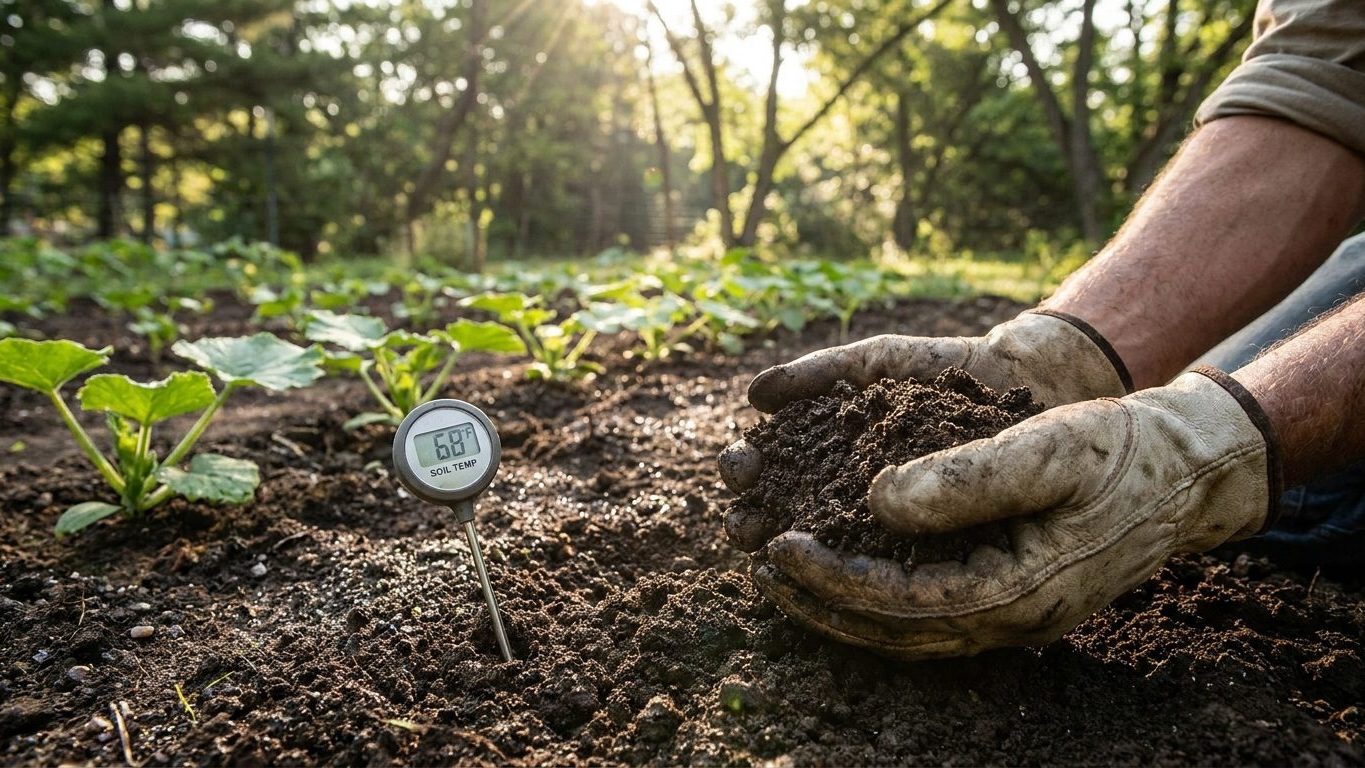
Soil warmth by feel is the first check. Winter squash seed sits and rots in cold, wet soil rather than germinating, regardless of what the calendar says about May 18. Pushing a bare hand a few inches into the planting bed and feeling for warmth, not just dryness, gives a better read on whether the soil is actually ready than the date on a seed packet.
The first flush of male flowers is the second signal worth watching. Squash plants typically produce male flowers before female ones, and a garden that’s running warm and vigorous will show that first flush earlier than one that’s lagging. It’s an early indicator of how the season is tracking compared to an average year, well before any fruit is visible.
The appearance of first true leaves, the second set that shows the plant’s actual leaf shape rather than the rounded seed leaves, marks the point where a seedling has shifted from living off stored seed energy to actually growing on its own. A garden where true leaves show up noticeably faster or slower than expected is signaling something about its own microclimate, whether that’s a warm south-facing slope running ahead of the provincial average or a low, shaded spot running behind it, and that’s information no station-based frost date can hand over on its own.