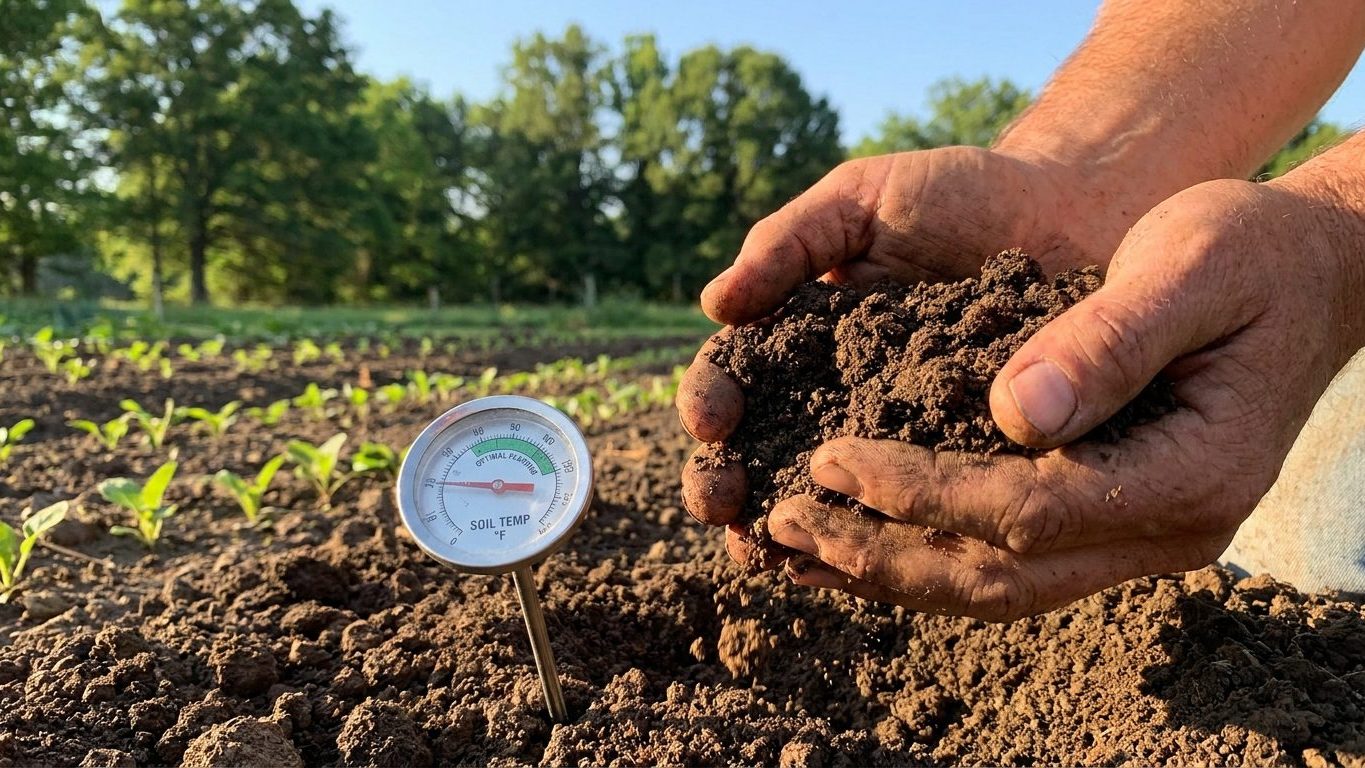

Winter Squash in Saskatchewan goes into the ground only after the soil itself has warmed, generally in the last days of May or the first days of June, and with a frost-free window running to roughly mid-September, the real decision isn’t when to plant but which type of squash can finish ripening before the cold returns.
When the soil is warm enough in Saskatchewan

Gardeners ask for a date, but the honest answer starts with a different question: is the soil warm, not just the air. Winter squash seed rots in cold, wet ground before it ever sprouts, and transplants sulk or stall if the roots sit in soil below the mid-60s Fahrenheit. Frost dates are a proxy for that warmth, useful because they’re easy to track, but the soil itself lags behind the air by days or weeks depending on how much sun a bed gets and how heavy the ground is.
For Saskatchewan, the reference point is the average last spring frost of May 18, recorded at the Saskatoon SRC station by Environment and Climate Change Canada over the 1981-2010 normals period. That date is a mean, not a guarantee. In roughly half the years on record, frost arrived later than May 18, sometimes well into the last week of the month. Treat it as the midpoint of a window rather than a green light, and hold off on setting out squash, whether from seed or transplant, until the ground itself has caught up with the calendar.
Saskatoon sits in Canadian plant hardiness zone 3a, according to Natural Resources Canada’s Plant Hardiness Site, using 1991-2020 normals. That’s worth naming carefully: the Canadian zone system is built from seven climate variables, not the single minimum-temperature measure the USDA uses south of the border, so a Canadian 3a does not translate to any single USDA zone. Comparisons across the border on hardiness alone don’t hold up, and gardeners here shouldn’t try to line their zone up with a US chart to find their planting date.
The other reality is that Saskatchewan is not one climate. A station reading in Saskatoon tells you about Saskatoon. Gardens in the Cypress Hills uplands or in the province’s northern forest fringe run weeks behind that May 18 average, while some sheltered river valleys warm faster. The safest local check remains simple and low-tech: press a soil thermometer a few inches down, wait for a run of mild nights, and let that reading, not the calendar, decide when winter squash goes in.
How long the season lasts here
Subtracting the two Saskatoon SRC averages, a last spring frost of May 18 and a first fall frost of September 18, gives a frost-free window of about 123 days. That’s the number that governs everything else about Growing Winter Squash here, because unlike a quick summer crop, squash needs its entire season to bulk up, mature a hard rind, and cure enough sugar and starch to store through winter. An immature fruit pulled ahead of frost neither cures properly nor keeps.
A 123-day window is workable for winter squash, but it isn’t generous. It leaves little room for setbacks: a cool, slow spring that delays planting by two weeks, or a wet patch that stunts young plants, can push a squash right up against the September frost average with fruit still filling out. That reality changes how the crop gets started. Direct seeding after the soil has warmed is the simplest approach, but many Saskatchewan gardeners get ahead of the season by starting squash indoors three to four weeks before the last frost mean, then transplanting with care, since squash roots resent disturbance and a rough transplant can cost the plant a week of stalled growth it doesn’t have to spare.
What this window does not allow, in most years, is a second sowing of squash after an early harvest. Succession sowing works well for fast crops like lettuce, radish, or bush beans, where a second planting can still mature before frost. Winter squash, needing the better part of the whole season for one crop, doesn’t leave that margin here. Readers planning a fuller vegetable rotation, mixing squash with quicker crops that can be resown through the summer, should check the site’s succession sowing guide for how to sequence shorter-season vegetables around a single, season-long squash planting.
The practical upshot: in Saskatchewan, the first sowing (or transplanting) of winter squash is effectively the only sowing. Getting that timing right, anchored to soil warmth rather than the calendar date alone, matters more here than in territories with a longer buffer on either end.
Heat and water in Saskatchewan

Two figures from the Saskatoon normals tell the rest of the story: an average of 0.0 days a year above 90°F, and summer rainfall of about 6.6 inches across June, July, and August. Winter squash is not a plant asking for extreme heat, but it does want warmth and enough light to push growth along quickly within a short season, and Saskatoon’s normals show a summer that almost never delivers real heat stress. That’s a different profile from the classic hot-climate squash-growing challenge of scorched leaves and blossom drop; it essentially doesn’t apply here.
What applies instead is the cooler, damper side of the ledger. With no days reliably crossing 90°F, squash vines in Saskatchewan grow under conditions that favor foliar disease more than heat stress: powdery mildew on the leaves, slower fruit set in a cool stretch, and a ripening period that can run right up against the frost window described above. The month-by-month rainfall breaks down as follows:
| Month | Average rainfall |
|---|---|
| June | 2.59 in |
| July | 2.38 in |
| August | 1.68 in |
That’s a fairly even spread through the growing months, with August, right when fruit is sizing up and starting to cure, the driest of the three. Rainfall alone doesn’t answer the watering question, though. These are normals for a reference station, not a promise for any one garden, and how far 1.68 inches of August rain goes depends on the soil underneath it: a sandy bed lets that rain through in a day, while a heavier clay soil holds it for a week. A rain gauge on the actual plot, checked through the growing season, tells a gardener far more than the regional average ever will.
The combination here, cool summers with no meaningful heat load and moderate, fairly reliable rainfall, means the two biggest risks for Saskatchewan squash growers aren’t drought and heat stress but mildew pressure and a fruit that’s still sizing up when frost arrives. Airflow between plants, spacing that lets leaves dry after rain or dew, and watching the calendar toward September matter more here than irrigation planning.
Which winter squash suit Saskatchewan
Given a 123-day window, cool summers, and no real heat stress but a real mildew risk, the type of winter squash matters more than any single growing technique. The clearest guidance for Saskatchewan gardens points toward the earliest-maturing types within the winter squash category, the ones bred or selected to finish reliably within a short prairie season, rather than the larger, longer-season types that need heat and length this territory doesn’t reliably offer.
Because the summer here runs cool and rainfall arrives steadily rather than as scarce, punishing dry spells, disease resistance and airflow matter as much as speed. A type prone to powdery mildew is a bigger liability in Saskatoon’s climate than in a hot, dry one, since the humidity and moderate rain give mildew spores exactly the conditions they need across June, July, and August. Choosing types noted locally for mildew tolerance, and spacing vines to let air move between leaves, does more real work here than any spray program.
This page won’t name a specific variety, and that’s a deliberate choice, not an oversight. Variety trials shift year to year, seed availability changes, and the types actually proven to mature reliably within Saskatchewan’s frost window are the kind of information that only a provincial or local trial can give honestly. Naming a cultivar here, without that trial data behind it, would be a guess dressed up as advice, and Saskatchewan gardeners deserve better than a guess on a crop with as little seasonal margin as this one.
The better move is to bring these territory facts, the mid-May soil-warming window, the roughly 123-day season, the cool and mildew-favoring summer, straight to Saskatchewan’s Ministry of Agriculture resources, where variety trial results and locally tested recommendations for winter squash are kept current. That’s the source built for the one question this page can’t answer with certainty: which named variety, right now, is proven to finish in a Saskatchewan garden before the frost comes back.