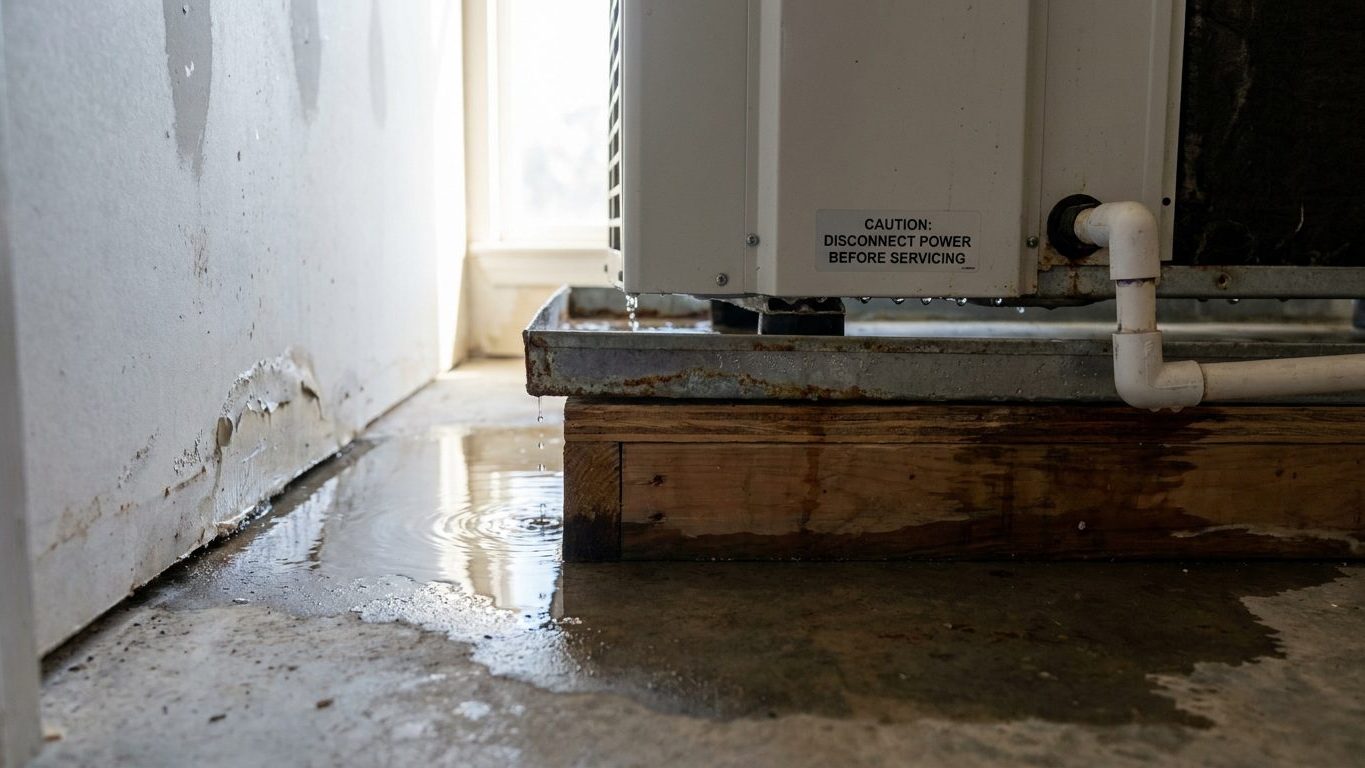

Water pooling around your indoor unit almost always means the condensate system isn’t draining the way it should, not a plumbing leak or a refrigerant problem. A clogged drain line, a cracked pan, or a coil that just thawed after icing over are the usual suspects. Catch it early and it’s a quick fix. Ignore it and you’re looking at mold, warped flooring, or a system that shuts itself off mid-summer.
Water Around the Indoor Unit
Every air Conditioner, whether it’s a central system with an air handler tucked in a closet or attic, or a ductless mini-split mounted on a wall, does the same basic job: it pulls humidity out of the air as that air passes over a cold Evaporator coil. That moisture condenses into liquid water, drips into a collection pan, and then travels out of the house through a drain line, usually a length of PVC pipe that ends somewhere outside, like a wall stub or a condensate pump discharge.
Water shows up around the unit when any link in that chain breaks. The drain line clogs with algae, dust, or debris and backs up until the pan overflows. The pan itself cracks or rusts through, especially in older units. The coil ices over, usually from restricted airflow or low refrigerant, and then thaws all at once, dumping more water than the pan and line were built to handle in a short burst. Or the line loses its pitch, meaning gravity stops doing its job and water just sits and eventually spills over the edge instead of draining.
The two common setups behave a little differently, and it helps to know which one you have before you start troubleshooting.
| Feature | Central Air Handler | Ductless Mini-Split Indoor Unit |
|---|---|---|
| Typical location | Attic, basement, or utility closet | Mounted on an interior wall or ceiling |
| Drain path | Gravity-fed PVC line, sometimes long runs through walls or attic space | Short internal drain, often paired with a condensate pump for horizontal runs |
| Most common failure point | Clogged or unpitched drain line | Clogged condensate pump or blocked internal tray |
| Safety backup | Float switch that cuts power if the pan fills | Some models have a float sensor; many rely on a secondary drain pan |
In states where a large share of homes run on individual equipment rather than central systems, this distinction matters more. In New York, for example, 88% of homes use some form of air Conditioning, but only 29% have central air. The other 61% run on individual equipment, meaning ductless mini-splits, window units, wall units, or portables, according to the U.S. Energy Information Administration’s 2020 Residential Energy Consumption Survey. That’s a lot of households where the indoor unit in question is a wall-mounted mini-split head with its own small drain and, often, its own condensate pump rather than a long gravity line hidden in the attic.
How to tell, in your own house
Work through these checks in order. Each one costs less time and money than the next, and stopping after the first three still covers the fixes that catch most cases.
- Look outside first. Find where the condensate drain line exits the house (usually a small white PVC pipe near the Outdoor Unit or foundation) and check whether it’s dripping steadily, barely dripping, or bone dry during a hot, humid run. Bone dry while the system is clearly cooling is a red flag for a clog upstream.
- Check for ice. Open the access panel or look at the mini-split’s coil (with the unit off) for frost or ice buildup. If you see ice, turn the system off and let it thaw completely for several hours before running it again. Running an iced-up unit just makes the eventual overflow worse.
- Clear the line yourself. At the outdoor termination point, a wet/dry shop vac held tightly over the pipe opening for 30 to 60 seconds can pull out a moderate clog. This is the single most effective free fix and it’s fully within homeowner territory.
- Check the condensate pump, if you have one. Mini-splits and some air handlers in basements use a small pump to push water uphill to a drain. Listen for it running when the system cycles, and check that the float switch inside isn’t stuck. A pump that’s silent when it should be working is worth noting for the technician.
- Inspect the pan for cracks or rust. A visual check only, no removal of panels beyond what the manufacturer intends for filter access.
Homeowner work stops there. Opening the sealed refrigerant system, handling refrigerant, or disassembling the blower housing to access an internal drain pan requires an EPA Section 608 certification under the Clean Air Act, and it’s not something to attempt with a wrench and good intentions. Same goes for re-pitching a drain line that runs inside a wall or ceiling cavity, or diagnosing a coil that’s icing over from low refrigerant charge rather than a dirty filter. If the line is clear, the pump is running, and water still appears, that’s the point to call a technician rather than keep guessing.
What it costs you to ignore it
A little standing water looks minor. It doesn’t stay that way. Condensate sitting against drywall, subfloor, or ceiling material feeds mold within days, not weeks, especially in the humid conditions that caused the overflow in the first place. Once mold takes hold in a wall cavity or attic insulation, it spreads through the same air the system is supposed to be cooling and cleaning.
On the equipment side, a rusted or corroded pan gets weaker every time it holds water it wasn’t designed to hold, and eventually it fails outright. Many systems include a float switch specifically to shut the unit down before an overflow gets serious, which protects your house but also means your air conditioning simply stops working, often on the hottest day of the summer, until someone clears the problem. A coil that keeps icing over because of restricted drainage or airflow also loses cooling capacity gradually, so the house feels warmer and more humid well before the system fully quits.
None of this requires a catastrophic leak. It’s the slow version: a little water today, a little mold next month, a shutdown at the worst possible time after that. The fixes at the top of the checklist above take a shop vac and ten minutes. The fixes at the bottom take a technician and a diagnosis. Knowing which one you’re facing is the difference between a minor inconvenience and a system down for days.