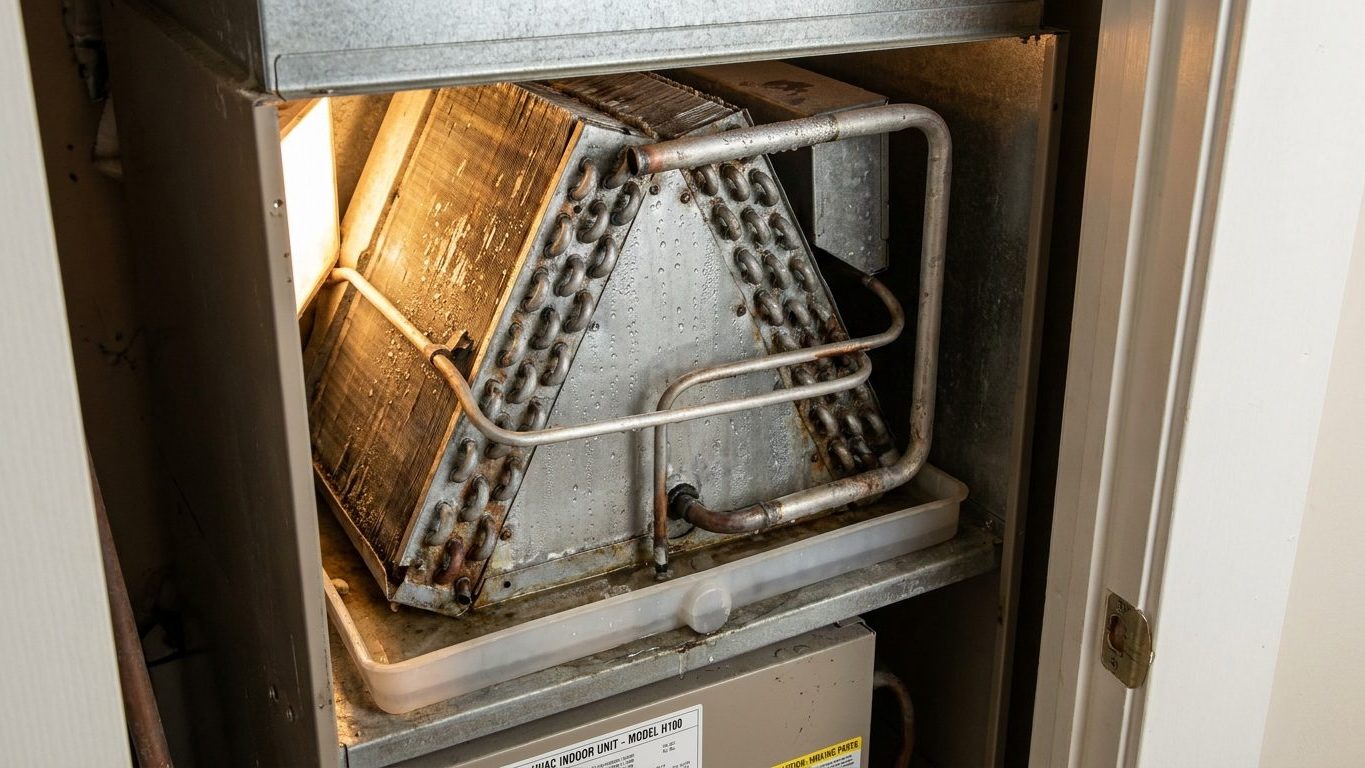

Evaporator coil cleaning means clearing dust, grime, and biological buildup off the finned coil inside the indoor unit so air can pass through it freely and heat transfer can happen the way it’s supposed to. A clean coil cools better, runs shorter cycles, and doesn’t smell musty. A dirty one restricts airflow, ices up, and makes the whole system work harder for less cold air. Some of that cleaning is homeowner work. Some of it isn’t.
Where the cold is actually made
Most homeowners have never laid eyes on their evaporator coil, and that’s not surprising. It sits tucked inside the indoor cabinet, usually mounted above or beside the furnace, positioned directly in the path of the air the blower pushes through the house. This is the one spot in the entire system where refrigerant absorbs heat from your indoor air. Not The Outdoor Unit, not the ductwork, not the thermostat. Right here, inside a metal box in your basement, attic, or utility closet, is where the actual cooling happens.
That location comes with a built-in problem. The coil runs wet for the entire cooling season, condensing moisture out of the air the same way a cold glass of water sweats on a humid day. It does this in the dark, inside a sealed cabinet, with every cubic foot of air your house breathes passing directly over its surface. A coil that’s damp, dim, and constantly bathed in household air is exactly the kind of environment where dust sticks and organic growth takes hold.
Everything that follows in this article traces back to that one fact. The coil’s job requires it to be cold and wet while air moves across it nonstop for months. Mark a date each season to have that coil looked at before summer’s peak load hits it hardest. An owner who understands why the coil gets dirty, iced, or smelly has already solved half the diagnostic puzzle before a technician ever shows up.
The coil itself is a fairly simple piece of hardware: a series of copper or aluminum tubes bent into a serpentine path, wrapped with thin aluminum fins that multiply the surface area available for heat exchange. Air from the blower moves across those fins, refrigerant flows through the tubes, and heat jumps from one to the other. It works beautifully when the fins are clean and open. It works progressively worse as they clog.
Dirt, ice, and the smell
A coil doesn’t fail in one dramatic way. It degrades through a handful of specific mechanisms, and each one leaves a different clue for the person living in the house. The table below breaks down what’s physically happening on the coil against what actually shows up as a symptom.
| What’s happening on the coil | What the occupant notices |
|---|---|
| Dust matted into the fins | Weak airflow from the vents, longer cooling cycles, rooms that never quite reach the setpoint |
| Biological growth on a wet surface | A musty smell when the system kicks on, sometimes strongest right at startup |
| Ice forming on the coil | Reduced airflow, warm air blowing instead of cold, sometimes water pooling near the indoor unit as the ice melts |
| Fins bent flat | Airflow that seems permanently restricted no matter how clean the filter is |
Every one of those problems traces back, in the overwhelming majority of cases, to something upstream of the coil itself: the air filter. This is where the brief facts from ENERGY STAR matter most. The agency states plainly that “airflow problems can reduce your system’s efficiency by up to 15 percent.” A clogged or bypassed filter is one of the most common causes of that airflow loss, and it’s also the direct reason dust reaches the coil in the first place.
ENERGY STAR’s guidance on maintenance frequency is equally direct: “Inspect, clean, or change air filters once a month in your central air Conditioner, furnace, and/or heat pump.” That’s not a seasonal chore. It’s a monthly one, across all three types of equipment, and skipping it is functionally the same as leaving the coil exposed.
A dirty coil is a filter story before it’s a coil story. Check the filter monthly, on all three pieces of equipment named above, and a large share of coil problems never develop at all. Ice, in particular, is a symptom worth taking seriously rather than clearing away and forgetting. It points to either too little airflow moving across the coil (a filter, a blocked return, a failing blower) or too little refrigerant circulating through it. Melting the ice off doesn’t fix either cause; it just buys a few hours before it forms again.
What can be cleaned, and by whom
Being honest about the limits here matters more than sounding capable. The face of the coil, the side facing the return air or the access panel, is often reachable by an owner willing to open a panel and look. The inside of an A-coil, the folded section tucked between the two slanted faces, generally is not reachable without pulling the coil out of the cabinet, and that’s not a task for someone without HVAC training. The drain pan sitting underneath the coil is part of the same system and deserves the same attention, since it’s what carries away all the condensate the coil produces.
What an owner can reasonably do
- Cut power to the system at the disconnect or breaker before opening anything
- Open the access panel, if the unit has one, and locate the coil
- Look at the fins for visible dust, debris, or discoloration without touching anything yet
- Vacuum gently along the fins with a soft brush attachment, never across them
- Check the drain line and pan for standing water, sludge, or a slow drip that suggests a clog
The direction of that vacuuming matters more than it sounds like it should. Fins are thin aluminum, bent to a specific spacing, and running a brush across them instead of along them flattens the fins and closes the very gaps air needs to pass through. That turns a cleaning attempt into a new airflow problem.
Two more limits are worth stating plainly. Nothing wet belongs anywhere near the blower motor or the control board sitting nearby, since moisture in those areas causes problems that have nothing to do with the coil. And no chemical coil cleaner should be used outside exactly what its label allows, both in terms of surfaces and in terms of dilution. Coil-cleaning sprays exist for a reason, but they’re formulated for specific materials and specific rinse procedures, and improvising with them tends to go badly.
Past that point, the job changes character. A coil that needs to be pulled out of the cabinet for a full cleaning is a service call, not a weekend project. And anything that touches the refrigerant circuit, meaning the sealed tubing carrying refrigerant through the coil, is never homeowner work under any circumstances. That line isn’t about difficulty. It’s about a closed system that isn’t meant to be opened casually, by anyone.
When the coil itself is the fault
There’s one coil problem that changes the entire conversation, and it’s worth closing on because it gets confused with the dirt-and-ice problems above far too often: a coil that’s actually leaking refrigerant. The tubing running through an evaporator coil can develop a pinhole leak from corrosion, vibration, or simple age, and once that happens, refrigerant slowly escapes the sealed system it was charged into.
The signs build gradually rather than announcing themselves. Cooling performance weakens over weeks or months rather than failing all at once. Ice starts forming on the coil, the same symptom that shows up with an airflow problem, which is exactly why a leak often gets misdiagnosed at first. Run times stretch longer as the system struggles to satisfy the thermostat with less refrigerant doing the work.
Here’s the point worth repeating plainly, because it’s easy to miss: a system that’s “low” on refrigerant is a system with a leak somewhere in it. Refrigerant isn’t a consumable that depletes with normal use the way a filter or a battery does. It’s a sealed charge, put in once and meant to stay there. If the level has dropped, refrigerant went somewhere, and that somewhere is a leak point that needs to be found and repaired.
Topping off the charge without finding that leak amounts to paying for the same refrigerant twice, since it will slowly leak out again through the same unrepaired point. A leaking evaporator coil is a sealed-system repair, not a simple part swap in the way a filter or a capacitor gets swapped, and it’s not a project that belongs in the same category as vacuuming fins or checking a drain pan. For more on how refrigerant charge, leaks, and the repair-or-replace decision fit together, the refrigerant and system-lifespan guides elsewhere on this site walk through that territory in more depth.
Common questions
Can I clean the evaporator coil myself?
The visible face of the coil, reached through an access panel, can often be gently vacuumed along the fins by a homeowner. The interior of a folded A-coil and anything requiring the coil to be pulled from the cabinet is a service job.
Why does my air conditioner smell musty when it turns on?
That smell typically comes from biological growth on the wet surface of the evaporator coil or in the drain pan beneath it, both of which stay damp throughout the cooling season.
Why does my evaporator coil keep icing up?
Ice on the coil points to either restricted airflow, most often from a dirty filter or blocked return, or a low refrigerant charge caused by a leak somewhere in the sealed system.
Does a dirty filter really affect the coil?
Yes. The filter is what stands between household dust and the coil’s fins, and a clogged or bypassed filter is one of the leading reasons coils get dirty and airflow suffers in the first place.