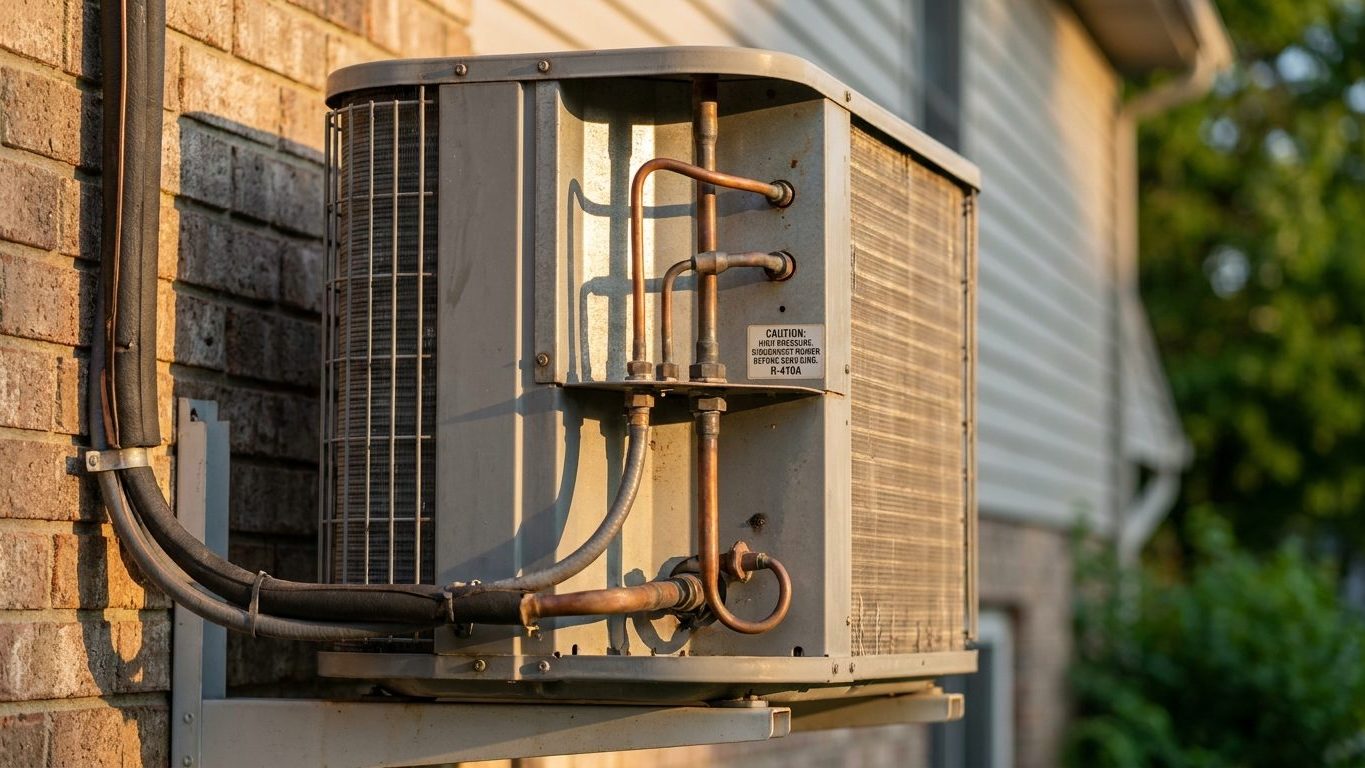

A compressor failure means the sealed circuit can no longer move heat out of the house: the part that pressurizes refrigerant has stopped doing its job, either because it burned out electrically, seized mechanically, or was starved of what it needed to run. The result is warm air from the vents, sometimes a hum or a tripped breaker, and a decision about repair or replacement that hinges on the compressor’s condition and the age of everything around it.
The part the whole system is built around

Every air Conditioner and heat pump moves heat by changing the pressure of a refrigerant, and the compressor is what makes that pressure change happen. Refrigerant arrives at the compressor as a low-pressure gas. The compressor squeezes it into a high-pressure gas, which raises its temperature enough that it can dump heat outside through the condenser coil. Without that pressure difference, refrigerant just sits at one pressure and one temperature, and no heat moves anywhere. The coils, the fan, the ductwork, the thermostat, all of it exists to support that one pressure event.
That’s why homeowners hear the compressor called the “heart” of the system, a phrase that gets overused but happens to be accurate here. It’s also why it sits inside a sealed circuit, brazed shut and charged with refrigerant at the factory or by a licensed technician, not something a homeowner opens to peek at.
Why its condition decides everything else
Two facts make the compressor the center of gravity for any repair-or-replace conversation. First, it’s the single most expensive component in the system, by a wide margin over a capacitor, a fan motor, or a coil. Second, because it lives inside the sealed circuit, diagnosing it properly means measurements a technician takes with the system apart, not a guess based on how old the unit looks. When a compressor is confirmed failed, the conversation almost never stays small. It becomes a conversation about the whole outdoor unit, and often about the indoor coil paired with it.
That’s also why a reader hearing “it’s your compressor” from a technician should want to see what led to that conclusion, not just accept the sentence. More on that further down.
What a failing compressor sounds and feels like
A compressor rarely fails silently. It usually announces itself first through sound, then through performance that slips over days or weeks. But nearly every symptom below has an alternate, cheaper explanation, and that ambiguity is exactly why a homeowner shouldn’t self-diagnose a compressor failure from the driveway.
| Symptom | What it usually points to | Cheaper explanation to rule out first |
|---|---|---|
| A hum from the Outdoor Unit but the fan and compressor never start | The compressor is trying to start but can’t | A failed start capacitor or contactor, a much smaller repair than the compressor itself |
| A hard clunk or bang at start-up | Mechanical strain inside the compressor | A worn mount or a loose panel vibrating against the cabinet |
| The Outdoor Unit trips its breaker every time it tries to start | The compressor is drawing far more current than it should on startup | A weak start capacitor forcing the compressor to labor, or a dirty condenser coil raising the head pressure it has to push against |
| Cooling that has faded gradually over a season | Reduced compressor efficiency, sometimes from wear | A slow refrigerant leak, a dirty filter, or a coil caked with dirt reducing heat transfer |
| The system runs constantly and never reaches the thermostat setpoint | The compressor may be underperforming | Undersized ductwork, a failing thermostat sensor, or a system that was always undersized for the house |
Why the honesty matters
Every row in that table has a cheap explanation and an expensive one, and the only way to tell them apart is measurement, not sound alone. A homeowner who hears a hum and assumes “compressor” might be paying to replace a capacitor’s job with a whole outdoor unit. The reverse is just as real: dismissing a tripped breaker as “just the weather” can let a struggling compressor keep straining until it fails outright. Either way, the fix is the same first step: get a technician to test before anyone talks about replacing anything.
What actually kills compressors
Compressors are built to run for a long time under the conditions they’re designed for. What actually ends them almost never happens in a single event, it’s the tail end of a condition that went unaddressed. Five causes account for most premature failures.
- Running low on refrigerant for a long time. Refrigerant does double duty in most systems: it carries heat, and it helps cool the compressor’s motor. A system that’s low, because it has a leak somewhere, forces the compressor to run hotter and work harder for the same output, and heat is what compressor windings and bearings tolerate worst over time.
- Running with a choked filter or a smothered outdoor coil. A clogged filter restricts airflow across the indoor coil, and a coil buried in grass clippings or cottonwood restricts airflow outside. Either one makes the compressor push against higher pressure than it was built for, cycle after cycle.
- Short cycling caused by an oversized system or a thermostat problem. An oversized unit cools the air fast, satisfies the thermostat, and shuts off, only to start again minutes later. Compressors experience the most electrical and mechanical stress at startup, so a unit that starts far more often than it should is aging faster than one that runs longer, steadier cycles.
- Electrical supply problems. A compressor motor expects power within a certain range and quality. Voltage that sags, spikes, or fluctuates because of house wiring issues or utility conditions puts strain on the motor every time it tries to start.
- A failed start component left unrepaired. A weak or failed capacitor or contactor makes the compressor labor to start, sometimes for weeks before anyone notices. Each hard start of that kind pulls more current and generates more heat than a clean one, and repeated hard starts are a well-known path to a burned-out motor.
The through-line across all five is the same: a compressor almost never fails alone or out of nowhere. It fails at the end of a chain, usually one that included a warning sign, a skipped filter change, or a small electrical problem that got postponed.
When a compressor fails
Once a compressor is confirmed failed, not just suspected, the physical job is substantial. The sealed circuit has to be opened. Remaining refrigerant is recovered rather than released. The old compressor comes out, a new one goes in, and then the whole circuit is evacuated to pull moisture and air out of the lines before it’s recharged. None of that is a same-hour fix, and none of it is something to attempt without licensed equipment.
The harder question isn’t the labor, it’s what surrounds it. A compressor replacement raises two questions worth asking out loud before deciding anything: how old is the rest of the outdoor unit and the indoor coil paired with it, and is the refrigerant this system uses still readily available and affordable to buy. That second question matters more than most homeowners expect, because refrigerant rules and availability shift over time, and a technician can tell a reader exactly where a given system’s refrigerant stands today. Neither question has a universal answer, it depends entirely on the specific system in the specific house.
What a homeowner shouldn’t do is accept a verbal verdict with nothing behind it. A compressor is expensive enough, and central to the decision enough, that “it’s your compressor” said without any measurement shown is a reasonable moment to ask for a second opinion. A technician confirming compressor failure should be able to point to what they measured and why it points to the compressor rather than a capacitor, a contactor, or a coil. For a fuller breakdown of how that repair-or-replace decision gets made once the compressor question is settled, see the guide on repair versus replacement.
Common questions
Can a compressor fail without any warning signs?
It’s uncommon. Most compressor failures follow weeks or months of some signal, a fading cooling capacity, a new sound at startup, or a breaker that trips occasionally before it starts tripping every time. A true no-warning failure does happen, usually tied to a sudden electrical event, but it’s the exception rather than the rule.
Does a failing compressor always mean the whole outdoor unit needs replacing?
Not automatically. A compressor can sometimes be replaced on its own. Whether that makes sense depends on the age and condition of the rest of the unit, and on refrigerant availability for that specific system, which is a question worth putting directly to the technician rather than assuming either way.
Is it safe to keep running the system if the compressor sounds strained?
No. A compressor that’s struggling to start or running under electrical strain is being damaged further with every cycle. Shutting the system off and calling for a technician before running it again is the safer path, both for the compressor and for anyone opening the outdoor unit later, since a run capacitor in that circuit can hold a charge even with the power off.
Can a homeowner check refrigerant level themselves to rule it out?
No. Refrigerant charge is measured with gauges connected to a sealed system, work that requires licensing, and a system that’s low always means a leak somewhere rather than a refrigerant top-off being a routine maintenance item. Refrigerant isn’t a consumable that gets used up over time; if the level is low, something let it out.