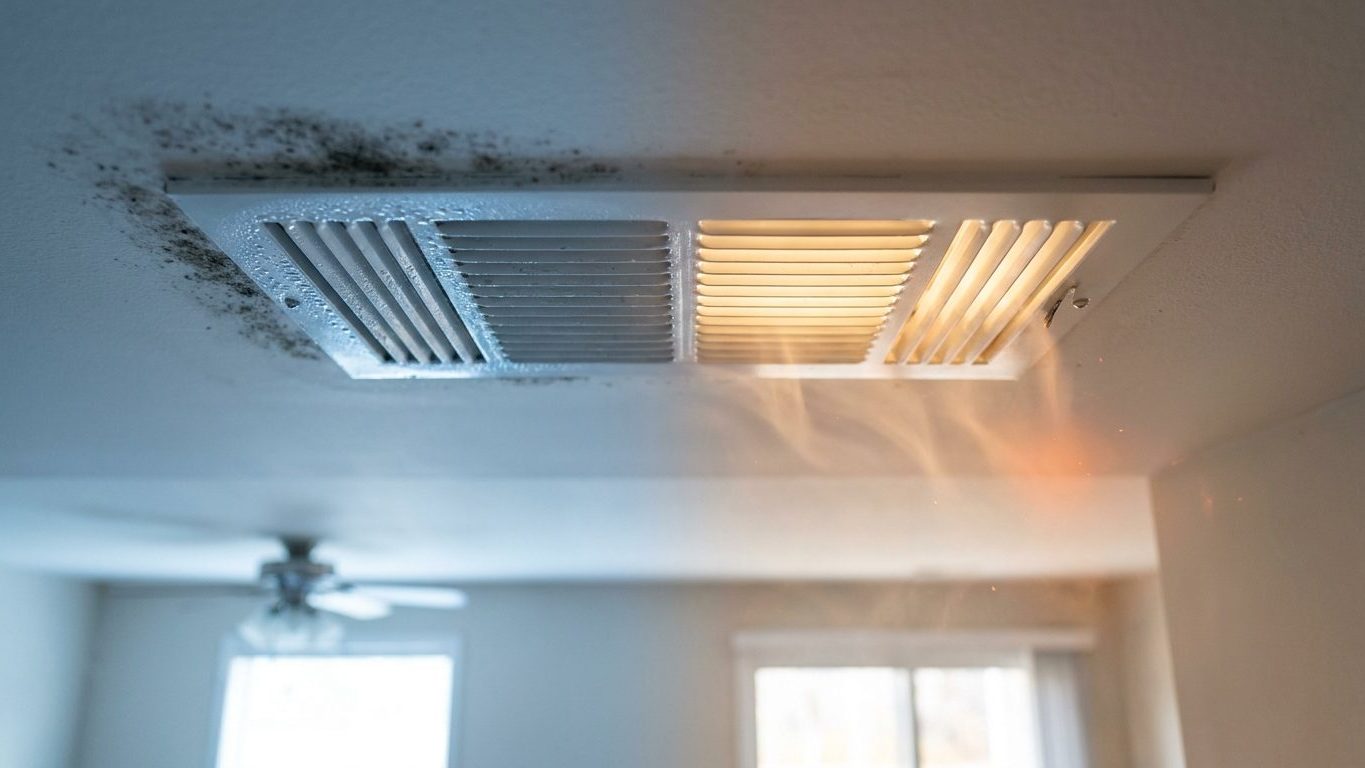

A musty smell from your vents almost always points to moisture and mold somewhere in the system, most often on the evaporator coil or inside the ductwork. A burning smell points to heat where heat shouldn’t be, usually dust cooking off a component or a motor working harder than it should. One is a comfort and air-quality problem. The other can be a safety problem. They call for different responses, and mixing them up wastes time.
Musty and Burning Smells from the Vents
Start with the musty one, because it’s the more common call. Your air conditioner and heat pump both pull warm, humid indoor air across a cold evaporator coil. That coil sheds moisture the way a glass of ice water sweats on a summer porch. Most of that condensation drips into a pan and out a drain line, but some of it clings to the coil fins, the drain pan, and the first few feet of ductwork. Add dust, and you’ve got a damp, dark, nutrient-rich surface, exactly what mold and mildew need to establish themselves. Once that colony is growing, every time the blower kicks on, it pushes air across it and carries the smell straight into your living room.
A burning smell works through a completely different mechanism. Furnaces, blower motors, and electrical connections generate heat as a normal part of operating, and that heat is supposed to stay contained within a narrow range. When something drifts outside that range, you smell it before you see it. The most harmless version is dust that settled on a heating element over the summer and singes off during the first heating cycles of fall, a smell that usually fades within an hour of the system’s first run. The less harmless version is a motor bearing running dry, a belt slipping, or an electrical connection loosening and arcing, all of which produce heat in a spot that was never designed to get hot, and none of which resolve on their own.
Where you smell it, and when, narrows things fast. A musty smell that shows up specifically when the Air Conditioner or heat pump is cooling, and fades once the compressor cycles off, points to the coil and drain pan. A burning smell that appears right when the blower motor starts, especially with a faint electrical or “hot plastic” edge to it, points to the motor or its wiring rather than to dust. A burning smell tied to the furnace’s ignition sequence, especially early in the heating season, is more likely the harmless dust-burn-off version, but only if it disappears after the first cycle or two.
How to tell, in your own house
Work through these in order. The sequence matters, because the first steps cost nothing and rule out the most common causes before you spend money or call anyone.
- Note exactly when the smell happens. Cooling mode only, heating mode only, or both? This single detail already tells you whether to suspect the coil/drain side of the system or the furnace/motor side, and it costs you nothing but attention.
- Check and change the air filter. U.S. ENERGY STAR advises to “inspect, clean, or change air filters once a month in your central air conditioner, furnace, and/or heat pump.” That guidance covers all three pieces of equipment together, which surprises a lot of heat pump owners who assume filter maintenance is a furnace-only chore. A clogged filter restricts airflow, which lets moisture linger on the coil longer and forces the blower motor to work harder, feeding both smells at once.
- Look at the supply and return vent covers. Pull off a return grille and look for visible dust caking, dark staining, or a musty odor concentrated right at that opening rather than deeper in the ducts.
- Check the condensate drain line and pan for standing water. A clogged drain backs water up into the pan, where it sits and grows mold instead of draining away. This is visual only; don’t disassemble anything to get a look.
Anyone who stops after these four steps has still done the work that matters most: they’ve isolated which mode triggers the smell, ruled out the simplest airflow cause, and checked the two spots most likely to be visibly wet or dirty.
Homeowner work ends at the filter, the vent covers, and what you can see without opening a panel. Do not open the furnace cabinet, touch the blower motor, or probe any electrical connections. Furnaces and blower assemblies carry line-voltage wiring, and a burning smell near a motor or control board can mean a live short. Refrigerant work on the coil itself requires EPA-certified handling by law. If the checks above don’t explain the smell, or if the burning smell has any electrical sharpness to it and doesn’t fade after a cycle or two, that’s the point to call an HVAC technician rather than go further yourself.
What it costs you to ignore it
A musty smell that goes unaddressed doesn’t stay contained to the coil. Mold spores don’t just sit still; they get pulled into the airstream and distributed through every room the ductwork reaches, which is a real concern for anyone in the house with allergies or asthma. Meanwhile the moisture that’s feeding the mold is also sitting on metal components it shouldn’t be sitting on, and prolonged dampness on a coil or drain pan invites corrosion over time, the kind of slow damage that shortens the life of parts you’d rather not replace early.
A burning smell carries a sharper kind of risk if it’s left alone. A motor bearing running dry doesn’t fix itself by continuing to run; the friction and heat compound until the motor either seizes or fails outright, usually at the least convenient moment, like the first cold snap of the season. A loosening electrical connection that’s arcing follows the same trajectory, except the failure mode there isn’t just a dead blower, it’s a heat source inside an enclosed cabinet with a system running for hours at a stretch. That’s not a comfort issue anymore. That’s a mechanism worth treating with urgency rather than curiosity.
Restricted airflow from a neglected filter, tied to either smell, makes the whole system work harder to move the same amount of air, which means longer run times and more wear across the board, from the blower motor to the compressor. None of that shows up as a single dramatic failure. It shows up as a system that seems to need more repairs than it used to, arriving sooner than the equipment’s age would otherwise suggest.