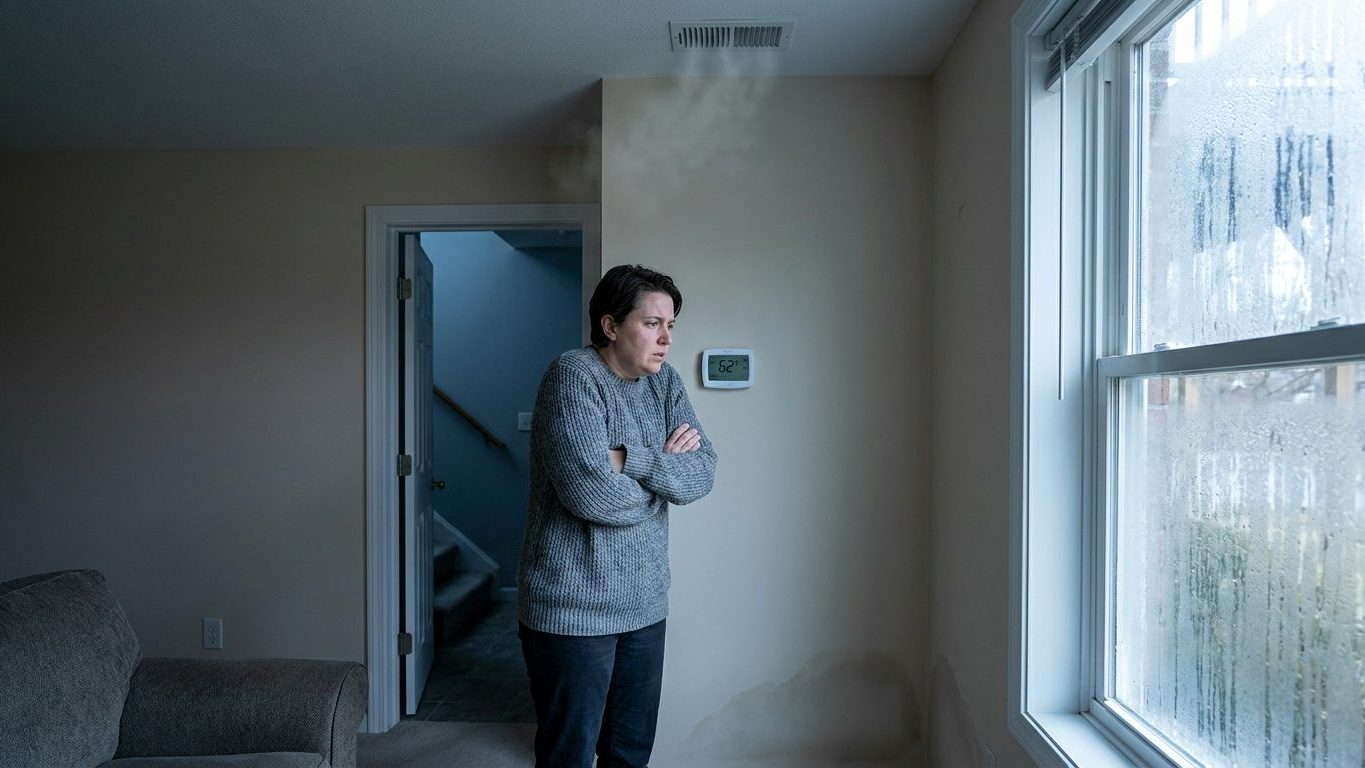

An air conditioner that keeps the house cold but still feels damp is almost always cycling off before it has run long enough to dry the air. The usual culprits are a system sized larger than the house needs, a fan setting left on ON instead of AUTO, a clogged filter starving airflow, or a home where the real moisture load (a damp basement, a slab, an unvented bathroom) was never an air conditioning problem to begin with. Each has a different fix, and none of them start with the thermostat.
Cooling and drying are two different jobs

An air conditioner does two things at once, and homeowners tend to notice only one of them. It lowers the air temperature, which the thermostat reports back almost instantly. It also pulls moisture out of the air by condensing it on the indoor coil, and that second job takes time the thermometer never measures.
Here’s the mechanism. As warm, humid air passes over the cold evaporator coil, water vapor condenses on the metal fins, the same way a cold glass of iced tea sweats on a humid porch. That condensed water drips into a pan and drains outside. But the coil only condenses meaningful amounts of water after it has been running long enough to get thoroughly cold and stay that way. In the first few minutes of a cooling cycle, most of the coil’s capacity goes toward dropping air temperature. Moisture removal ramps up later in the cycle and keeps working as long as the system keeps running.
That is why a short cooling cycle can hit the setpoint on the thermostat while leaving the air feeling clammy. The house reads 72 degrees. It also feels like a wet sponge. Both are true, because the thermostat only tracks temperature. It has no idea how many grains of moisture are still floating around the living room.
Relative humidity is also a moving target as temperature drops, which adds to the confusion. Cooler air holds less moisture at saturation, so cooling alone nudges relative humidity up even before you factor in a lack of drying time. A short-cycling system is fighting that math with one hand tied behind its back: it drops the temperature just enough to raise relative humidity, then shuts off before the coil has pulled out enough actual water vapor to compensate.
None of this means the equipment is broken. A system that cools the house to the setpoint quickly is doing exactly what a thermostat asks it to do. The mismatch is between what a thermostat measures and what a person actually feels, and that gap is where most “AC not removing humidity” complaints live.
The commonest cause is a system that is too big
Say it plainly: an oversized system is the single most common reason a house stays humid despite the air conditioner running. It is not a minor inefficiency. It is a mismatch that shows up as a comfort complaint every summer, in houses where the equipment is otherwise working exactly as designed.
An oversized unit has more cooling capacity than the house needs on a given afternoon. It reaches the thermostat’s setpoint fast, because it has more muscle than the load requires, and then it shuts off. Because moisture removal depends on run time rather than raw capacity, that short cycle cools the air without drying it. The system then sits idle until the temperature drifts back up, restarts, and repeats the same short, under-drying cycle all day. Every part of that behavior is normal for the equipment. The oversizing is the fault, not the machine’s performance within it.
Why oversizing happens so often
It usually comes from sizing “up to be safe,” a decision made with good intentions during a replacement or a new install. A bigger unit sounds like more comfort and more margin for a hot week. In practice it does the opposite for humidity control, because the extra capacity shortens every cycle rather than lengthening it. Nothing the homeowner adjusts at the thermostat corrects this. Lowering the setpoint further just makes the same short, powerful cycles run more often. It does not make them last longer.
The fix is not a number you can look up. A central system should be sized using a load calculation, a room-by-room accounting of a house’s actual heat gain based on square footage, insulation, window area and orientation, ceiling height, and local climate. That calculation is done by an HVAC contractor or a home energy auditor, not estimated from a rule of thumb or a chart built for room units. If you suspect oversizing, that load calculation, compared against the nameplate capacity of the installed equipment, is the diagnostic step, not a guess based on tonnage per square foot.
Two other things get blamed for humidity problems that are actually electrical or mechanical, and both deserve a straight warning rather than a home remedy. A fan’s run capacitor holds an electrical charge even after the system is switched off and unplugged, so there is no safe way to poke around inside that panel yourself, and no stick test that makes it safe. Separately, refrigerant is not something an air conditioner uses up the way a car burns gas. A system that is “low on refrigerant” has a leak somewhere in the line set or coil. Topping it off without finding the leak just buys a few weeks before the same symptoms return. Both situations call for a licensed technician, not a DIY fix.
What can be changed without new equipment
Before assuming the system needs replacing or resizing, a few adjustments cost nothing and address the most common causes of poor drying directly.
- Set the fan to AUTO, not ON. This is the single most useful change on this page. When the fan is set to run continuously, it keeps blowing across the coil between cooling cycles, picking up the water sitting in the drain pan and on the coil fins and pushing that moisture straight back into the house. AUTO lets the fan shut off with the compressor, so the water drains away instead of getting re-evaporated into the living room.
- Raise the setpoint by a degree or two. A slightly higher setpoint means the system takes longer to satisfy the thermostat on each cycle, and a longer cycle spends more time in the part of the run where real moisture removal happens.
- Seal obvious moisture sources. A running clothes dryer vented indoors, an unvented bathroom fan, a crawlspace with exposed dirt, or a leaky window seal can add more water vapor to a house than a properly sized air conditioner can remove in a normal cycle.
- Check the filter and returns. A clogged filter or blocked return grille restricts airflow across the coil, which hurts both cooling and drying. U.S. ENERGY STAR notes that “airflow problems can reduce your system’s efficiency by up to 15 percent,” and a starved coil is a common source of exactly that kind of loss.
These four changes address the causes that show up most often in real houses: a fan setting nobody thought to check, a thermostat set to chase a number rather than a feeling, an unrelated moisture source doing more damage than the AC can undo, and a system quietly working against restricted airflow. None of them require a service call, and all four are worth ruling out before assuming the equipment itself is the problem.
When the answer is not the air conditioner
A basement that feels damp in a mild, mostly-closed-windows month is usually not an air conditioning complaint at all, even if that is where the frustration gets aimed. The central system barely runs on cooler days, because the thermostat upstairs is satisfied quickly, which means the coil gets almost no chance to pull moisture out of the air down where it is most noticeable. the Air Conditioner Is Not failing at that job. It is simply not running enough to attempt it.
This is where a standalone dehumidifier does something a central air conditioner cannot: it runs independently of the thermostat’s temperature target, cycling based on humidity level alone, and it can do that in a basement or a single room without cooling the space at all. An air conditioner is built to manage temperature across the whole house and removes moisture as a byproduct of that job. A dehumidifier is built to manage moisture directly, in one space, regardless of temperature. They solve different problems, and a persistently damp basement below an otherwise comfortable house is usually a sign that a dehumidifier belongs there, not that the central system needs replacing.
How a house is cooled in the first place also shapes which fix applies. Nationally, 89% of U.S. homes use some form of air-conditioning equipment, with 67% relying on a central system and 26% on individual equipment such as a ductless mini-split, a window unit, or a portable unit, according to the U.S. Energy Information Administration’s 2020 Residential Energy Consumption Survey. That national mix hides real regional differences: Connecticut reports air conditioning in 90% of homes but central systems in only 34% of them, while Hawaii sits at 57% with air conditioning and 48% on individual equipment. In a house running a single window or portable unit, humidity troubleshooting starts with that unit’s own settings and drainage, not with duct-based airflow or a whole-house load calculation, because the diagnostic steps for individual equipment differ from the central-system causes covered above.
Common questions
Why does my house feel humid even when the AC is running constantly?
If the system runs nonstop and the house still feels damp, the issue is usually restricted airflow (a dirty filter or blocked return) or a refrigerant leak reducing the coil’s ability to condense moisture, rather than short cycling. A technician can check airflow and refrigerant charge; a low charge points to a leak that needs locating, not just a refill.
Does a bigger air conditioner cool a house faster and better?
Faster, yes. Better for humidity, no. A larger system reaches the thermostat’s setpoint quickly and then shuts off before its coil has run long enough to remove much moisture, which is the mechanism behind most “cold but damp” complaints in oversized installations.
Should the AC fan run all the time for better circulation?
No. Running the fan continuously (fan set to ON) blows moisture that has condensed on the coil and collected in the drain pan back into the house between cooling cycles. Setting the fan to AUTO lets that water drain away instead.
Can a dehumidifier replace a central air conditioner?
No, they do different jobs. A dehumidifier manages moisture in one space independent of temperature; a central air conditioner manages whole-house temperature and removes moisture only as a byproduct of running. A damp basement in a mild month, when the central system barely cycles, is a common case where a standalone dehumidifier is the right tool.