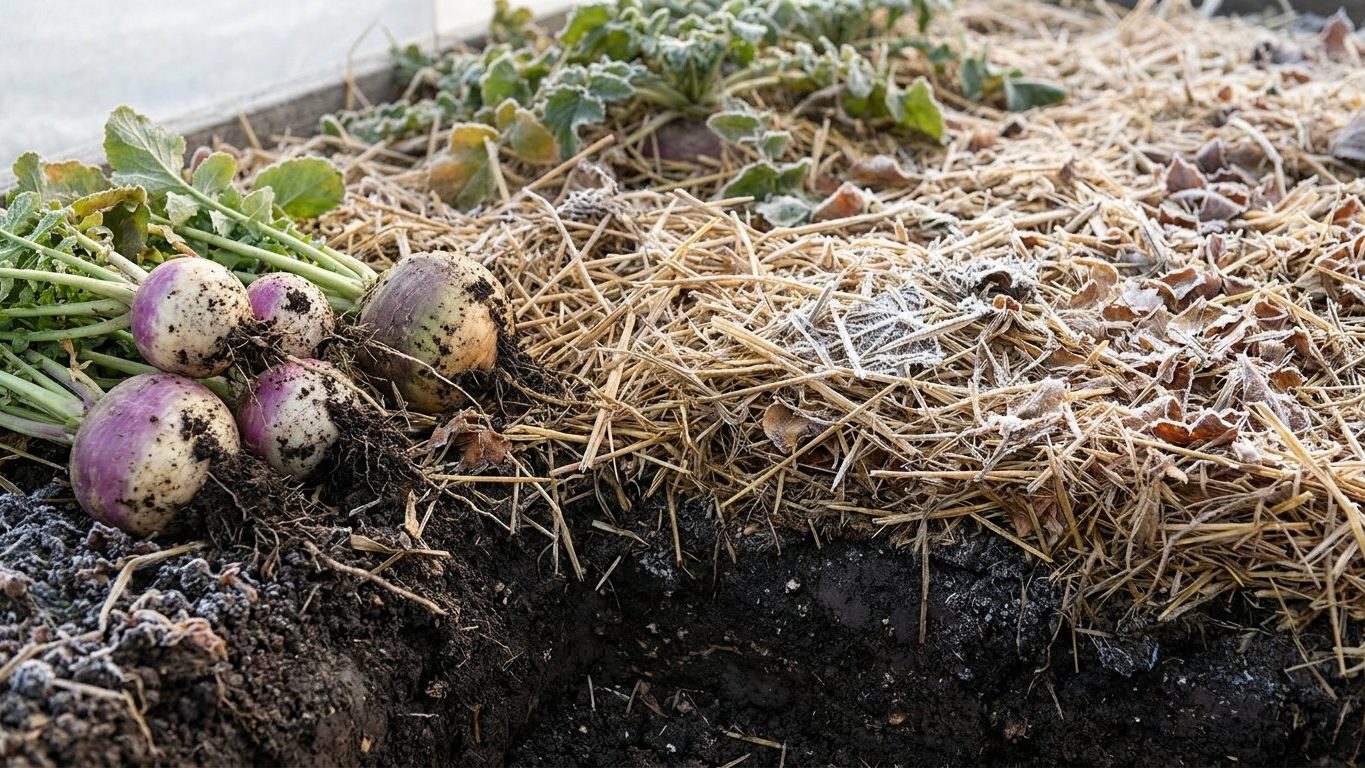

Turnips and Rutabaga can stay in the ground through winter in a lot of gardens, held under a thick mulch blanket that blocks frost from reaching the root. It works reliably in some climates and fails quietly in others, and the difference usually comes down to drainage and how cold the ground actually gets, not just the air temperature above it.
What is actually going on
The thing to understand here is soil insulation: mulch keeps the ground above the temperature that damages the root, and it only works to a point. A root sitting a few inches under loose straw or shredded leaves is buffered from the wild swings of air temperature above it. The soil itself holds heat far longer than air does, and a mulch layer slows the rate at which that stored heat escapes. That is the entire mechanism. It is not magic preservation, it is a delay tactic, and delay tactics have limits.
Turnips tolerate a light frost better than rutabaga does, and both improve in flavor after cold exposure because the plant converts some stored starch to sugar as a stress response. That is the appealing part of leaving them in place. The risk sits underground, invisible until you dig. If the soil around the root freezes solid and stays frozen, ice crystals rupture the cell walls inside the root, and what comes out of the ground in spring is often mush, not a vegetable. Mulch is there to prevent that freeze from reaching deep enough, not to prevent the ground from ever getting cold.
Moisture complicates the picture further. Ground that stays wet through winter conducts cold differently than ground that drains, and a root sitting in saturated soil is exposed to rot organisms that thrive in the same insulated, damp conditions the mulch creates. So the practice trades one risk (freeze damage) for a second one (rot), and which risk dominates depends entirely on the soil under your boots, not on anything printed on a seed packet.
Turnip and rutabaga are brassicas, in the same family as cabbage, kale, and mustard, and that matters for anything left in the ground over winter. Overwintering roots can carry forward the same soil-borne diseases and pest larvae that trouble the rest of that family, and a bed used this way should not be the same bed planted to cabbage or kale the following spring. A gardener who rotates turnips into last year’s cabbage row, or plants cabbage into this year’s turnip row, has not actually rotated anything. See our guide to rotating brassica crops for how to plan around that overlap.
Before pulling anything stored this way, inspect it closely. A soft patch, a weeping spot, or a moldy crown ends the question regardless of how the rest of the root looks. Firmness and a clean cut are the only things worth trusting, and even those should be checked again at the point of use, not assumed from a glance in the garden.
In the garden
The steps themselves are simple. What decides whether they work is a set of local facts this page cannot answer for you: how deep your frost line goes, how wet your soil sits in November, and whether your winters bring a reliable snow cover or leave bare ground exposed to wind. Here is the sequence, with what tends to go wrong at each stage.
- Leave the roots unharvested past first light frosts. This is when the sugar conversion happens and flavor improves. Go wrong here by harvesting too early out of habit, and you lose the flavor benefit for no safety gain.
- Stop watering and let the soil surface dry slightly before mulching. Mulching over wet ground traps that moisture against the root all winter. Go wrong here by mulching right after a heavy rain, and you have built a damp chamber instead of an insulated one.
- Apply a thick, loose mulch layer once several hard frosts have occurred, not before. Straw, shredded leaves, or clean hay all work by trapping air, not by being wet or matted down. Go wrong here by mulching too early, while soil is still warm, and you extend the growing season into a period when pest larvae and disease organisms are still active, undoing the point of storage.
- Mark the rows clearly before the ground freezes or snow covers everything. Go wrong here and you spend a January afternoon digging blind through frozen ground looking for a row you can no longer find.
- Check periodically through a thaw, if your climate gets one. A midwinter warm spell can soften mulch and invite rodents looking for food. Go wrong here by assuming the mulch is permanent and never look again until spring, and you may find the rows raided.
The single fact that overrides all of this is soil drainage. Heavy clay that holds water through winter is a poor candidate for in-ground storage no matter how well the other steps are followed, because the roots sit in saturated cold soil rather than dry insulated soil. Raised beds or well-drained loam are far more forgiving of small mistakes in timing or mulch depth.
What it depends on where you are
Some of this practice is national and some of it is entirely local, and this page cannot tell you which side of that line your garden falls on. Season length decides how long the roots have to size up before the ground turns cold. Summer heat decides whether the crop even reaches maturity in good condition, since both Turnips and Rutabaga struggle and turn woody or bitter in prolonged high heat. Summer rainfall, and winter rainfall behind it, decide the drainage question that governs rot risk more than anything else on this page.
A garden with a short, mild winter and reliable snow cover behaves nothing like a garden with a long winter and bare frozen ground exposed to wind. A garden with sandy, fast-draining soil behaves nothing like one with heavy clay that holds water into December. None of these variables show up on a seed packet, and none of them are fixed facts a general gardening page can hand you.
The most reliable way to close that gap is to check your state’s cooperative extension service, which publishes guidance specific to local soils and frost patterns, and to look at the varieties trialled for your region rather than assuming a national recommendation applies where you garden. The USDA Plant Hardiness Zone Map is a useful starting reference for how cold your winters typically get, though it describes average minimum temperatures rather than the depth of ground freeze, which is the number that actually matters for in-ground storage.
Within this site’s guides to Turnips and Rutabaga, the state-level pages go further into which regions support this practice reliably and which ones are better served by pulling the crop and storing it indoors instead. Treat this page as the mechanism and the general method, and treat those pages, along with your extension office, as the source for whether your own garden is a good candidate at all.
The mistake that costs the most
The single mistake that costs gardeners the most on this point is treating in-ground storage as a universal technique rather than a soil-dependent one, and applying it in heavy or poorly drained soil regardless. Mulch does not fix drainage. It cannot fix drainage. Piling straw over a bed that sits wet through winter simply insulates that dampness against the root all season, and the result is not a preserved vegetable in spring but a bed of rot discovered too late to replace it.
This mistake is costly precisely because it is invisible until the moment of harvest. Unlike a frost-killed root, which at least shows visible damage early, a root rotting slowly in saturated soil gives no sign from above ground. The foliage may look fine, the mulch may look undisturbed, and the failure only becomes clear when a fork goes into the row and pulls up something soft and discolored instead of a firm root.
The fix is not a better mulch or a thicker layer. It is an honest look at the bed before committing the crop to it. Soil that puddles after rain, or stays visibly damp days after a storm has passed, is not a candidate for this method regardless of season length or mulch depth. In that situation, the safer path is to harvest before hard frost and move to conventional cold storage indoors, where drainage is not a variable at all.
Where the soil does drain well, the remaining risk is manageable with attentive timing rather than guesswork, and the reward, roots held fresh with no cellar space needed, is real. But that reward depends on getting the soil question right first. Everything else on this page, the mulch depth, the timing, the marking of rows, only matters once that one condition has been checked and confirmed.