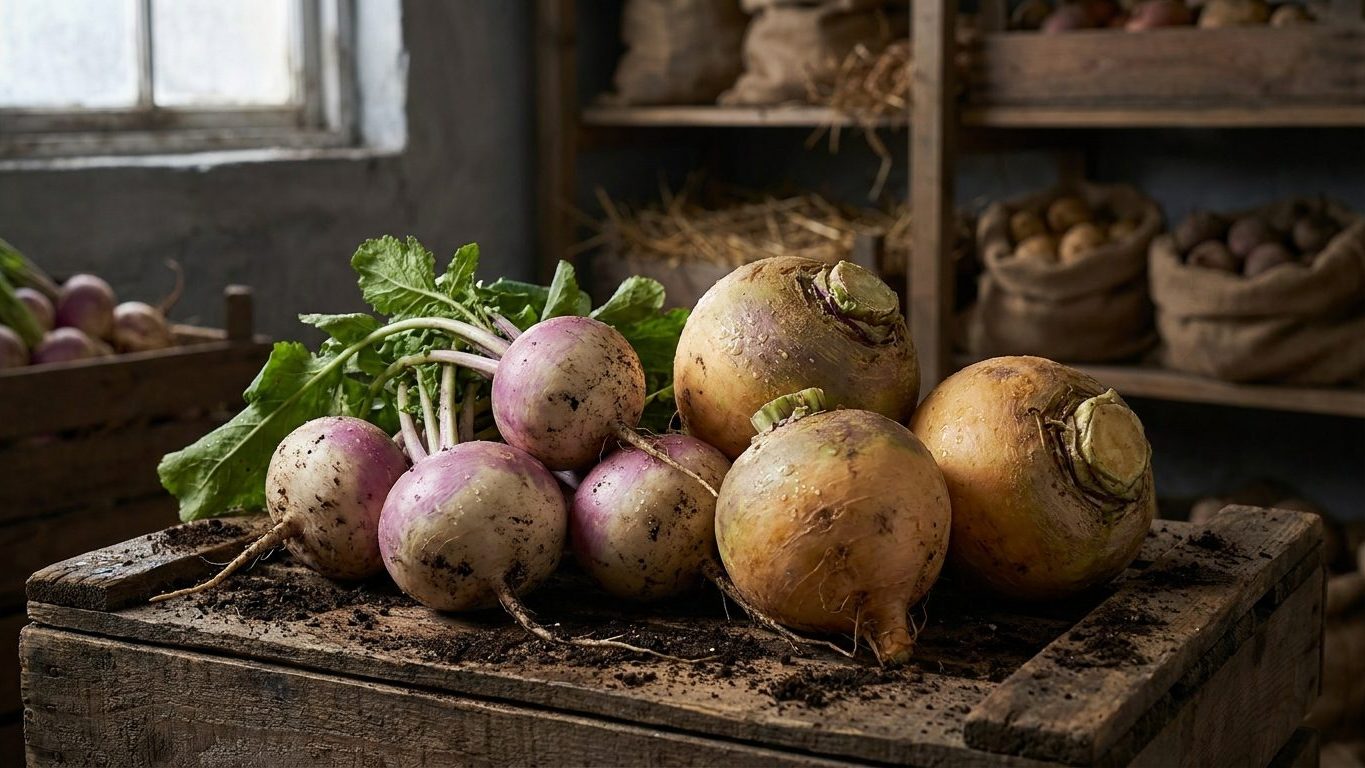

Turnips and Rutabaga both store through winter when the roots go in clean, cold and slightly damp, but the two behave differently. Rutabaga’s waxy skin holds moisture for months in a root cellar or a similarly cool spot. Turnips are softer and thinner-skinned, and they fade faster even under ideal conditions. Neither survives careless handling at harvest.
What is actually going on

A turnip or a rutabaga sitting in storage is still alive. It’s a dormant root, breathing slowly, drawing on its own sugar and water reserves until you eat it or it gives out. Cold slows that respiration to a crawl. Warmth speeds it up, which is why a root left on a kitchen counter turns soft and pithy in days while the same root in a cold, damp spot holds firm for much longer. Storage life isn’t really about the calendar. It’s about how fast you can slow the root’s own metabolism without freezing it outright.
Moisture loss is the other half of the equation. A root’s skin is a barrier, and once it’s broken, water escapes through the wound and the root shrivels from the inside out. This is why the foliage matters so much at harvest. Leaves and stems left attached keep pulling moisture out of the root long after it’s out of the ground, the same way a cut flower keeps drinking from a vase. A turnip with its top still on can lose a noticeable amount of firmness in a week, even sitting in a cool room.
Wound entry is the flip side of moisture loss. Every nick, tear, or bruise in the skin is also a door for decay organisms already living in garden soil. Storage rot rarely starts in the middle of a sound root. It starts at a cut, a spot where a fork went in too close, or where the root was yanked instead of dug and the skin tore at the shoulder. Once a soft rot or a mold gets a foothold at that entry point, it spreads through the flesh, and given time and the right humidity, it can spread to neighboring roots in the same box or bag.
None of this is unique to these two crops. Turnips and Rutabaga are brassicas, in the same family as cabbage, kale, broccoli and mustard, and they carry the same disease pressures in the soil and in storage, including clubroot and various rots that persist in beds where brassicas have grown repeatedly. If you’re planning next year’s plot, that’s worth reading alongside a crop rotation guide for the brassica family, because storing this year’s roots well doesn’t undo a rotation mistake that sets up next year’s crop for trouble before it’s even planted.
Because this is food going into your winter kitchen, one rule matters more than any storage technique: a soft patch, a weeping spot, or a moldy crown ends the question for that root, no matter how good the rest of it looks. Storage conditions can slow decay, but nothing reverses it once it’s started.
In the garden
Most storage failures trace back to something that happened, or didn’t happen, in the first hour after the root came out of the ground. The table below walks through the sequence and what tends to go wrong at each stage.
| Step | What to do | What goes wrong if you skip it |
|---|---|---|
| Timing the harvest | Lift roots after some cool fall weather has firmed them up, but before repeated hard freezes hit the ground. Local frost timing varies enough that your state extension service is a better guide than a generic date. | Roots left through several freeze-thaw cycles crack internally, and those cracks turn into rot pockets once in storage. |
| Lifting | Dig roots out with a fork loosening the soil first, rather than gripping the top and pulling. Rutabaga’s taproot especially resists a straight pull. | Pulling tears the skin at the soil line or snaps off the taproot, opening a wound right where soil-borne organisms are most concentrated. |
| Trimming the tops | Cut the foliage back close to the crown, leaving a short stub rather than cutting flush into the crown flesh. | Leaves left on keep pulling moisture from the root for days. Cutting too deep into the crown opens another entry point for decay. |
| Brief curing | Let roots dry off in a cool, shaded, airy spot for a short period, just long enough for surface soil to dry and minor nicks to seal over. This is a much shorter process than the curing winter squash needs. | Skipping this locks field moisture and surface scrapes straight into storage, and rot can start within days. |
| Sorting | Separate out any root with a cut, insect damage, split skin, or soft crown, and eat those first instead of storing them. | One damaged root packed in with sound ones can spread decay through the whole box or bag before you notice. |
| Choosing a storage method | Layer roots in damp sand, sawdust, or peat in boxes kept in a cold, humid spot such as a root cellar or unheated space, or bag smaller amounts loosely in perforated plastic in the refrigerator crisper. | Dry storage causes shriveling and pithy texture. Sealed, unventilated bags trap condensation and encourage rot instead of preventing water loss. |
| Checking through winter | Go through the stored roots roughly once a month, handling gently, and pull anything showing softness, weeping, or mold at the crown. | A single decaying root left in contact with others spreads the problem before the next check. |
Rutabaga generally tolerates this whole process a little better than turnips, thanks to that thicker skin, which is part of why it has a reputation as the longer-keeping of the two. Turnips reward faster handling and earlier eating rather than being pushed to match rutabaga’s staying power.
What it depends on where you are
How much of this comes down to technique and how much comes down to climate is worth being honest about. Season length decides when roots size up enough to be worth storing at all, and that varies by region more than any single planting guide can capture. Summer heat and rainfall shape how the crop grows in the first place, since both turnips and rutabaga tend to turn woody or bitter under stress from heat or drought, which affects what you’re putting into storage before winter even starts.
Where you live also decides how you’ll store the roots, more than any technique described here. A gardener with access to a naturally cold, humid basement or an unheated outbuilding that holds steady near-freezing temperatures through winter has an easy path to long storage. A gardener in a milder or more humid climate, where outdoor structures never get reliably cold, is usually better off relying on the refrigerator for smaller batches, since ambient storage in a warm garage or shed won’t slow the roots down enough to matter.
Humidity swings by region too. Naturally damp climates may need less added moisture in a storage box, while dry regions, especially inland and at higher elevations, often need damp sand or another moisture source to keep roots from shriveling regardless of temperature.
This page can’t tell you your first frost date, your local humidity, or which storage setup matches your basement, garage, or root cellar, and it won’t guess at a zone or a season length that varies by county. For that, the state-specific pages in this guide and your local extension service are the better resource, since they’re built around actual regional data rather than a national average that fits no one exactly.
The mistake that costs the most
The single mistake that ruins the most stored turnips and rutabaga isn’t a wrong temperature or the wrong container. It’s mixing a damaged root in with sound ones. A gardener who bruises a root while digging, notices a small nick, and tells themselves it’s fine because it’s just one small spot, has just planted a rot problem in the middle of the whole storage box.
Decay organisms don’t need much of an opening, and once a soft rot takes hold at a bruise or a cut, the moisture it releases as it breaks down the tissue creates the exact damp, decaying environment that spreads to whatever is touching it. In a box layered with sand, that can mean losing several neighboring roots before the next monthly check catches the problem. In a bag in the crisper drawer, it can mean the whole bag is gone within a couple of weeks.
The fix costs nothing but a few extra seconds at harvest: sort as you go. Any root that’s nicked, cracked, has a soft spot, or shows the faintest weeping at a cut should go into the kitchen pile for near-term eating, not into the long-term storage box. It doesn’t matter how good the rest of the root looks. A damaged root is a liability the moment it’s damaged, not a risk that shows up later. Storing only the sound, unbroken roots, and checking on them regularly for that first soft patch or moldy crown, does more to protect a winter’s worth of turnips and rutabaga than any temperature or humidity adjustment ever will.