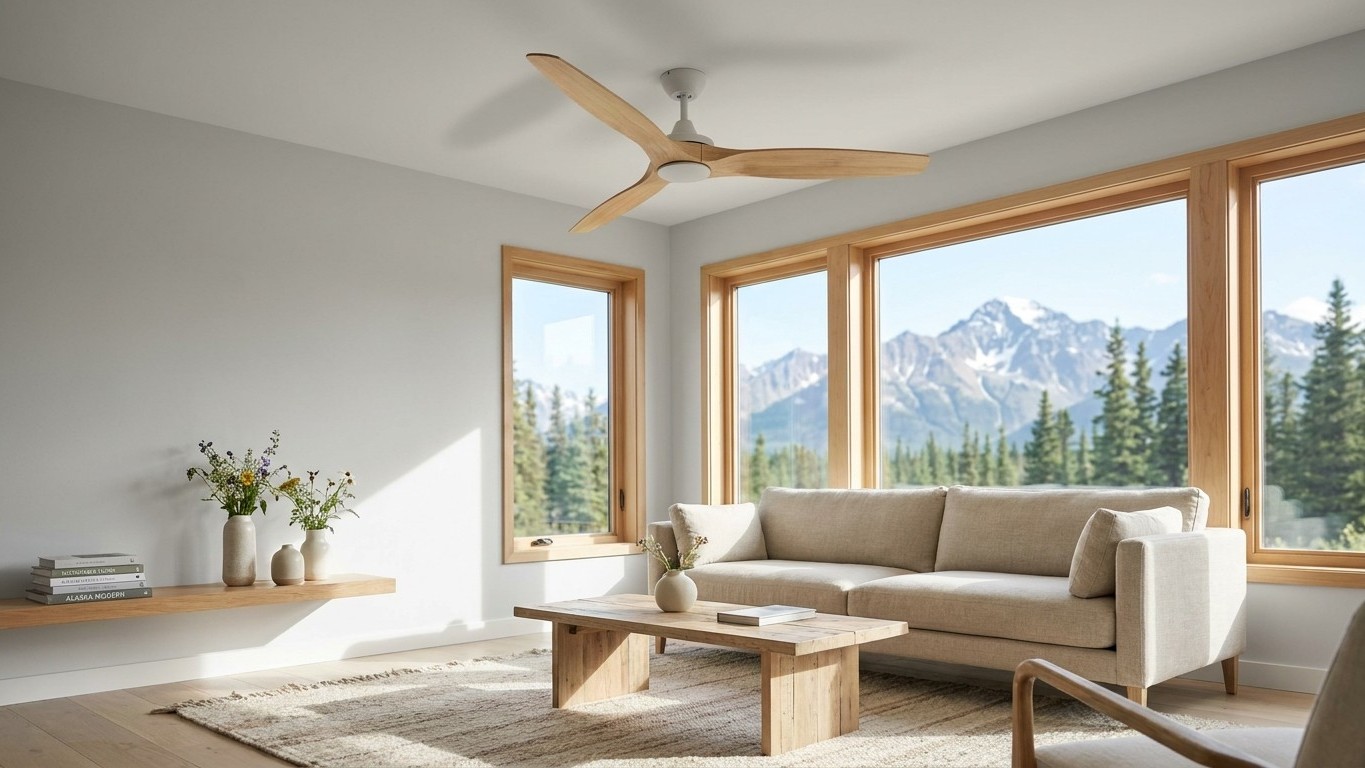

In Alabama, air conditioning is close to universal: 94% of homes report using some form of cooling equipment, and the large majority of that is a central system rather than a window unit or portable. Ceiling fans back up the mechanical cooling in most houses too.
What homes in Alabama actually cool with
According to the U.S. Energy Information Administration’s Residential Energy Consumption Survey (RECS 2020), 94% of Alabama homes use air-conditioning equipment of some kind. Of those, 81% run a central air-conditioning unit, and 20% use an individual air-conditioning unit, meaning a ductless mini-split, a window or wall unit, or a portable. Separately, 84% of homes use ceiling fans alongside whatever mechanical cooling they have.
Those two cooling figures, 81% central and 20% individual, don’t add up to a clean split of the 94% who cool their homes at all. That’s the tell: a meaningful share of Alabama households run both. A house with central air for the main living space might still have a window unit propped in a converted porch, a garage apartment, or an add-on room the ductwork never reached. That overlap is common in a housing stock where additions and retrofits have piled up over decades.
Compare that to a state like Connecticut, where 90% of homes have air conditioning but only 34% run a central system. There, the gap between “has AC” and “has central AC” carries almost the entire story: most Connecticut homes cool room by room. Alabama is a different pattern. Central air is the default here, and individual units are a supplement rather than the primary strategy for most households.
That split isn’t a matter of taste. It follows construction history. Homes built with ductwork already in place, which describes a large share of Alabama’s postwar and newer housing, get central systems installed almost automatically when the AC goes in or gets replaced. Older homes without ducts, or additions that were never tied into the main system, fall back on individual units instead. A published share like this describes what got installed, shaped by what a given house could support and afford at the time. It isn’t a verdict on which setup performs better in Alabama’s climate.
How much cooling the year actually asks for
NOAA’s Climate Normals for 1991-2020, measured at the Huntsville reference station, put the mean number of days reaching 90°F or higher at 58.5 days a year. That’s a count of days at one station, not a statewide average temperature and not a measure that applies uniformly from the Gulf Coast to the Tennessee Valley. It’s a heat-load number: how often the air outside pushes past the point where a house needs real mechanical help to stay livable.
Nearly two months of 90-degree-plus days is a serious load. It’s the kind of number that, in a lot of states, would predict a housing stock leaning hard on central systems built to run for hours at a stretch rather than individual units cycling on and off in single rooms. In Alabama’s case, that prediction holds up: 81% central usage lines up with a summer that demands sustained, whole-house cooling rather than spot-treatment.
That alignment isn’t guaranteed everywhere, which is what makes it worth checking rather than assuming. A state can post a high day count above 90°F and still show a housing stock dominated by window units and mini-splits, if a lot of the housing was built before ductwork was standard, or if a large share of the market is older multifamily and manufactured housing where retrofitting ducts is impractical. The reverse also happens: a mild climate with relatively few 90-degree days can still show a mostly-central housing stock, simply because the homes were built new enough to include ducts as a matter of course, regardless of how much cooling those ducts actually get asked to do.
Alabama sits in the tidier case. A heavy heat load and a heavily central equipment mix point the same direction, which suggests the housing stock here was largely built, or renovated, with sustained summer cooling already assumed. That matters for maintenance too, since a system running through 58-plus days of extreme heat every year works harder, and fails more visibly, than one that only kicks in occasionally.
Wet heat or dry heat, and what it changes
Summer here is wet by the numbers. NOAA NCEI’s Monthly Climate Normals for 1991-2020, from station USW00003856, show about 12.1 inches of rain across June, July, and August, out of 54.3 inches for the year. June averages 4.06 inches, July 4.49, and August, the driest of the three summer months, still brings 3.55 inches. That’s precipitation, not humidity. It tells you how much rain falls, not how sticky the air feels or where the dew point sits on a given afternoon.
What that rainfall figure does connect to is how an air conditioner spends its time. A cooling system does two jobs at once: it drops the air temperature, and it pulls moisture out of the air as it passes over the cold coil. Removing that moisture takes run time. In a genuinely dry summer, nearly all of a unit’s work is temperature, and a short cooling cycle gets the room comfortable fast. In a wet one, a large share of the unit’s job is drying the air, and that only happens if the system runs long enough for moisture to actually condense out.
This is where an oversized unit causes different kinds of trouble depending on the climate. In a dry state, an oversized system is mostly just wasteful: it cools too fast, cycles off, and the house feels fine even if the equipment never runs long. In a wet-summer state like Alabama, oversizing is worse than wasteful. The unit blasts the room down to temperature in a few minutes, shuts off before it’s pulled meaningful moisture out of the air, and the result is a room that reads cold on the thermostat but feels damp and clammy to anyone standing in it.
Given Alabama’s summer rainfall pattern, a few priorities follow directly:
- Favor equipment sized to run in longer, steadier cycles rather than short blasts, since longer run time is what actually removes humidity.
- Use the fan or “auto” setting rather than “on” for central systems, so the blower stops when the compressor does and doesn’t re-evaporate moisture sitting on the coil back into the house.
- Resist the instinct to size up “for safety.” In a wet-summer climate, a unit that’s too big for the room is the more common mistake, not one that’s too small.
A rain gauge on a specific property still beats any regional normal. These are 30-year averages from one reference station, not a forecast for a particular yard, and local drainage, tree cover, and a home’s own microclimate can shift how much that moisture load actually matters day to day.
Sizing a room unit, from the published chart
For individual units, the kind installed in 20% of Alabama homes, ENERGY STAR publishes a straightforward starting chart matching room area to cooling capacity:
| Area to be cooled (square feet) | Capacity needed (BTU per hour) |
|---|---|
| 100 up to 150 | 5,000 |
| 150 up to 250 | 6,000 |
| 250 up to 300 | 7,000 |
| 300 up to 350 | 8,000 |
| 350 up to 400 | 9,000 |
| 400 up to 450 | 10,000 |
| 450 up to 550 | 12,000 |
| 550 up to 700 | 14,000 |
| 700 up to 1,000 | 18,000 |
| 1,000 up to 1,200 | 21,000 |
| 1,200 up to 1,400 | 23,000 |
This table is a starting point for a single room, not a formula that scales in a straight line. Notice that going from 100-150 square feet to 1,200-1,400 square feet doesn’t multiply the BTU figure by the same ratio as the area, so there’s no honest way to turn this into a flat rate “per square foot” and apply it elsewhere. Use the bracket that matches the room, not a calculation built from it.
It also doesn’t extend past its last line, and it doesn’t apply to a central system. A whole-house unit, the kind running in 81% of Alabama homes, gets sized through a proper load calculation that accounts for insulation, window area, orientation, and duct layout, not through a table built for one room and one window unit. In a state where central air is the default, this chart is most useful for exactly the situations described in Section 1: the sunroom, the garage apartment, the add-on that never got tied into the main ducts.
The same oversizing warning from the rainfall section applies here directly. A unit pulled from the next bracket up “to be safe” cools the room fast, shuts off, and never runs long enough to dry the air Alabama’s wet summers are already loading it with. Matching the bracket to the actual room size is the better bet, not rounding up.
What actually needs looking after here
With central air running in 81% of Alabama homes, duct condition matters here more than in a state dominated by window units. ENERGY STAR states plainly: “In a typical house, however, about 20 to 30 percent of the air that moves through the duct system is lost due to leaks, holes, and poorly connected ducts.” A house cooling unevenly, cold in one room and warm in the next, often has nothing wrong with the equipment itself. The air is escaping into an attic or crawlspace before it ever reaches the vent.
For the equipment that individual units add to the mix, and for the central systems that dominate here, the same basic filter habit applies. ENERGY STAR: “Inspect, clean, or change air filters once a month in your central air conditioner, furnace, and/or heat pump.” That’s once a month, not once a season, and it covers all three types of equipment, so a house running a heat pump alongside central air still needs the filter checked on the same monthly schedule.
Skipping that habit has a measurable cost. ENERGY STAR notes: “Airflow problems can reduce your system’s efficiency by up to 15 percent.” A system can be mechanically sound and still underperform badly if airflow is restricted, and a clogged filter is the single cheapest fix on that list.
A seasonal pass through an Alabama home’s cooling setup, given how much of it runs through summers this hot and this wet, looks like this:
- Check and replace filters monthly through the cooling season, for both central systems and any mini-split or window unit running alongside them.
- Have ductwork inspected for the leaks and disconnections ENERGY STAR describes, since a house losing a fifth to a third of its conditioned air through the ducts is losing both cooling and money before that air reaches a single room.
- Confirm the thermostat fan setting is on “auto” rather than “on,” so moisture pulled from the air during the cooling cycle doesn’t blow back into the house once the compressor shuts off.
- Before the heaviest stretch of 90-degree days arrives, have the system checked for the kind of routine service covered in this site’s central air conditioning and heat pump maintenance guides.