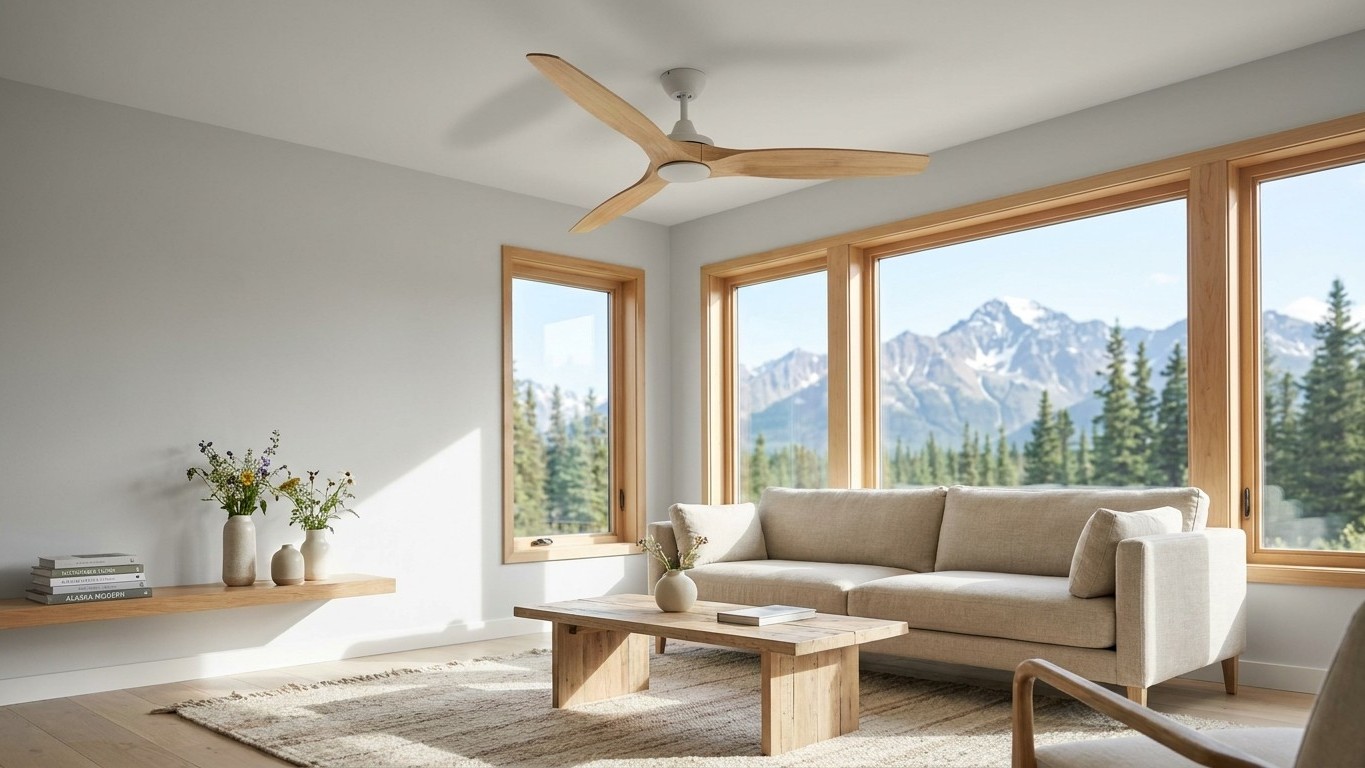

Just 57.2% of Prairie region households run any air conditioning at all, according to Statistics Canada, against 68.3% across Canada as a whole. Where cooling exists here, it’s usually a window unit, a portable, or a ductless mini-split added to a house that wasn’t built with cooling in mind, not a central system tied into the furnace ductwork.
What homes in Alberta actually cool with
Statistics Canada’s Canadian Social Survey puts air conditioning in 57.2% of Prairie region households, against 68.3% across Canada as a whole (The Daily, July 8, 2025). That figure covers Alberta, Saskatchewan and Manitoba as one block, since the agency doesn’t publish a separate rate for Alberta on its own. Treat it as a regional signal rather than a provincial one.
The survey asks only whether a household has air conditioning, not what kind. That’s a real gap next to the US data used on other pages in this cocoon, where the EIA’s Residential Energy Consumption Survey splits a home’s cooling into a central system versus a window unit, mini-split, or portable. Statistics Canada’s figure folds all of that together, so a Prairie household reporting air conditioning could be running a whole-house system or a single window unit propped into one bedroom. The 57.2% doesn’t say which, and the two surveys don’t subtract or combine into some cross-border total.
A lower ownership rate isn’t a verdict on comfort, either. It reflects what was affordable, or what was standard practice, when a home went up: decades when a hot week was rare enough that builders skipped ductwork sized for cooling, and homeowners since have added a window or portable unit only for the handful of days each summer that call for it.
How much cooling the year actually asks for
At Calgary Int’l A, the reference station Environment and Climate Change Canada uses for this region’s climate normals, the year averages 1.37 days a year reaching 32°C or higher, the exact match for the 90°F threshold used on the US pages in this cocoon. That’s a count of extreme-heat days at one airport station over the 1981-2010 normals period, not a summer-long average temperature and not a province-wide figure. A more familiar benchmark at the same station is 5.1 days a year above 30°C, which better describes an ordinary hot spell here than the rarer outlier heat wave.
Either way, the heat load is thin. A year with barely more than one day above 32°C and just five above 30°C asks far less of a cooling system than a summer with weeks in that range. That roughly matches the equipment picture from the section above: a region where more than four in ten households skip air conditioning altogether isn’t ignoring a cooling need so much as matching what a short, cool summer calls for.
That agreement isn’t automatic everywhere in this cocoon. A state or province can rack up weeks above 90°F and still lean on central air because its houses were built with ductwork already in place for a furnace, while a milder territory ends up on window units simply because central systems arrived late to its housing stock. Alberta’s numbers point the same direction on both counts: a modest heat load and a modest ownership rate, with no strong case for anything more than the room-sized cooling most Prairie households already choose.
Wet heat or dry heat, and what it changes
Calgary’s climate normals put summer precipitation at 216 mm (8.5 inches) across June, July and August, out of 419 mm (16.5 inches) for the whole year, per Environment and Climate Change Canada’s 1981-2010 station data. August is the driest of the three summer months, at 57 mm (2.24 inches), against 94 mm (3.7 inches) in June and 66 mm (2.58 inches) in July. That’s a rainfall count, not a humidity reading. It says nothing about how sticky the air feels on a given afternoon, only how much rain typically falls.
By that measure, a Calgary summer leans dry, especially once June’s showers give way to a drier July and August. That matters for how a cooling unit actually spends its time.
An air conditioner does two things every time it runs: it drops the temperature, and it pulls moisture out of the air. Removing that moisture takes run time. The compressor has to keep cycling well past the point where the thermostat alone would shut it off, so the coil stays cold long enough to condense water out of the passing air. In a wet summer, that drying is a big share of the machine’s job. In a dry one like Alberta’s, most of the work is temperature alone, since there’s less moisture in the air to begin with.
That changes what matters when running a unit here:
- Run time is less critical than in a humid climate, since a system doesn’t need to loiter at low speed just to dry the air
- Fan setting can lean toward higher speeds without the clamminess a humid territory would risk
- Sizing still matters as much as anywhere: an oversized unit cools a room fast, shuts off, and never runs long enough to pull out the little moisture that’s present, leaving the room cold and slightly damp even in a dry-summer place
Sizing a room unit, from the published chart
ENERGY STAR publishes a starting-point chart for room air conditioners, matching square footage to cooling capacity in BTU per hour. It applies to a single room served by a window, portable, or similar unit, reproduced exactly as published below.
| Area to be cooled (sq ft) | Capacity needed (BTU/hr) |
|---|---|
| 100 up to 150 | 5,000 |
| 150 up to 250 | 6,000 |
| 250 up to 300 | 7,000 |
| 300 up to 350 | 8,000 |
| 350 up to 400 | 9,000 |
| 400 up to 450 | 10,000 |
| 450 up to 550 | 12,000 |
| 550 up to 700 | 14,000 |
| 700 up to 1,000 | 18,000 |
| 1,000 up to 1,200 | 21,000 |
| 1,200 up to 1,400 | 23,000 |
This is a starting point, not a load calculation, and it doesn’t extend past its last line or scale down into a figure per square foot. A room bigger than 1,400 square feet needs a proper load calculation, not an extrapolation off this chart. It also has nothing to say about a central system, which is sized by a contractor’s load calculation that accounts for insulation, windows, and orientation, not a table built for a single room.
That distinction matters most here because this is a territory where a meaningful share of cooling runs on exactly the kind of unit this chart covers. Getting the size right avoids the most common mistake with room units: buying bigger than the room calls for. An oversized unit isn’t a safety margin, it’s a fault. It cools the air fast, shuts off, and never runs long enough to pull moisture out, leaving the room cold and clammy instead of comfortable.
What actually needs looking after here
Whatever a Prairie household is cooling with, ENERGY STAR’s maintenance advice starts in the same place: “Inspect, clean, or change air filters once a month in your central air conditioner, furnace, and/or heat pump.” That’s once a month, not once a season, and it covers all three pieces of equipment together, a detail worth noting since a household with a heat pump often assumes filter advice is only about the furnace.
A dirty filter doesn’t always announce itself as a failure. ENERGY STAR notes that “Airflow problems can reduce your system’s efficiency by up to 15 percent.” A system can be in working order and still underperform simply because air isn’t moving through it the way it should, which is exactly why the monthly filter check is the cheapest maintenance act available.
The duct caveat is narrower, and it only applies where a house is actually tied into ductwork. ENERGY STAR’s figure is stark: “In a typical house, however, about 20 to 30 percent of the air that moves through the duct system is lost due to leaks, holes, and poorly connected ducts.” Since Statistics Canada’s survey doesn’t say how many Prairie households run central systems versus window or portable units, that caveat matters here only for the share of homes that actually have ducts to leak from. A window unit or portable has none, so this line doesn’t apply to it at all.
A seasonal pass through the setup, built around what this territory actually runs, comes down to a short list:
- Check or change the filter monthly, on any central air conditioner, furnace, or heat pump
- Before the first hot stretch, confirm airflow at the vents or window unit is unobstructed, since a blocked path can cost up to 15 percent in efficiency
- If the house runs central air, have ducts checked for the leaks ENERGY STAR flags as typical, since 20 to 30 percent losses there quietly undo whatever the equipment itself is doing right
- For a window, portable, or mini-split unit, confirm the sizing against the ENERGY STAR chart before assuming a bigger unit will cool better
For equipment-specific detail, from central air maintenance to mini-split care, the individual guides elsewhere in this cocoon go deeper than a single territorial page can.