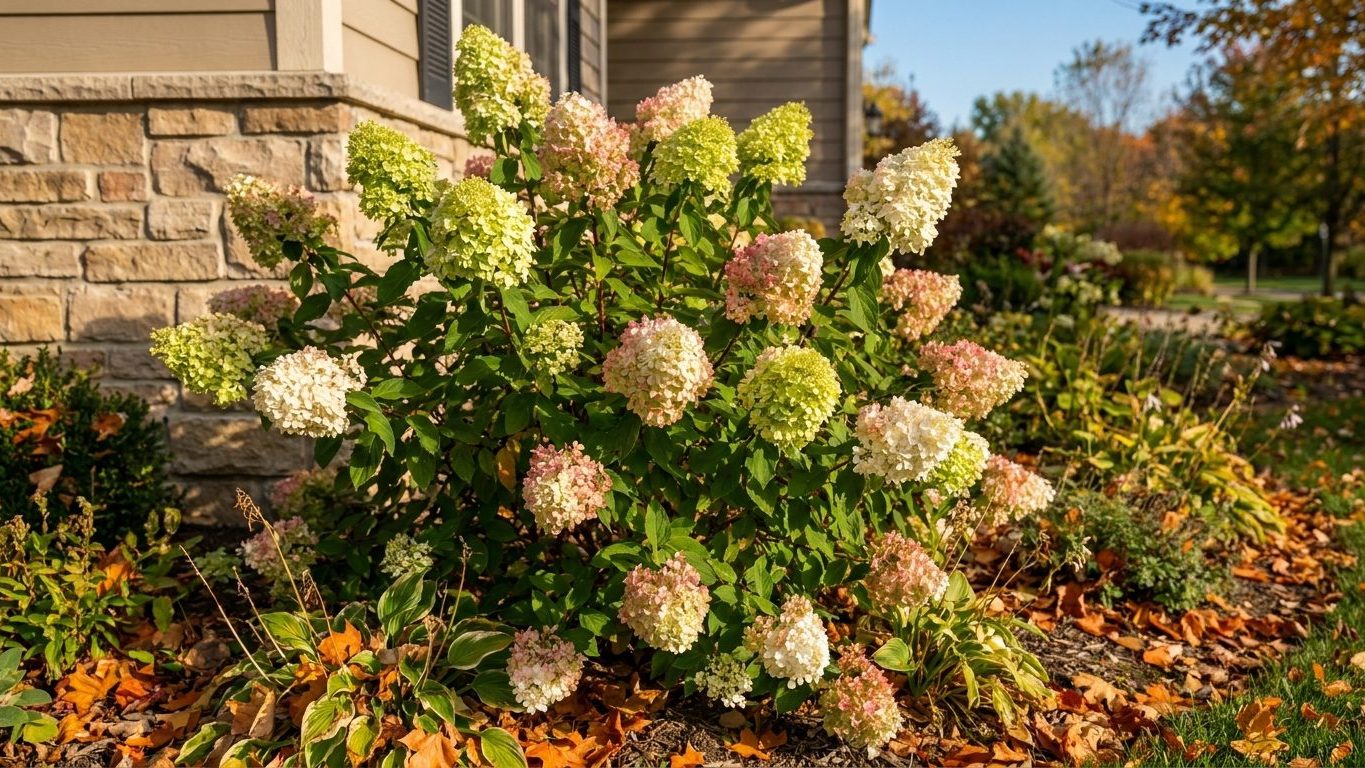

Limelight is a panicle hydrangea (Hydrangea paniculata), hardy in USDA zones 3a through 8b, and it flowers on the current season’s growth rather than on wood that survived winter. That single fact answers most of what a shopper wants to know: it blooms reliably almost everywhere in the country, its color stays white to cream aging pink and tan no matter the soil, and it tolerates full sun better than any other hydrangea type.
What Limelight actually is
Limelight belongs to the panicle group, the only hydrangea type the North Carolina Extension Gardener Plant Toolbox describes as taking full sun well. That trait separates it from the bigleaf and oakleaf types most gardeners picture when they hear “hydrangea”: a spot with six or more hours of direct light, which would scorch a mop-head, suits Limelight fine.
Its hardiness range runs USDA 3a through 8b, wider on the cold end than bigleaf hydrangea (6a-11b) and wider than oakleaf as well. That spread exists because Limelight flowers on the current season’s growth. Winter can kill the stems back to the ground in a hard zone and the plant still blooms that summer, because the flower buds haven’t formed yet when the cold arrives; they form on the wood that grows after the thaw.
The source description notes a compact habit and lime-green flowers that age to creamy white, a more restrained size than some panicle varieties that reach 25 feet. That compactness fits a foundation bed or mixed border without the staking a taller, floppier panicle type would need. Because it can be cut back hard while dormant, the plant resets its shape every year rather than accumulating the woody, sprawling structure older panicle Hydrangeas develop over a decade.
What Limelight is good for

This is a landscape and cut-flower plant, so “good for” means what the flowers and habit deliver. The cone-shaped panicles, lime-green opening to creamy white, hold their shape well after cutting, which is why Limelight shows up so often in dried-flower arrangements and fall wreaths. The flower structure is dense with individual florets rather than flat lacecaps, and that density is why the stems dry stiff instead of wilting.
Because it’s the one hydrangea type that tolerates full sun, it does a job the others can’t: filling a hot, exposed border or a spot along a south-facing wall where a bigleaf or oakleaf hydrangea would need afternoon shade to avoid leaf scorch. The source calls panicle hydrangea “a good substitute for the mop-head hydrangea in areas where that species is not winter hardy,” a direct answer for gardeners in the northern half of the country who want the hydrangea look without the winter dieback risk that comes with bigleaf’s old-wood flowering.
It also works as a low-maintenance hedge or screen; the genus toolbox rates maintenance as low and growth rate as rapid for paniculata, so a young plant fills in fast without the fussing bigleaf Hydrangeas demand around pruning timing. What it isn’t good for is color experiments: Limelight’s white-to-cream color is fixed by genetics, not soil chemistry, and no amount of aluminum sulfate or lime will shift it.
Where it ripens in time, and where it is a gamble
Because Limelight flowers on new growth rather than on buds set the previous year, the frost-timing math is different from what applies to bigleaf hydrangea. A late spring frost that would strip a bigleaf’s flower buds does nothing to Limelight, since those buds haven’t formed yet. The real question is whether the growing season inside a given zone gives the new stems enough warm weeks to grow, set buds, and open flowers before autumn cold shuts growth down.
Across most of its USDA 3a-8b range, that isn’t a tight race. Panicle hydrangea’s rapid growth rate means the plant typically pushes several feet of new wood and opens its first flowers by mid-to-late summer even in a moderate zone, leaving weeks of display before frost. Generally, the wider the zone number, the more margin exists between “buds open” and “first freeze,” since warm-season length increases moving from zone 3 toward zone 8.
The tighter end of the range is zone 3a, where the frost-free window is shortest and a cold, late spring can delay new growth by weeks. The plant still survives, but the display can run later into a shortened season than in zone 6 or 7, and an early autumn frost can end the bloom before it fully develops. At the opposite end, zone 8b, the plant isn’t fighting a short season, it’s fighting heat and moisture stress through the hottest stretch of summer.
None of this changes the fact that Limelight is one of the more forgiving hydrangea types to place correctly. Exact pruning timing and zone-specific caution depend on a reader’s own state and microclimate, which belongs on a zone-specific growing page rather than here.
The two ways a season goes wrong
A wide hardiness range doesn’t mean uniform performance across it, and two failure modes sit at the two ends of Limelight’s zone spread. In the cold end, the limit isn’t survival, it’s accumulated warmth. A frost-free window can be long enough on paper while the actual warm days inside it stay too few or too cool for the current season’s new growth to mature fully into flower. The plant lives; the bloom is simply smaller or later than a gardener further south would see from the same variety.
In the warm end of the range, the problem flips to heat. Panicle hydrangea tolerates full sun better than any other hydrangea type, but “tolerates sun” isn’t the same as thriving in extreme heat with irregular water. Zone 8b summers push temperatures into the range where many flowering shrubs slow bud development and drop moisture faster than shallow roots can replace it, and paniculata is shallow-rooted, which is exactly why mulch is recommended for it. Without consistent moisture through the hottest stretch, flowering can stall or blooms can come out smaller and shorter-lived.
For a compact, current-season bloomer like Limelight, the cold-end limitation matters less than it would for a taller panicle variety needing a longer season to reach full size before flowering. The heat-and-moisture limitation in zone 8 and warmer is the more practical thing to plan around: afternoon shade and reliable watering do more for this variety in a hot zone than shade ever would in a cold one.
What it resists, and what it does not
The genus toolbox names three diseases across hydrangeas generally, leaf spot, bacterial wilt, and powdery mildew, and adds two more specifically for panicle hydrangea: rust and bud blight. That’s a longer disease list than some other hydrangea types carry, and it’s worth taking at face value rather than assuming a shrub this tough for cold and sun is equally tough against fungal and bacterial problems. Good air circulation and avoiding overhead watering late in the day reduce the leaf-wetness conditions that favor leaf spot and powdery mildew.
On pests, the picture is calmer. Aphids, scales, nematodes, and mites are all named, but the source describes them as “rarely a problem” for hydrangeas generally. Deer are a different story: the same source lists deer as a damage agent even while touching on resistance to challenges elsewhere, and where a source disagrees with itself like that, the honest reading is that hydrangeas get browsed by deer in practice. Don’t rely on any claim of deer resistance for this genus.
One more fact worth flagging: hydrangea toxicity is documented only for bigleaf hydrangea, and only in large quantities, causing nausea, stomach pain, vomiting, and sweating in people and in cats, dogs, and horses. That toxicity note does not extend to panicle hydrangea in the source, so it isn’t a documented concern for Limelight specifically, but pet owners with mixed hydrangea plantings should still know which species in their yard carries that risk.
Growing it without the usual mistakes
The single most useful thing to remember about Limelight is that it flowers on the current season’s growth, which means the dormant-season pruning that would remove a bigleaf hydrangea’s flowers for the year does the opposite here: cutting it back hard while dormant is exactly what the source recommends, and it encourages the vigorous new growth that carries that year’s blooms. There’s no risk of pruning away next summer’s flowers the way there is with old-wood bloomers.
Its compact habit needs less staking and spacing than taller panicle varieties, but it still benefits from the same shallow-root care the genus toolbox flags for paniculata: a layer of mulch to conserve moisture and buffer root-zone temperature swings. Soil tolerance is genuinely wide, clay, loam, or sand, acid to alkaline, as long as drainage is decent; occasional wetness is acceptable but standing water is not.
Because color doesn’t respond to pH in this variety, skip any fertilizer regimen aimed at shifting bloom color, including the high-phosphorus feeding that pushes blue bigleaf flowers toward pink. If wildlife value matters, leave cut stems standing at 12 to 24 inches after the dormant cutback rather than clearing them away; native bees nest in the hollow stems of hydrangeas and other perennials until the stems naturally disintegrate.
Common questions
Does Limelight hydrangea change color like other hydrangeas?
No. Color shift with soil pH applies only to bigleaf and mountain hydrangeas. Limelight is a panicle type, and its lime-green-to-cream-to-tan color progression happens as the flower ages, regardless of soil acidity or alkalinity.
Can Limelight hydrangea survive a hard winter?
Its documented hardiness range is USDA 3a through 8b, and because it flowers on the current season’s growth, dieback to the ground in a severe winter doesn’t prevent it from blooming again once new growth appears in spring.
Should Limelight be planted in full sun or shade?
Panicle hydrangea is the one type in the genus that takes full sun well, according to the NC State Extension Gardener Plant Toolbox. In the hottest zones within its range, consistent watering matters more than shade, since the plant is shallow-rooted.
Is Limelight hydrangea toxic to pets?
Documented toxicity in the genus applies specifically to bigleaf hydrangea, and only in large quantities. That risk is not documented for panicle hydrangea in the source used here, though gardeners with several hydrangea types on the same property should still know which species poses the risk.