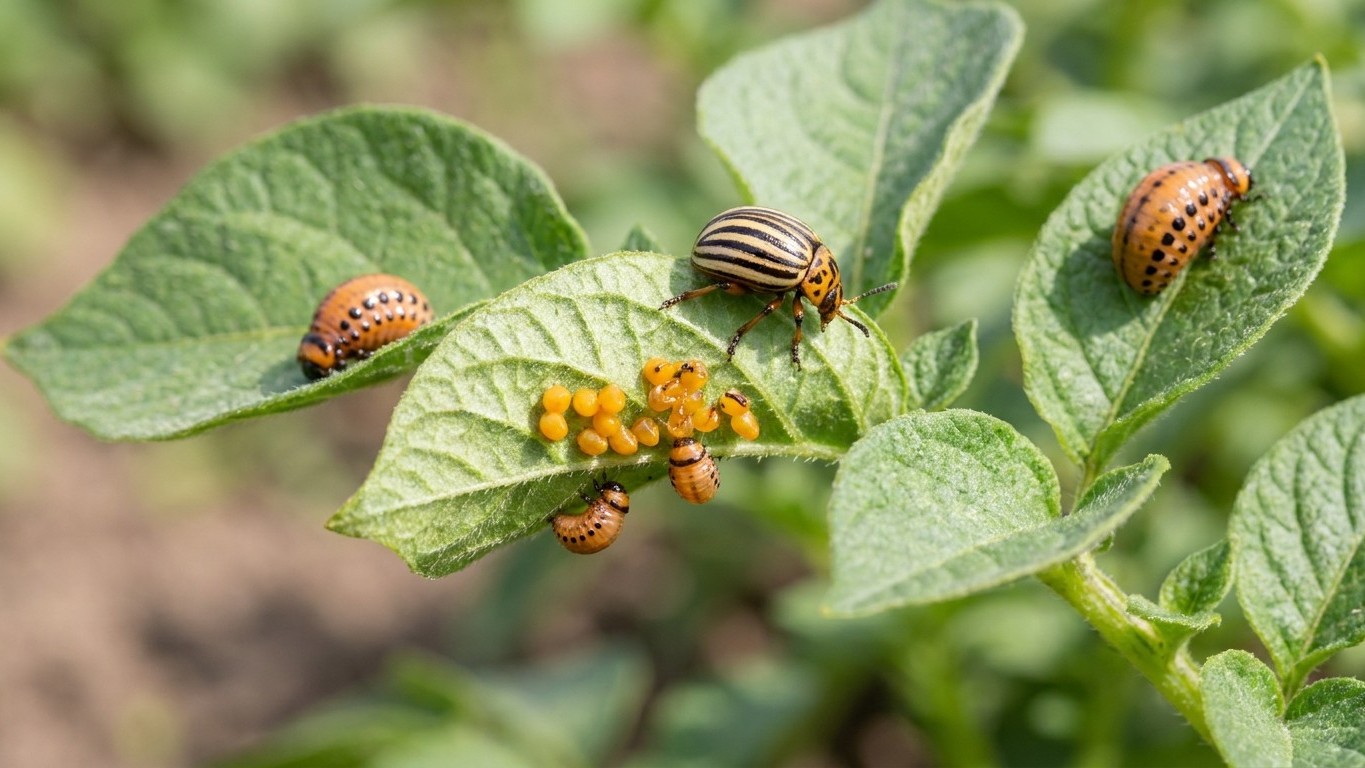

Ohio State University Extension (Ohioline) documents nine garden pests that turn up in home gardens across the state, and six of them actually feed on potato: aphids, cutworms, European earwig, slugs, spotted cucumber beetle, and twospotted spider mite. Cutworms and slugs move in first, right around the May 5 to May 15 frost-free window (zone 6a), while spider mites wait for the hottest, driest stretch of the season to build up on the foliage.
Which pests attack potato in Ohio

Ohio State University Extension (Ohioline) lists nine species as documented garden pests in this territory: aphids, cutworms, European earwig, Japanese beetle, slugs, spotted cucumber beetle, squash vine borer, striped cucumber beetle, and twospotted spider mite. Not all nine belong on a potato page, and pretending otherwise would be sloppy.
Squash vine borer and striped cucumber beetle are both cucurbit specialists. The borer tunnels into the stems of squash, pumpkin, and zucchini vines; potato has no vine for it to enter, so it simply isn’t a threat here. Striped cucumber beetle feeds on cucurbit leaves and can spread bacterial wilt between squash plants, but it has no particular pull toward potato foliage. Japanese beetle is the third one to set aside. It skeletonizes the leaves of roses, grapes, and linden trees far more readily than it touches a potato plant, and Ohioline’s documentation of it in home gardens doesn’t point to potato as a target.
That leaves six species that do feed on potato. Aphids cluster on the undersides of leaves and can carry virus between plants, which is one reason healthy, virus-free planting stock matters as much as any spray. Cutworms cut young stems off at the soil line, usually before a gardener has even noticed the plant emerge. Slugs rasp holes in leaves and, in wet years, tunnel into tubers sitting near the surface. European earwig feeds on soft young foliage and can nick emerging shoots, though it’s often as much a scavenger as a pest. Spotted cucumber beetle chews ragged holes in leaves and flowers once plants are established. Twospotted spider mite causes the fine stippling that shows up on foliage during hot, dry weeks, and it can build up fast once conditions favor it.
The decision that matters at this stage isn’t which of the nine is scariest, it’s recognizing that three of them have nothing to do with a potato bed at all. A gardener who treats for squash vine borer on a potato row is chasing a problem that was never there.
When each one shows up, and what it does first
Everything in an Ohio garden runs off the same clock: the frost-free window of May 5 to May 15 for zone 6a. Potatoes typically go into the ground ahead of that window, so the earliest pest pressure lines up with the plants breaking through the soil and pushing up their first leaves.
Cutworms are usually the first sign of trouble, and the first sign is often a missing plant. A stem gets severed right at ground level, and a seedling that looked fine the evening before is lying flat the next morning. Slugs show up on the same early timeline, especially after a cool, wet spring, and their damage looks like ragged, irregular holes in the leaves, sometimes with a telltale slime trail nearby. European earwig can overlap with both, nibbling small notches into young foliage and occasionally into emerging shoots, though its damage tends to be lighter and less complete than a cutworm’s.
Aphids move in as the plants fill out and the canopy thickens, clustering on the undersides of leaves where they’re easy to miss until the colony is well established. Curled, yellowing leaves and a sticky residue on the foliage below are usually the first clue, since aphid feeding produces honeydew that other insects and sooty mold both take advantage of. Spotted cucumber beetle tends to arrive once the plants are flowering, leaving small round holes in leaves and sometimes damaging blossoms.
Twospotted spider mite is the last to build, and it favors the hottest, driest part of the growing season. Dry heat is the trigger that turns a light mite population into a visible problem, since mites reproduce fastest when humidity drops and rain isn’t washing them off the leaves. The first sign is usually a fine, pale stippling on the upper leaf surface, sometimes with faint webbing on the underside if the population has had time to grow.
Telling the damage apart from everything else
Potato foliage can look rough for reasons that have nothing to do with insects, and mistaking one for the other wastes time and sometimes money. The single fastest way to sort it out is to check the underside of the leaf and the base of the stem before assuming a pest is responsible.
| Symptom | Possible pest cause | Likely non-pest cause | What distinguishes it |
|---|---|---|---|
| Plant cut off at soil line | Cutworms | Mechanical damage from a hoe or trowel | Cutworms leave a clean, severed cut and the larva is often curled in the soil nearby; tool damage looks torn or crushed |
| Ragged holes in leaves | Slugs, spotted cucumber beetle | Hail or wind-whipped foliage | Slug damage comes with a slime trail; weather damage is scattered across many plants at once, not just one |
| Yellowing, curling leaves | Aphids | Nitrogen deficiency or uneven watering | Aphid colonies are visible on the leaf underside along with sticky honeydew; nutrient issues show up evenly across the whole plant, not clustered on new growth |
| Fine pale stippling on leaves | Twospotted spider mite | Drought stress or early blight | Mite damage comes with faint webbing under magnification; drought stress affects the whole plant uniformly and blight brings dark lesions, not stippling |
None of these signs are a substitute for a firm identification, and a gardener who’s unsure is better off bringing a sample, or a clear photo, to the local Extension office rather than guessing at a treatment.
What actually works here, and what is a waste of time
Timing beats almost everything else on a short Ohio growing season, and the frost-free window is the anchor for that timing. A physical barrier or row cover put in place before plants emerge from the soil around the May 5 to May 15 window stops cutworms and earwigs before they ever get a bite in, which is far more reliable than trying to catch the damage after the fact.
Hand-picking works for slugs and spotted cucumber beetle if a gardener is willing to check plants in the early morning or evening, when both are most active. Shallow traps set at soil level can pull slugs away from the plants overnight. Keeping the bed weeded and free of debris removes the daytime hiding spots both pests rely on. Starting with certified seed potatoes also matters more than most gardeners assume, since uncertified seed can carry virus into the bed, and aphids will spread that virus to nearby plants the moment they start feeding.
Spider mites are the one pest where timing works against the gardener instead of for them, since their population builds during the hottest, driest stretch of the season when nobody wants to be out watering. Regular watering that keeps foliage from drying out reduces the conditions mites favor, and it costs nothing beyond the water itself.
What’s a waste of time: reacting to Japanese beetle, squash vine borer, or striped cucumber beetle sightings on a potato bed, since none of the three are documented as potato feeders here. Treating for a pest that was never targeting the crop doesn’t protect the plant, it just spends effort somewhere it won’t pay off. Any decision beyond timing and barriers, including what’s labeled for use on potato in Ohio, belongs with the local Extension office rather than a guess.
Where to check this for your own county
Ohio State University Extension is the authority behind every pest named on this page, and its documentation is statewide, not county-by-county. That gap matters: a pest common in one county’s clay soil or wetter microclimate can be a non-issue two counties over. The only way to know what’s actually active in a specific garden is to ask locally.
Every county in Ohio has an OSU Extension office, and most take calls, photos, or physical samples from home gardeners trying to identify a pest or plan a response. County staff know what’s been reported nearby that season, which is information that never makes it into a statewide list. They can also confirm whether a suspected pest matches what’s shown here or whether it’s something else entirely, since insect damage can look similar across several unrelated species.
The next useful step for a gardener seeing damage on potato foliage right now is straightforward: photograph the damage, check the underside of the leaves and the base of the stem, and bring both the photo and the plant’s history (planting date, recent weather, watering habits) to the county Extension office before assuming which of the six pests, if any, is responsible.
Common questions
Do all six potato pests show up in every Ohio garden?
No. Ohioline’s list is documented statewide, but presence varies by county and even by garden. A backyard plot with consistent watering may never see spider mites, while a shaded, damp bed might see slugs every year.
Is European earwig usually a serious potato pest?
It’s documented in Ohio gardens and can nick young foliage and shoots, but its damage tends to be lighter than cutworms or slugs. Most of the time it’s a minor player rather than the main cause of damage.
Can Japanese beetle damage potato plants at all?
Ohioline documents it as a garden pest in the state, but it isn’t listed as a potato feeder here. It’s far more associated with roses, grapes, and ornamental trees than with potato foliage.
What’s the single best window for preventing early-season damage?
Getting physical barriers or row covers in place before or right at the frost-free window of May 5 to May 15 gives cutworms and earwigs nothing to reach once plants emerge, which is more effective than treating damage after it appears.