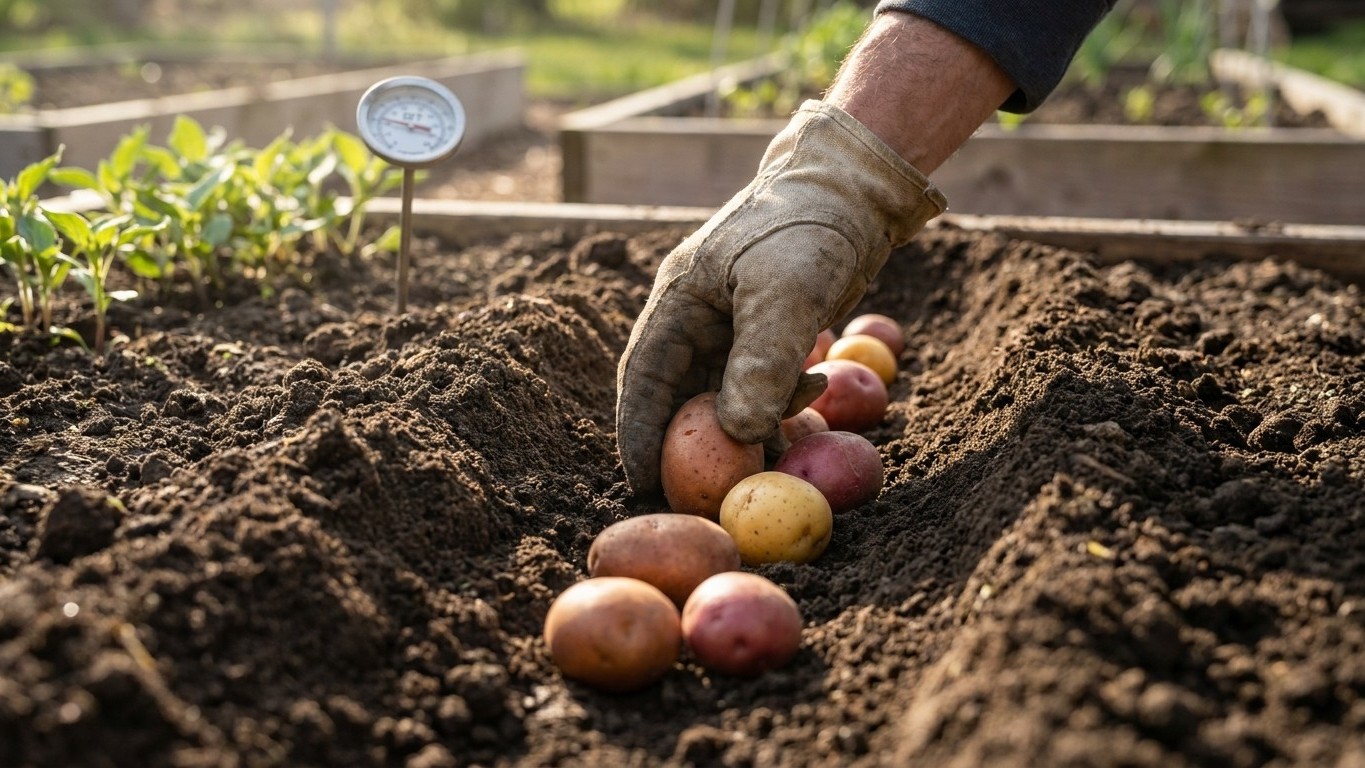

Early to mid-season varieties are the safer bet for most of Ohio, because they finish sizing before soil temperatures climb past the 90°F ceiling that stops tuber fill, according to Utah State University Extension and the University of Maine Cooperative Extension. Plant them as soon as soil hits 50°F, typically 14 to 21 days before the last frost date of May 5 to May 15 in zone 6a, per Ohio State University Extension’s Ohio Gardening Calendar.
The short answer
The window that matters is narrower than most gardeners assume. Ohio State University Extension’s Ohio Gardening Calendar puts the last spring frost for zone 6a between May 5 and May 15. Work backward from that date and the planting slot lands in mid to late April, since Utah State University Extension’s fact sheet Potatoes in the Garden says seed potatoes go in the ground as soon as soil reaches 50°F, which falls 14 to 21 days ahead of the last frost.
That timing isn’t arbitrary. It’s built around a heat threshold that both Utah State and the University of Maine treat as the single biggest factor in whether a potato crop sizes up or stalls. Once soil temperatures climb above 90°F, tuber set and fill are inhibited. Watering more doesn’t reverse it. The plant simply stops putting energy into the tubers underground, no matter how green the foliage looks above.
Match that mechanism against Ohio’s summer and the answer becomes obvious: varieties that finish their bulking phase early, before the hottest stretch of July and August sets in, carry less risk than ones that need a long season to size up. Neither Utah State nor the University of Maine publishes a specific days-to-maturity count for individual varieties, so the honest way to sort them is by season class, not by a number. Extension programs group potatoes into early, mid-season, and late classes, and that classification is what should drive a variety choice in a state where soil can cross the 90°F line well before Labor Day in a hot year.
For a home garden, that generally means leaning toward early and mid-season classes, planted as soon as the soil reaches that 50°F mark, so the bulk of tuber development happens while soil temperatures are still moderate. Late-season types aren’t off the table everywhere in Ohio, but they carry more exposure to the heat ceiling described above, especially in southern counties where summer soil temperatures run hotter for longer. The safer play, backed by the same mechanism, is to treat a hot Ohio summer the way you’d treat a short growing season anywhere else: get the crop planted early, and get it out of the heat before the ceiling closes the door on sizing.
Also worth stating plainly: certified seed matters more than variety choice in most seasons. Uncertified seed potatoes carry viruses that cut yield regardless of how well-suited the variety is to Ohio’s climate. That single fact does more for a crop’s outcome than any amount of variety debate.
What actually decides it
Two mechanisms run this whole decision, and neither one is about which variety name sounds the most familiar at the garden center. One sets the floor for planting. The other sets the ceiling for how long the plant has to work before it stops sizing tubers.
Soil temperature, not the calendar, triggers planting
Utah State University Extension is specific on this: potatoes go in the ground once soil temperature reaches 50°F, not on a fixed date. In a cool spring, that point might land closer to the last frost date. In a warm spring, it can come noticeably earlier. Ohio’s zone 6a last-frost window of May 5 to May 15, per Ohio State University Extension, gives a rough backstop, but the 14-to-21-day lead time before that frost date is what actually determines when seed potatoes belong in the soil. A gardener checking a thermometer pushed a few inches into the bed gets a more accurate signal than one checking a calendar.
The 90°F heat ceiling decides which season class survives the summer
This is the mechanism that decides the whole crop, and it’s the part most guides skip. Once soil temperature crosses 90°F, tuber set and fill stop, according to both Utah State University Extension and the University of Maine Cooperative Extension’s Bulletin #2077. That’s not a yield reduction that responds to more water or fertilizer. It’s a hard stop on sizing. A late-season variety that needs a long stretch of moderate soil temperature to bulk up runs a real risk of hitting that ceiling before it finishes, particularly in a region where summer soil temperatures climb well past 90°F for stretches of the season. An early or mid-season variety, by contrast, does most of its tuber-sizing work before that ceiling becomes a factor, simply because it needs less total time in the ground.
Reading the same logic against a different state or county
Apply this reasoning anywhere and it holds: check the local last-frost date, back-calculate the 50°F planting window, then ask how many days of soil above 90°F that location typically sees before harvest. Where that count runs high, the answer is to plant early and treat the crop as a spring dig, not a summer-long project. Where it runs low, a longer-season variety has more room to work. The mechanism travels; only the local numbers change.
How to do it
- Check soil temperature with a probe thermometer a few inches deep, rather than relying on the calendar, and wait until it reads 50°F before planting seed potatoes.
- Count backward from Ohio’s zone 6a last-frost window of May 5 to May 15 (Ohio State University Extension) to confirm the 50°F soil mark falls in the expected 14-to-21-day pre-frost range for your location.
- Buy certified seed potatoes rather than saving tubers from a previous crop or using grocery-store potatoes, since uncertified seed carries viruses that reduce yield regardless of variety.
- Choose an early or mid-season class for most Ohio locations, since these finish tuber sizing before soil temperatures are likely to cross the 90°F ceiling described by Utah State University Extension and the University of Maine Cooperative Extension.
- Plant at the 50°F soil mark so the bulk of the growing season falls before the hottest stretch of summer arrives.
- Monitor soil temperature through the season, especially in July and August, since tuber fill stops once it passes 90°F regardless of watering.
- Harvest early-season varieties as soon as foliage dies back, rather than leaving tubers in warming soil, to get them out of the ground before extended heat sets in.
What goes wrong
- Planting by the calendar instead of soil temperature. A gardener who plants on a fixed date regardless of soil conditions can end up putting seed potatoes into cold, wet ground that rots before sprouting, or missing the early window entirely. Check soil temperature directly and plant at the 50°F mark instead.
- Choosing a late-season variety in a hot part of the state. A long-season variety that needs extra weeks to bulk up can run straight into the 90°F soil ceiling before it finishes sizing, leaving small tubers no amount of extra water will fix. Favor early or mid-season classes where summer soil heat is a known risk.
- Watering more once growth stalls in midsummer. Once soil crosses 90°F, tuber fill stops as a physiological response, not a moisture deficit. Extra irrigation doesn’t restart sizing. The fix is timing the crop so the bulk of tuber development happens before that heat threshold is reached, not compensating for it afterward.
- Planting saved or uncertified seed potatoes. Tubers held back from a previous harvest, or potatoes bought for eating rather than planting, commonly carry viruses that reduce vigor and yield no matter how well the variety class matches the climate. Certified seed is the one input worth paying for.
- Leaving tubers in the ground during a late-summer heat spell. Even after foliage dies back, tubers sitting in soil that’s crossed 90°F aren’t gaining anything and can suffer quality loss. Dig early-season crops promptly once the tops die down rather than waiting for a convenient weekend.
Common questions
Can late-season potato varieties still work anywhere in Ohio?
In cooler pockets of the state where soil temperatures stay below the 90°F threshold longer into summer, a late-season class has more room to finish sizing. Where extended heat is typical, early or mid-season classes carry less risk, based on the heat-ceiling mechanism described by Utah State University Extension and the University of Maine Cooperative Extension.
Does the May 5 to May 15 frost date apply across all of Ohio?
That range is specific to zone 6a, as published in Ohio State University Extension’s Ohio Gardening Calendar. Other hardiness zones within the state have different last-frost windows, so the 14-to-21-day pre-frost planting calculation should be run against the local zone rather than assumed statewide.
Is a floury or waxy label a useful way to pick a variety?
Neither term appears in the Utah State or University of Maine fact sheets used here. What’s published instead is intended use, such as baking or boiling, which is a more reliable way to match a variety to a recipe than a texture label that isn’t consistently defined across sources.
Why does certified seed matter as much as variety selection?
Certified seed potatoes are produced under programs that screen for viruses. Uncertified seed, including tubers saved from a home garden or bought for eating, commonly carries virus loads that suppress yield regardless of how well-matched the season class is to local climate. It’s a single decision that affects the crop as much as, or more than, variety choice itself.