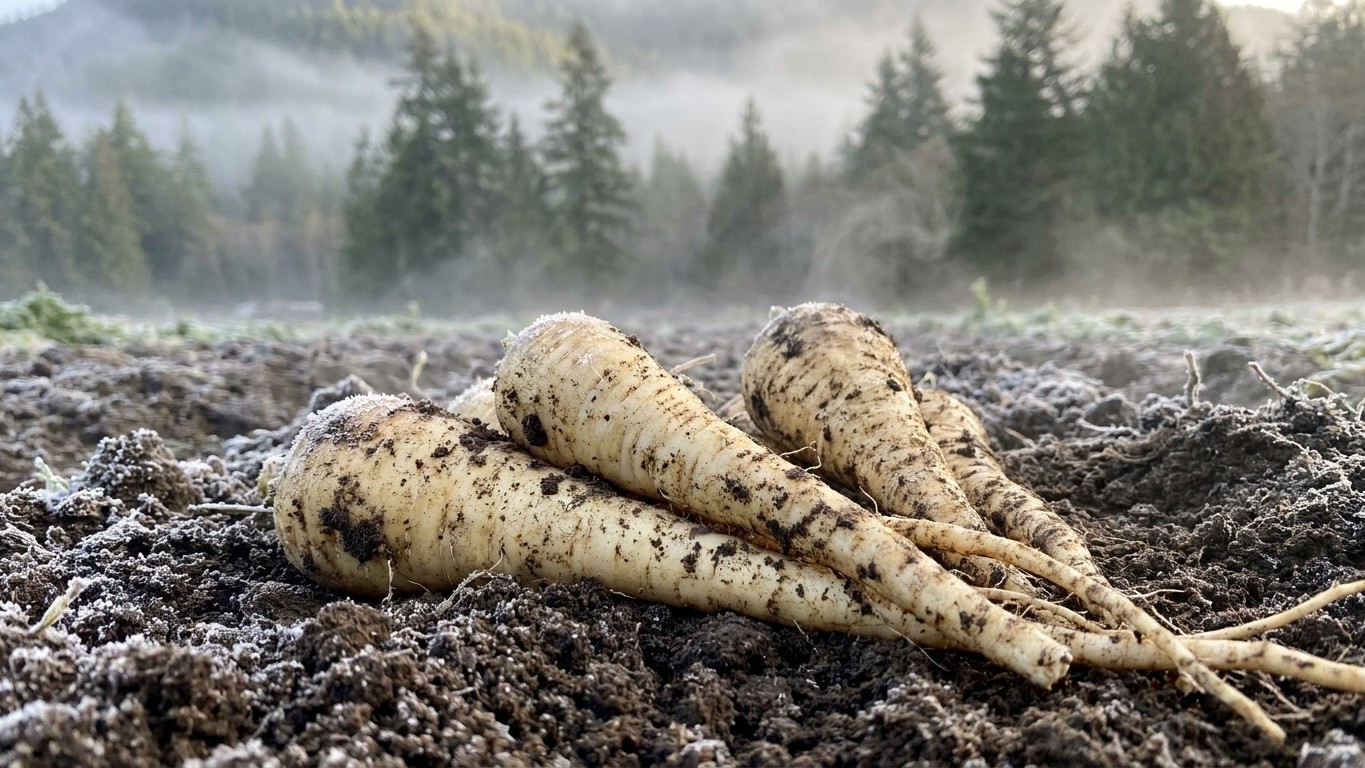

Utah State University Extension documents six insect and mollusk pests that show up on parsnip foliage and seedlings here: aphids, flea beetles, grasshoppers, leafminers, slugs, and spider mites. Each one arrives at a different point in the growing season, tied to the state’s frost windows rather than a fixed calendar date, and each leaves a different mark on the plant.
Which pests attack parsnip in Utah

Utah State University Extension keeps a broader list of vegetable-garden pests for this territory, and it includes names that have nothing to do with a parsnip bed. Cabbage looper and imported cabbageworm feed on brassicas, cabbage, broccoli, kale, and skip past a root crop with no leafy heads to bore into. Corn earworm targets corn and tomato fruit, not the ferny top-growth of a parsnip. Cucumber beetles and squash bug are cucurbit specialists, they want melon and squash vines, and onion thrips stay close to the onion family. The list also names pests tied specifically to melon crops and to potato plants, both of which are simply different hosts than parsnip.
What is left after that sorting is a short list, and Utah State University Extension does not document more than these for a parsnip planting: aphids, flea beetles, grasshoppers, leafminers, slugs, and spider mites. Aphids cluster on the undersides of young leaves and along stems, sucking sap and leaving a sticky residue behind. Flea beetles are tiny, dark, and jump when disturbed, and they favor tender seedling leaves over mature foliage. Grasshoppers are generalist feeders that chew ragged notches out of any leaf in their path, parsnip included, especially once other food sources dry up later in the season. Leafminers tunnel between the leaf surfaces, leaving pale winding trails that are easy to spot but hard to treat once the larva is inside the leaf. Slugs work at night and in damp weather, rasping holes in leaves and sometimes taking out whole seedlings before a gardener ever sees one. Spider mites are barely visible without a hand lens, but their feeding shows up as a fine stippling on the leaf surface, often with faint webbing at the leaf joints.
None of these six is guaranteed to show up in a given garden, and the presence of one does not mean another is coming. Treating the list as a checklist to spray against, rather than a set of possibilities to watch for, wastes both time and product.
When each one shows up, and what it does first
Parsnip seed goes into the ground two to three weeks before the last spring frost, and in this territory that frost falls somewhere between April 12 and April 29. Germination is slow, 14 to 21 days, and a gardener who does not expect that delay often assumes the seed failed and digs up the row too early. That waiting period matters for pest timing too, because the earliest pest pressure lands on seedlings that have barely broken the surface.
Flea beetles and slugs are usually the first visitors, arriving as soon as tender seedling leaves are up. Flea beetle damage shows as small, round shot-holes scattered across a leaf, almost like it was hit with fine buckshot. Slug damage looks different, larger ragged holes with smooth edges, often paired with a silvery slime trail on the soil or the leaf itself, and it tends to follow damp, cool stretches of spring weather.
Aphids build up a few weeks later, once there is enough leaf mass to support a colony. The first sign is rarely the insect itself, it is curled or puckered new growth, sometimes with a faint shine from the sticky honeydew aphids leave behind. Leafminers follow a similar timeline, showing up as pale, winding trails inside the leaf tissue rather than damage on the surface.
Grasshoppers and spider mites tend to be a mid to late season problem, building numbers as the weather turns hot and dry through summer. Grasshopper feeding looks like larger chunks missing from leaf edges, and numbers climb as the season goes on and other vegetation nearby dries out. Spider mites favor hot, dry conditions, and the tell is stippled, dusty-looking foliage rather than obvious holes, sometimes with fine webbing near the base of the leaf stems in a heavy infestation. Parsnip foliage stays in the ground through fall while the root sizes up and sweetens, so any of these six can, in theory, still be active right up until the first fall frost arrives between October 18 and October 29.
Telling the damage apart from everything else
A lot of what looks like insect damage on parsnip foliage is something else entirely, and mistaking one for the other means treating a problem that was never there. Yellowing leaves get blamed on aphids when the real cause is often uneven watering or heavy, compacted soil that is keeping the roots from developing normally. A forked or misshapen root gets blamed on a soil pest when Utah State University Extension points to two separate causes instead: heavy or stony ground that splits the taproot as it pushes down, and overwatering, which is a different mechanism entirely and needs a different fix.
| Symptom | Possible non-pest cause | What tells them apart |
|---|---|---|
| Yellow, pale leaves | Nitrogen deficiency or inconsistent watering | No holes, stippling, or trails on the leaf surface itself |
| Forked, split root | Heavy/stony soil, or overwatering | No feeding marks on the root skin; check soil texture and watering schedule separately |
| Wilting despite moist soil | Root disease or mechanical injury from cultivation | Roots show internal discoloration rather than surface chewing |
| Slow, uneven germination | Normal 14-21 day germination window, not pest damage | No seedling present yet to show feeding marks |
A parsnip bed that looks stunted before the seedlings have had their full 14 to 21 days to emerge is not a pest problem yet, it is a timing problem. Beyond that window, if the damage does not match anything in the table above, a local county Extension office can look at an actual sample rather than a description of one.
What actually works here, and what is a waste of time
Utah’s growing season is short enough that timing a physical barrier matters more than reaching for any product after the fact. A floating row cover laid over the bed right at seeding, before flea beetles or slugs find the first leaves, keeps both off the plant without any need to identify which one showed up first. That cover comes off once the plants are established enough to tolerate some feeding, or once pollination becomes a concern for neighboring crops.
Hand-removal works surprisingly well against slugs and grasshoppers precisely because neither moves fast. A short evening check during a damp spring catches slugs before they do much damage, and grasshopper numbers in a home garden rarely justify anything beyond picking them off or netting the bed during their peak activity.
Watering on a consistent schedule, rather than letting the soil swing from dry to soaked, addresses the overwatering half of the forked-root problem before it starts, and it also happens to reduce the kind of stressed, aphid-attracting new growth that follows an inconsistent watering pattern. Deep, sandy soil is what Utah State University Extension recommends for parsnip in general, and heavy soil needs to be double dug rather than treated with anything after the fact once the roots are already misshapen.
What wastes time is reacting to cosmetic leaf damage on a root crop. A few flea beetle holes or a leafminer trail rarely affects the size or sweetness of the root below, since the plant’s energy is going into the taproot, not the leaf surface. Treating every visible mark as an emergency leads to unnecessary spraying on a crop where the edible part is underground and mostly unaffected by moderate foliage feeding. Anything beyond physical barriers and consistent watering should go through a county Extension office, since they are the only ones who can confirm what is actually labeled for use on a home vegetable garden in this state.
Where to check this for your own county
Utah State University Extension is the source for every pest named on this page, and its county offices are where a gardener gets a local answer rather than a statewide one. A pest documented for Utah as a whole does not mean it is present in every county, or every garden within a county, since elevation, soil, and microclimate all shift what actually shows up on a given property.
The frost dates used throughout this page come from a Salt Lake City reference station, and Utah State University Extension notes that most of the state sits higher and colder than that valley, while southern Utah runs warmer. A garden at higher elevation may see a later last frost and an earlier first fall frost than the April 12 to April 29 and October 18 to October 29 windows cited here, which shifts both the seeding date and the point at which frost sweetening begins.
The next useful step for anyone seeing damage on a parsnip planting is a call or visit to the local county Extension office, ideally with a leaf or a photo of the actual symptom in hand. That office can confirm whether what is showing up matches one of the six pests documented for this territory, or whether it points toward a soil, water, or disease issue instead, something no statewide list can settle from a description alone.
Common questions
Why are my parsnip seedlings taking so long to appear?
Parsnip germination runs 14 to 21 days under normal conditions, which is slower than most other garden vegetables. A bare-looking row at day ten is not a failed planting, it is still within the normal window.
Do I need to spray for pests every year to grow parsnip in Utah?
No. Utah State University Extension documents six possible pests for this crop here, but none of them appears guaranteed in any given garden or season, and a floating row cover at seeding handles the earliest risks without any product at all.
Why did my parsnip roots come out forked instead of straight?
Two separate causes are documented for this: heavy or stony soil that splits the taproot as it grows down, and overwatering, which is a different problem with a different fix. Neither one is pest damage.
When are parsnips actually ready to harvest for the best flavor?
The root needs 100 to 120 days from seeding, and the sweetest flavor develops only after several weeks of frosty fall weather converts stored starch into sugar. A mild winter with no sustained frost exposure will still produce a parsnip, just not a sweet one.