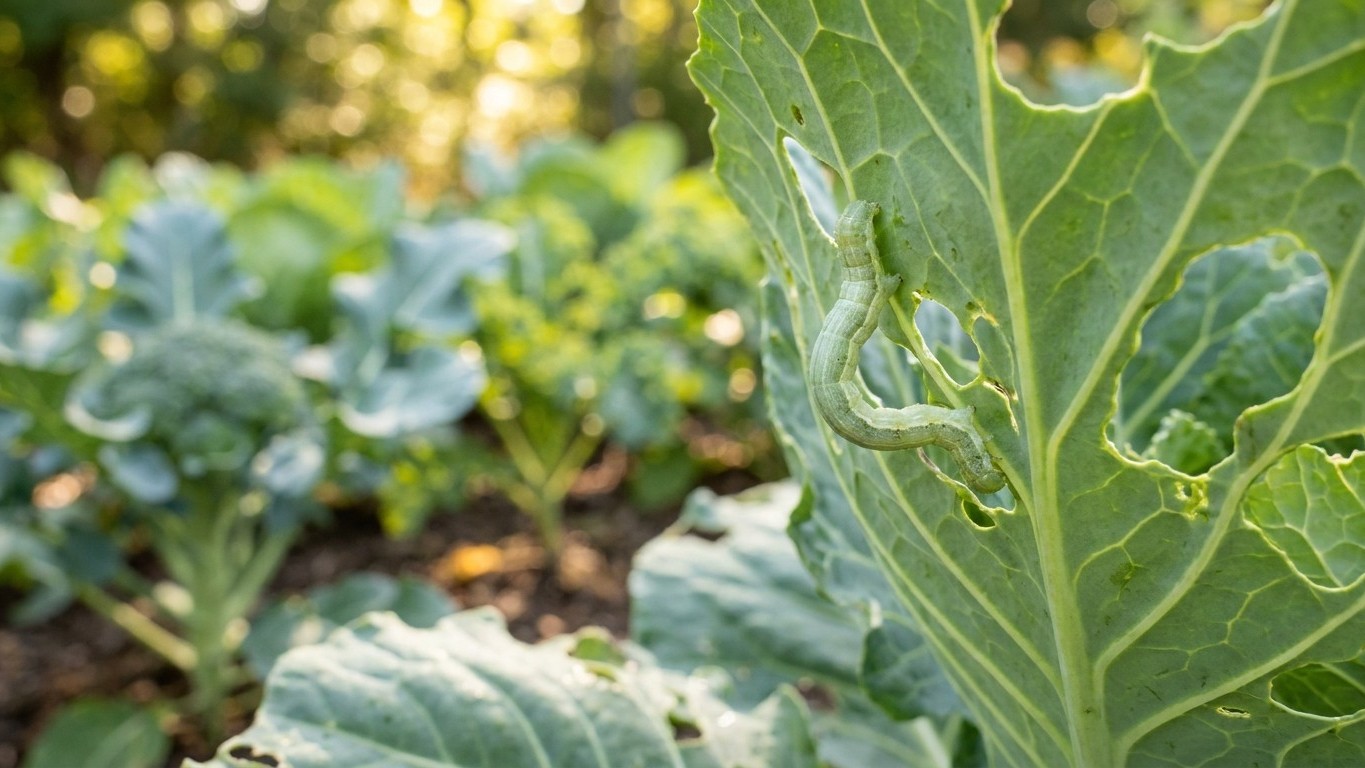

Cabbage loopers become active in Tennessee gardens from late April through early November, with the heaviest pressure hitting brassica crops in August and September. These pale green caterpillars don’t survive Tennessee’s winter freezes in most years, but adult moths migrate north from Gulf Coast states each spring, laying the eggs that turn into the leaf-shredding larvae gardeners find on cabbage, broccoli, and kale. Stopping them comes down to catching the caterpillars early, using Bt sprays, and keeping row covers on young transplants before the moths ever land.
When Cabbage Loopers Show Up in Tennessee
Tennessee sits in a transition zone for this pest. Cabbage loopers (Trichoplusia ni) don’t reliably overwinter as far north as Nashville or Knoxville because sustained hard freezes kill off the pupae. Instead, the state gets reinfested every year by moths flying up from warmer regions along the Gulf Coast and parts of Florida, where the insect survives winter without interruption.
That migration pattern explains why looper activity in Tennessee tends to ramp up gradually rather than appearing all at once in spring. Early arrivals show up on spring cabbage and collard plantings by late April or May, but populations stay relatively low through June. The real spike comes in mid to late summer, when several overlapping generations have had time to build up. A single female moth can lay several hundred eggs over her lifespan, and in Tennessee’s warm months a generation can complete its life cycle in around a month, so numbers compound fast.
Fall brassica gardens, planted in August for a September and October harvest, often take the worst hit. That’s the same window when looper populations across the Southeast peak, and gardeners who skip protection on fall kale or broccoli transplants frequently find the crop chewed to lace by the time cooler weather arrives. East Tennessee’s higher elevations see slightly later and lighter pressure than the warmer Middle and West Tennessee counties, but no region of the state is exempt.
How to Identify Cabbage Loopers Before Damage Spreads
The caterpillar itself is the easiest stage to recognize. It’s smooth-skinned, light green, and tapers slightly toward the head, usually reaching about an inch and a half at full size. A pale white stripe runs down each side of its body. What sets it apart from other cabbage-eating caterpillars is its movement: lacking a full set of legs in the middle of its body, it arches its back into a loop as it crawls, the same way an inchworm does. That looping gait is the single most reliable field ID, faster than counting stripes or checking color.
Adult moths are far less noticeable. They’re grayish-brown, active at dusk and after dark, and rest on plants or nearby structures during the day with wings folded flat. Each forewing carries a small silvery or white marking shaped roughly like an arrowhead or a figure-eight, a detail that separates cabbage loopers from similar-looking moths in the garden. Because the moths fly at night, most gardeners never spot the adult and only notice the problem once larvae are already feeding.
Damage patterns give away an infestation before the caterpillars themselves are found. Young larvae feed on the undersides of leaves, leaving thin, papery patches where they’ve skeletonized the tissue without chewing all the way through. Older larvae bite ragged, irregular holes straight through leaves, and on cabbage they’ll tunnel into the developing head, leaving behind wet, greenish-black droppings (frass) that contaminate the crop even where feeding damage looks minor. Broccoli and cauliflower are especially vulnerable because loopers will burrow between the florets, where they’re nearly impossible to spot until the vegetable is cut open at the kitchen counter.
Which Tennessee Crops Are Most at Risk
Cabbage loopers aren’t picky within the brassica family, but some crops show damage faster than others:
- Cabbage and collards, where larvae bore directly into the head
- Broccoli and cauliflower, where hidden feeding between florets ruins marketability
- Kale and mustard greens, where skeletonized leaves show up within days
- Turnip greens, particularly in fall plantings
Loopers will also feed on lettuce, spinach, tomato, and even some ornamentals when brassica hosts run short, though damage on those crops tends to be lighter and less common in home gardens.
What Stops Cabbage Loopers in a Tennessee Garden
The most consistently effective tool for home gardeners is Bacillus thuringiensis subspecies kurstaki, sold widely as Bt. It’s a naturally occurring soil bacterium that produces a protein toxic to caterpillar digestive systems but harmless to bees, birds, pets, and people. Bt only works once a caterpillar eats it, so timing matters: spraying when larvae are small, under half an inch, gives far better control than waiting until they’re nearly full grown and less sensitive to the toxin. Because Bt breaks down in sunlight within a few days, evening applications during active feeding periods hold up better than midday sprays.
Row covers offer the simplest form of prevention, especially for spring and early fall transplants. A lightweight floating row cover, secured at the edges with soil or garden staples, physically blocks egg-laying moths from ever reaching the plants. The catch is timing removal correctly: covers need to come off before flowering on crops that require pollination, and they should go on immediately after transplanting rather than after damage is already visible.
Hand removal still works on a small backyard scale. Checking the undersides of leaves every few days during peak season (July through September in most of Tennessee) lets gardeners pick off larvae and squash egg clusters before populations explode. It’s tedious, but for a dozen cabbage plants it’s often faster than mixing and applying a spray.
Natural Predators Already Working in Tennessee
Cabbage loopers have a long list of natural enemies already present in most Tennessee landscapes, and protecting them cuts down on how much intervention a garden needs. Parasitic wasps, including several Trichogramma species, lay their own eggs inside looper eggs and caterpillars, killing the pest before it can do much feeding damage. Ground beetles, lacewings, and paper wasps all prey on looper larvae directly. Birds, particularly wrens and sparrows that nest near garden edges, pick off caterpillars as a routine part of foraging.
Broad-spectrum insecticides undercut this natural control by killing beneficial insects along with the target pest, which is one reason Bt remains the preferred choice for gardeners trying to manage loopers without also wiping out pollinators and predator populations. Planting flowering herbs like dill, fennel, and yarrow near brassica beds gives parasitic wasps a nectar source and tends to keep their numbers higher through the season.
Timing a Response to Tennessee’s Growing Season
Spring plantings need the least defense. Because looper populations are still building from their spring migration, cabbage and broccoli set out in March and April usually mature before pressure peaks, especially in cooler parts of East Tennessee. A single early-season Bt application, applied if caterpillars are spotted, is often enough.
Fall crops carry the highest risk and deserve the most attention. Anyone direct-seeding or transplanting broccoli, kale, or cabbage in August for a fall harvest is planting straight into the season’s peak looper activity. Row covers installed at transplant, combined with a weekly leaf check through September, catch most problems before they cost a harvest. Removing old brassica debris after harvest also matters: leftover stems and leaves left in the garden can shelter late-season pupae, giving the next generation a head start rather than forcing moths to migrate back in from farther south.
Crop rotation offers a smaller but real benefit. Moving brassicas to a different bed each year doesn’t stop migrating moths from finding the crop, since they fly rather than overwinter locally in most of Tennessee, but it does reduce the buildup of soil-borne pathogens that often accompany heavy looper feeding, since damaged leaf tissue is more prone to secondary fungal infection.
One detail worth knowing before reaching for a spray: cabbage loopers are frequently confused with imported cabbageworms and diamondback moth larvae, both of which also attack brassicas in Tennessee but respond to slightly different control timing. A quick look at how the caterpillar moves, that distinctive looping crawl versus a straight-line crawl, is usually enough to tell them apart in the garden before deciding on treatment.