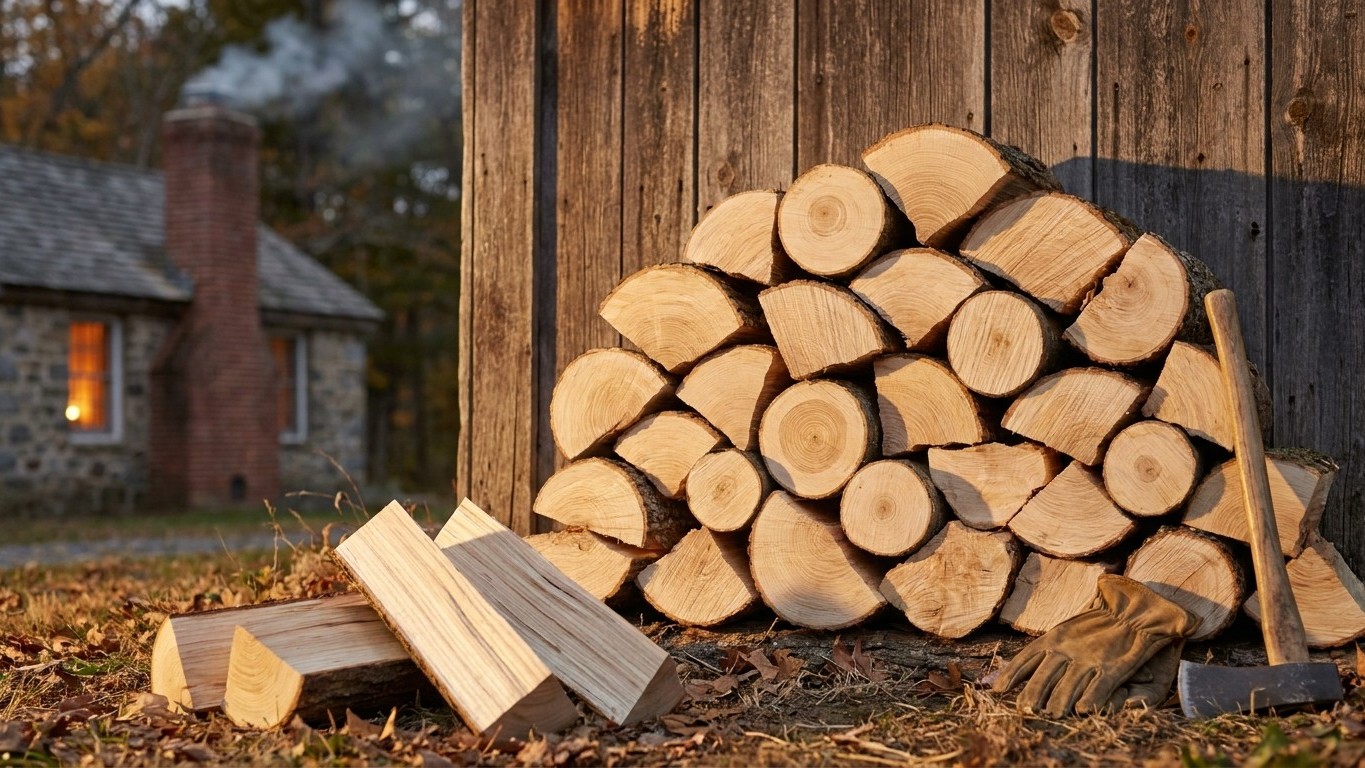

Ash ranks among the best all-around firewoods in North America: it splits easily, seasons fast (six months to a year), burns hot at 23.6 million BTUs per cord according to the Missouri Department of Conservation, and produces low smoke with minimal sparking. If you’ve got ash on your property or see it cheap at a firewood stand, buy it. It’s the kind of wood that works for beginners and experienced burners alike.
What makes ash stand out isn’t any single trait. Plenty of woods burn hotter (hickory, oak). Plenty season faster (poplar, pine). Ash sits in a sweet spot where every category lands in the “good to excellent” range, which is rare. Most firewoods force a tradeoff. Ash barely asks you to make one.
Heat Output: How Ash Stacks Up

White ash, the most common species burned for heat, delivers roughly 23 to 24 million BTUs per full cord when properly seasoned. That puts it in the same tier as red oak and just behind sugar maple and hickory. For comparison, a cord of white pine only produces around 15 million BTUs, so ash generates nearly 60 percent more heat from the same volume of wood.
Green ash and black ash, two other common species, burn slightly cooler than white ash but still outperform most softwoods and many other hardwoods like aspen or basswood. If you’re stacking a mixed woodpile, ash of any type earns a spot in the “primary heating wood” category rather than the “kindling and shoulder-season” pile.
This heat output translates directly to fewer reloads. A stove burning ash logs at a moderate air setting can hold a solid coal bed for six to eight hours overnight, similar to oak, without the extended seasoning time oak demands.
Why Ash Burns Consistently
Ash has a relatively uniform grain structure and moderate density (around 42 pounds per cubic foot when dry), which means it burns evenly rather than in unpredictable bursts. Woods with more resin or irregular grain, like pine or fir, tend to flare up and die down. Ash holds a steadier flame, which matters if you’re regulating temperature in an insert or wood stove rather than an open fireplace.
Smoke and Creosote: What to Expect
Properly seasoned ash produces little smoke compared to softwoods or unseasoned hardwoods. This isn’t marketing talk, it’s a function of low resin content and a moisture level that, once dried below 20 percent, allows for cleaner combustion. Less smoke means less creosote buildup in your chimney flue, which lowers the risk of chimney fires over a heating season.
The catch is seasoning. Ash that’s still green or only partially dried will smoke heavily and build creosote just like any other wet wood. The wood’s reputation for clean burning only holds up if you’ve given it enough time, and that’s where a lot of first-time burners get tripped up buying “seasoned” ash from a roadside stand that’s actually only been split for eight or ten weeks.
A moisture meter is worth the twenty-dollar investment if you’re burning ash for the first time. Split a log, press the pins into the freshly exposed face, and look for a reading at or below 20 percent. Anything higher and you’re better off letting it sit through another summer.
Sparks and Safety in the Fireplace
Ash throws relatively few sparks compared to woods like pine, spruce, or hemlock, which makes it a safer choice for open fireplaces and outdoor fire pits where you don’t have a screen or glass door containing the embers. The wood’s tight grain and low resin content mean fewer trapped gas pockets that pop and send embers flying.
That said, “few sparks” doesn’t mean “no sparks.” Any firewood with bark still attached can pop occasionally as trapped moisture in the bark ignites. If you’re burning ash in an open hearth, keep a screen up regardless of species, and never leave a fire unattended, even with a low-spark wood like ash.
Splitting and Seasoning Ash
Ash splits cleanly along its grain, which is part of why it’s a favorite among people who process their own firewood by hand. Unlike elm or sycamore, which have interlocked grain that fights back against a maul, ash tends to separate in one or two clean strikes when the rounds are cut to standard 16-inch lengths. This isn’t a minor convenience. If you’re splitting a full cord by hand, the difference between wood that splits easily and wood that doesn’t can mean hours of extra labor.
Seasoning time for ash runs six months to a year, depending on your climate and how the wood is stacked. In dry climates like the Mountain West or parts of the Southwest, six months of stacking in a sunny, wind-exposed spot can bring ash down to burnable moisture levels. In humid regions like the Southeast or the upper Midwest, plan on a full year to be safe.
Some old-timers claim ash can be burned “green,” meaning freshly cut, with decent results. There’s a kernel of truth here: ash has lower moisture content in living wood compared to species like oak or hickory, so it dries faster and produces less smoke even at higher moisture levels than most woods would. But burning it green still means less heat output, more smoke, and faster creosote buildup than burning it properly seasoned. Treat the “green ash burns fine” claim as a last-resort option, not a recommendation.
Stacking for Faster Drying
Split rounds into pieces no wider than 4 to 6 inches across to expose more surface area. Stack them off the ground on pallets or rails, oriented so wind can pass through the rows, and cover only the top of the stack, leaving the sides open for airflow. Ash dries fastest in a single-row stack with full sun exposure, which is easier to achieve than it sounds if you’ve got even a small clearing.
Why Emerald Ash Borer Damage Makes Ash Firewood So Plentiful
Here’s a detail unique to ash that most other firewood species don’t share: the emerald ash borer, an invasive beetle first detected in Michigan in 2002, has killed hundreds of millions of ash trees across the eastern and midwestern United States over the past two decades. In many states from Ohio to New York to Minnesota, entire stands of ash have died standing, which has flooded local firewood markets with dead, already-drying ash logs.
For homeowners, this has an upside and a downside. The upside: ash firewood is often cheap and plentiful in affected regions, since landowners are clearing dead trees anyway and selling or giving away the wood. The downside: moving ash firewood across state or county lines can spread the emerald ash borer to new areas, which is why many states enforce firewood movement quarantines. Buying and burning wood locally, ideally within 10 to 50 miles of where it was cut, isn’t just a suggestion in ash-borer-affected regions. It’s often a legal requirement enforced by state agriculture departments.
Before hauling firewood across a state line for a camping trip or a rural cabin, check your destination state’s quarantine rules. Violations can carry fines, and more importantly, moving infested wood can wipe out ash populations in areas the beetle hasn’t reached yet.
Identifying Ash Firewood
If you’re buying unsplit rounds or picking up wood from a downed tree, ash bark has a distinctive diamond-shaped ridge pattern that becomes more pronounced with age. The wood itself is pale, almost cream-colored when freshly split, with a straight, consistent grain that lacks the dramatic color variation you’d see in oak or walnut. Ash also tends to be lighter in weight than oak or hickory of the same dimensions when green, though the difference narrows once both are fully seasoned.
One quick field test: ash wood has a springy, almost rubbery quality when you flex a thin split piece, which is part of why it’s historically been used for tool handles and baseball bats. Brittle wood that snaps rather than bends is more likely to be a different species.