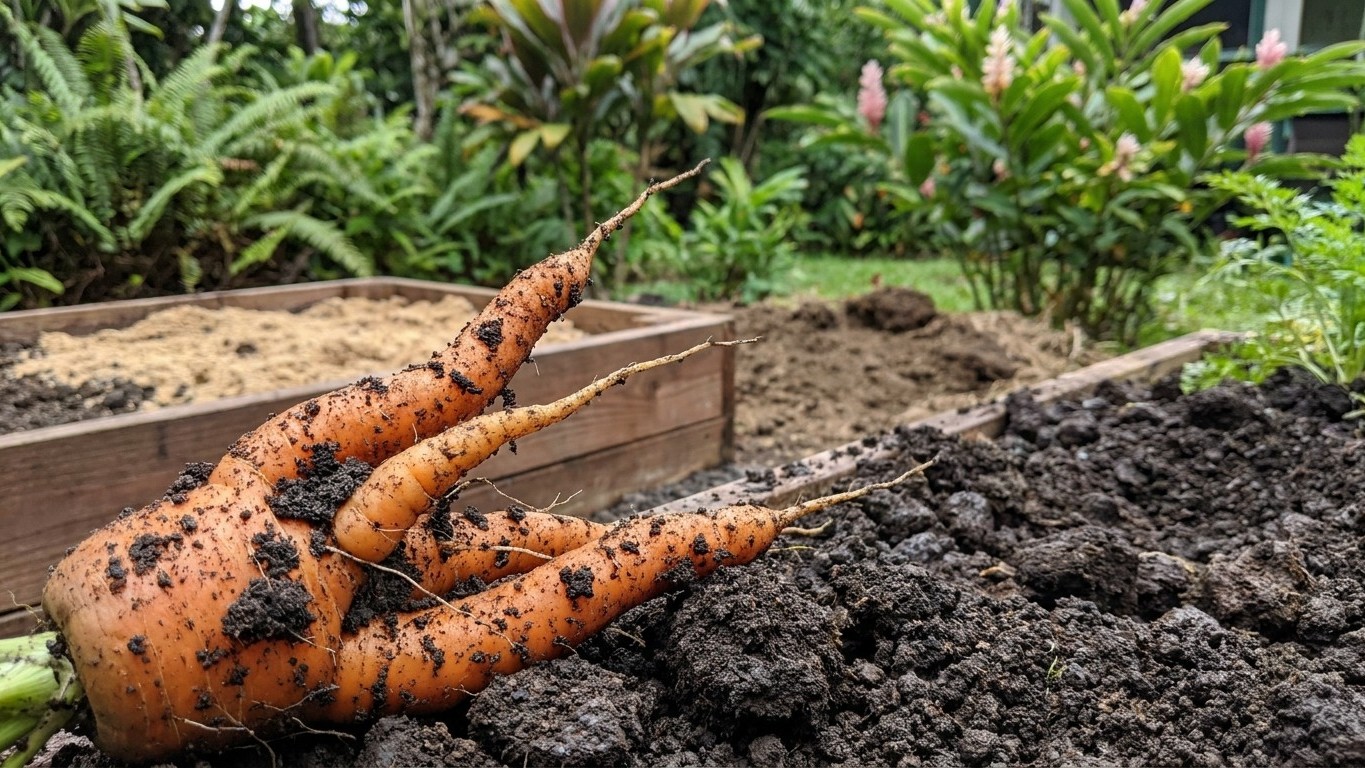

Pull carrots when the shoulders are broad and deep orange, then cut the tops off and chill the roots just above freezing. That pairing decides whether a Kansas harvest lasts a week or several months. Timing runs on the day you seeded, not the calendar. Storage runs on one number most houses miss: 33 °F. Here is how to hit both.
When carrots are ready in Kansas
Read the plant first
Look for shoulders that have rounded up at the soil line and turned a full, deep orange, which usually happens about 65 to 75 days after planting, according to Clemson Cooperative Extension. Home gardens often run longer, commonly 70 to 100 days, because slower types and cool spells stretch the clock. Pale, thin shoulders mean the root is still bulking up. Wait.
The best test is destructive but cheap. Water the row, loosen the soil beside one carrot, pull it and look. If it is the size and color you were after, harvest a few more. If not, you have lost one carrot and gained a week of certainty.
Count from the seeding date
Carrots are sown in place. They do not get transplanted, so every one of those days counts from the morning the seed went into the ground. A row seeded on April 15 would reach the 70-to-100-day mark between June 24 and July 24. That is arithmetic, not a recommended sowing date, but it shows how wide the window is. Sowing dates matter less than what the plants look like.
The frost dates that anchor a Kansas planting schedule are not published on this page, and they swing a lot between the southeast corner and the High Plains. Your county office of K-State Research and Extension can give you the last spring and first fall frost dates for your own town. For a fall crop, count backward from that first frost, using the same 70 to 100 days.
What the ground does to the answer
Kansas’s official state soil is the Harney series, a deep, dark prairie Mollisol. The representative surface layer is 9 percent sand, 24 percent clay and 67 percent silt, with organic matter about 2.0 percent, a pH of about 6.7 and good drainage, according to USDA NRCS. Utah State University Extension says carrots want deep, sandy, well-drained soil rich in organic matter, and that heavy or rocky ground makes the root fork. A silty, well-drained loam sits closer to that ideal than heavy clay does, though it is much lower in sand.
Treat that as a starting point, not a diagnosis. Kansas spans hundreds of soil series, and river bottoms, hill country and any lot a builder has scraped or filled can look nothing like Harney. A jar test settles it at home: fill a straight-sided jar a third full of garden soil, add water, shake hard and let it sit. Sand drops first, silt next, clay last, and the layers show your proportions within a day or two. For a real pH and organic matter number, send a sample through your county extension office. More on that in Will Carrots Fork in Kansas Soil?, and the full season is covered in Growing Carrots in Kansas.
Keeping them, and for how long
Clemson Cooperative Extension, through its Home & Garden Information Center, puts it plainly: store carrots at 33 °F and high humidity to prevent wilting. The source gives no humidity percentage, only “high,” so think of a closed, damp environment rather than an open shelf. And 33 °F is just above freezing. It is not a cellar temperature in the everyday sense, and it is much colder than a pantry or a mudroom.
The temperature matters because warmth wakes carrots up. A root held at 50 °F starts to sprout and go soft in a fraction of the time it would last near freezing. Cold slows that respiration to a crawl, and humidity stops the root from shriveling as it loses water.
Why the tops come off first
The same Clemson source says bunched carrots, meaning the plants with their tops still on, can be stored for about 10 to 14 days. That number is the whole argument for trimming. Leaves keep drawing moisture out of the root long after harvest, so a carrot with greens attached is slowly wilting from the inside. Cut the tops off before storing, leaving a small stub, and the same cold, humid conditions can hold trimmed roots for months.
Read that duration correctly. Ten to fourteen days for bunched carrots, and months for trimmed ones, are ceilings under near-perfect conditions, not guarantees. A fridge that runs a few degrees warm, a bag that traps too much condensation or a carrot nicked by a spade will all shorten it. Sort as you store: only clean, undamaged roots go in the long-term bin. Anything split, gouged or soft gets eaten this week.
Harvest also matters. Brushing off loose soil rather than scrubbing is a common practice, and the roots should go into storage dry on the surface. Extension guidance also treats the tops as compost or, if they are fresh, as something to use quickly, since they wilt faster than the roots do.
Where in the house that actually is
Almost no room in a Kansas house sits at 33 °F on its own. The realistic choices look like this:
- Refrigerator crisper drawer: the closest match for most households. Fridges are set to protect milk and leftovers, so many run a little warmer than 33 °F, and the back wall can dip low enough to freeze a bag of carrots.
- Heated rooms and pantries: too warm. Expect sprouting and softening well before the fridge would show any change.
- Attached or detached garage: it swings with the weather. A Kansas cold snap can freeze roots overnight, and a warm October afternoon can push the space far above where carrots want to be.
- Basement or cellar: promising if it is unheated and stays cool without freezing, but the reading on a thermometer matters more than the assumption.
Trimmed carrots in a perforated plastic bag, or packed in a container with a damp (not dripping) cloth over them, do well in a crisper drawer. The bag holds humidity. The holes let out excess moisture so mold does not take over.
Before you commit a whole harvest to any spot, leave a thermometer there for several days and read it at different times of day. Skip that step and you find out about a freezing garage or a warm basement when the carrots turn to mush. Aim for a steady reading just above freezing, and check again after the first hard cold arrives, since a spot that was fine in October can change by December.
What goes wrong here
Freezing is the first risk. Kansas winters can drop fast, and a garage or outbuilding that held carrots at a safe temperature in early fall may fall below freezing during a single cold night. Frozen roots thaw into limp, watery sticks. The fix is unglamorous: check the thermometer after every forecasted hard freeze, and move carrots to the fridge if the space is running cold.
A wet autumn is the second. Carrots pulled from saturated soil carry moisture into the bag, and that is how rot and mold get started. Harvest when the ground is workable rather than soupy, let the surface dry, and discard any root with soft spots. If rain is in the forecast for a week, it is often better to leave the carrots in the ground a few more days than to store wet ones. Damage in the field can also come from insects. K-State Research and Extension documents grasshopper, blister beetle and several beetle species in Kansas gardens, and What Eats Carrot in Kansas, and When covers what to watch for.
The third failure is the glut. A long row of carrots comes ready all at once, and nobody eats fifty pounds in two weeks. Sow in shorter rows spread over several weeks, and use the harvest window rather than fighting it. Give the surplus to neighbors, a food pantry or a family with a bigger fridge, and cook and freeze what you cannot store cold. A modest crop that gets eaten beats a big one that ends up in the compost bin.
Common questions
How do I know a carrot is ready without pulling it?
Check the shoulders at the soil line. They should be broad and deep orange. If the tops of the roots are still pale and slim, give it more time. Pulling one test carrot is the surest check.
Do the days count from transplanting?
No. Carrots are sown in place and never transplanted, so the 70 to 100 days count from the day you seeded.
How long do carrots keep in the fridge?
Clemson Cooperative Extension says bunched carrots, with tops attached, keep about 10 to 14 days at 33 °F and high humidity. Trimmed carrots can last months under the same conditions, but that is a maximum and depends on your fridge’s real temperature.
Can I store carrots in my garage or cellar?
Only if a thermometer shows it holds steady just above freezing. Garages swing with Kansas weather, and warm spaces cause sprouting. Test the spot for several days before filling it.