
The sourced record for this page doesn’t carry a documented list of carrot-eating insects specific to Kansas. What it does carry is the state’s official soil profile and the agronomic facts about how carrots grow in it, and those two things explain most of what gardeners in the state actually blame on pests: forked roots, stunted growth, and wilted tops that often trace back to ground, not insects. For anything that looks like a bite mark or a tunnel, the county extension office is the next call.
Which pests attack carrot in Kansas
No species list for carrot pests in Kansas appears in the verified material behind this page. That matters more than it sounds, because a lot of what gets called “pest damage” on carrots in this state is actually the root reacting to the ground it’s growing in, not an insect feeding on it.
Kansas’s official state soil is the Harney series, a Mollisol, the deep, dark prairie soil that helped build the Corn Belt. USDA’s Soil Survey Geographic Database puts its surface horizon at roughly 9 percent sand, 24 percent clay, and 67 percent silt, with a pH near 6.7 and organic matter around 2.0 percent, well drained. That’s a silt loam leaning toward heavy, not the deep, sandy, loose ground carrots actually want.
Utah State University Extension is blunt about what carrots need: deep, sandy, well-drained soil rich in organic matter. Heavy or rocky soil makes the root fork. On ground with a quarter of its surface made up of clay, that forking risk is real before a single insect shows up. So the first thing to rule out on a misshapen carrot in Kansas isn’t a bug, it’s the dirt.
Why this list can’t be padded
It would be easy to list off the usual garden-pest suspects here, wireworms, carrot rust fly, aphids, because they show up on carrot-pest pages for other states. But none of them are documented for Kansas in the sourced material for this page, and adding them anyway would be a guess dressed up as a fact. If a reader spots chewing damage, tunneling, or sudden wilting that clay soil and moisture stress don’t explain, the county extension office is equipped to identify the actual culprit from a sample or a photo, something this page can’t responsibly do without the state-specific record to back it up.
The Harney soil figures also come with a built-in caveat worth repeating: they describe the series that represents Kansas as a whole, not the dirt in any one backyard. A garden on river bottom ground, hill country, or anywhere a builder scraped and refilled the lot will look nothing like it. Treat the state soil as a starting point for what the region’s ground tends to do, hold water, run close to neutral, resist digging, and confirm the real number with a soil test.
When each one shows up, and what it does first
Because carrots are sown in place, there’s no transplant date to anchor a calendar to. Every timing reference for this crop runs from the seeding date, not from setting out a start. Utah State University Extension puts full maturity at 70 to 100 days after seeding, and Clemson Cooperative Extension’s harvest window lands earlier, at about 65 to 75 days after planting. Whatever stresses a carrot root, whether it’s soil, moisture, or an insect, it has that entire stretch to leave a mark.
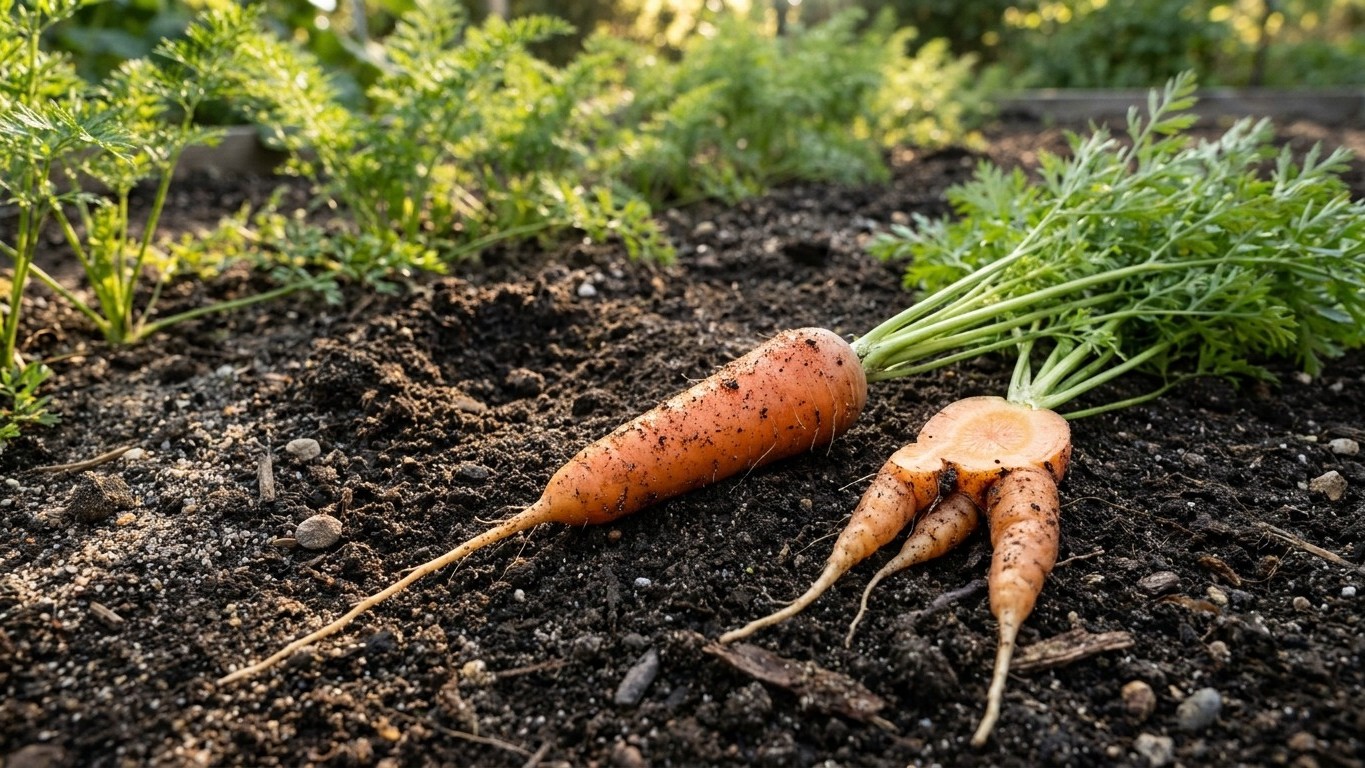
The earliest visible sign in Kansas’s heavier ground usually isn’t a chewed leaf. It’s a root that comes up twisted, split, or branched into two or three legs when it’s pulled at harvest, because the taproot met resistance from compacted clay or a rock while pushing down through the silt loam. That damage is invisible until harvest day, which is exactly why it gets mistaken for something that happened suddenly, like a pest strike, when it actually built up over the entire growing period.
What shows above ground versus below
Foliage tells a different story than the root does. Wilting tops during a dry stretch point toward water stress, since carrots pull moisture through a taproot that hasn’t fully developed for the first several weeks after seeding. Stunted, pale foliage without wilting points more toward compacted or poorly aerated soil holding the roots back, a plausible issue on ground that’s 24 percent clay. Sudden, ragged chewing on leaves or a hollowed root at pull time is the pattern that actually warrants a call to the local extension office, since that’s the kind of damage a soil texture problem doesn’t produce.
Without a Kansas-specific pest calendar in the sourced record, the honest guidance is to watch the root, not the calendar month, and to note how many days out from seeding the problem appeared. That detail is exactly what an extension agent will ask for first.
Telling the damage apart from everything else
Most of what looks like an attack on a carrot bed in Kansas has a mundane explanation once the root is out of the ground. Forking and splitting is the single most common complaint, and it’s a soil-texture issue, not a feeding wound, on ground running a quarter clay.
| Symptom | Likely cause | What settles it |
|---|---|---|
| Forked, split, or stubby root | Heavy or rocky soil, compaction | Soil test plus a look at how the bed was dug |
| Wilted foliage in dry weather | Underwatering, shallow root system | Check soil moisture at root depth, not just the surface |
| Stunted, pale plants, no wilting | Compacted or poorly aerated soil | Dig a test hole and check how easily it crumbles |
| Chewed leaves or a hollowed, tunneled root | Possible insect feeding | Sample or photo to the county extension office |
The distinction that matters most: soil problems build slowly across the entire root, tapering or forking evenly, while insect feeding tends to leave a localized wound, a tunnel, or a ragged bite mark somewhere specific on the root or leaf. A carrot that’s simply short and blunt across its whole length is telling a different story than one with a clean hole bored partway down.
This page won’t tell a reader what’s in their own garden, because that call depends on a sample in hand, not a soil series average. What it can say is that on ground resembling the state’s Harney profile, silt loam, well drained, mildly acidic to neutral, forking and stunting are the odds-on explanation before an insect is. When damage doesn’t fit that pattern, the county extension office is set up to look at an actual sample and rule pests in or out properly.
What actually works here, and what is a waste of time
On ground like Kansas’s Harney-series profile, the fix for most carrot problems is the bed, not a treatment. Working compost into the top foot of soil before seeding, and double digging where the clay content is highest, addresses forking directly, since it loosens the path the taproot has to push through. The state’s organic matter average sits around 2.0 percent; carrots do better with more than that, and compost is the direct way to raise it.
Raised beds solve the same problem without digging down through clay at all, and they’re a practical option anywhere the native ground is closer to the heavy end of that Harney texture range. Timing the seeding itself also matters more than any product would: since carrots run 70 to 100 days from seed to full maturity, getting the bed loose and workable before that seed goes in the ground does more for the final root shape than anything applied mid-season.
What’s a waste of effort: treating a forked or stunted crop as a pest problem when the sourced record for this page doesn’t document a species list to justify it, and reaching for a chemical response to a soil-texture issue that no spray fixes. This page also won’t recommend a specific product, active ingredient, or dosage, because only the state’s own extension service knows what’s registered for use in Kansas and under what conditions.
One more place effort gets wasted: after a good harvest. Clemson’s guidance is specific here, store carrots at 33°F and high humidity, and cut the tops off before storage. Leaves left on keep drawing moisture out of the root, which is why bunched carrots with tops on only hold for 10 to 14 days, while trimmed roots kept cold last far longer. A carrot that survived compacted soil and a full growing season can still be lost in the pantry at room temperature in a matter of days.
Where to check this for your own county
Kansas’s land-grant extension system runs through county offices tied to Kansas State University, and that local office is the right stop for anything this page can’t confirm, a specific insect on a specific plant, a soil test result, or a registered treatment. Pest presence documented at the state level doesn’t describe any one garden, and a symptom that fits a state-wide pattern still needs local confirmation before anyone acts on it.
The Harney soil figures cited here are representative values for a mapped series across the state, not a measurement of any particular yard. A garden’s actual pH, clay content, and drainage can differ completely from that average, especially on river bottom ground, hillsides, or a lot that’s been graded and filled. A basic soil test through the county office settles that question with an actual number instead of a state average.
The next useful step for anyone seeing forked roots, stunted plants, or chewing damage isn’t a product aisle, it’s a soil test kit and, if the damage looks like feeding rather than a texture problem, a sample bagged and taken to the county extension office. That’s the only path to a confirmed answer this page’s sourced facts don’t cover.
Common questions
Does a forked or split carrot in Kansas mean insects got to it?
Usually not. On soil resembling the state’s Harney series, which runs about 24 percent clay, forking is far more often a soil-texture problem than an insect wound. A clean, localized bite or tunnel is the sign that points toward pests instead.
How long will harvested carrots keep once they’re pulled?
Clemson Cooperative Extension recommends storing them at 33°F with high humidity. Bunched carrots with the tops still attached keep about 10 to 14 days; cutting the tops off before storage extends that considerably, since the leaves stop pulling moisture from the root.
Is Kansas’s state soil good for growing carrots?
The Harney series is well drained and near neutral in pH, but its texture leans toward silt and clay rather than the deep, sandy ground carrots prefer. Compost and loosening the bed before seeding help close that gap; a soil test confirms what a specific garden actually needs.
When should carrots go in the ground in Kansas?
This page’s sourced material doesn’t include a Kansas-specific planting date or frost window. What’s confirmed is that carrots are direct-sown, never transplanted, and take 70 to 100 days from seeding to full maturity, with harvest often possible around 65 to 75 days. A county extension office can supply the local frost-date guidance this page doesn’t have on record.