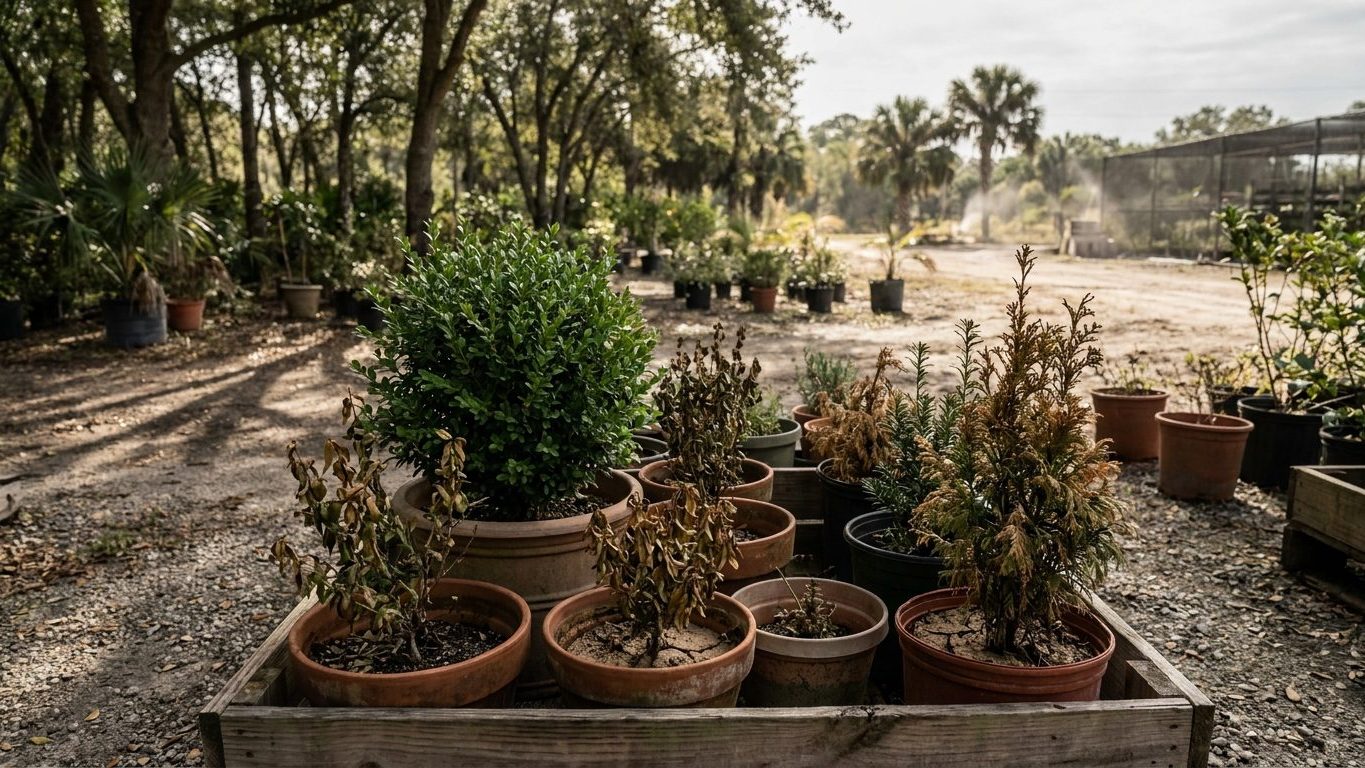

Ten of the twelve hedge plants documented on this site survive everywhere in Kansas. Two do not. Leyland cypress and cherry laurel hold only in zones 6a, 6b and 7a, so the coldest ground in the state, zone 5b, sits outside their range. Three of the ten survivors carry a different catch: once they outgrow their space, they can never be cut back down. Both facts should decide what you buy.
What actually holds in Kansas
Kansas spans zones 5b to 7a on the USDA Plant Hardiness Zone Map 2023, which is built on 1991-2020 climate normals. The system rests on a single variable, the average annual extreme minimum temperature. A zone tells you how cold the worst night of a typical winter gets. It says nothing about summer heat, drying wind or a dry August.
Cross that range with the hardiness data for each plant (drawn from the NC State Extension Gardener Plant Toolbox) and the result is three buckets, not two. Ten species hold across the whole state. Two hold in part of it. None fail everywhere.
The two that need your zone named
Leyland cypress (x Hesperotropsis leylandii) and cherry laurel (Prunus laurocerasus) are rated only for 6a, 6b and 7a. In a 5b yard, the one that sells fast at the garden center is a gamble. Leyland grows 3 to 4 feet a year and reaches 15 to 25 feet as a screen, which is exactly why people want it. Cherry laurel is slower, at 1 to 2 feet a year, and tops out at 6 to 15 feet as a hedge. Either one can look perfect for two or three winters and then lose everything in a single cold snap that a zone 6 yard would have shrugged off.
Look up your ZIP code on the USDA map before you shop. The state range is a spread, and the county next door can sit in a different zone.
Survives is not the same as thriving
A plant listed as hardy to a zone will live through that zone’s typical coldest night. It may not look good doing it. The upper end of a hardiness range is often a heat limit, not a cold one, so a plant rated to zone 7 on paper can still sulk through a hot Kansas summer. “Holds” here means survives. Whether it thrives depends on your site, your soil and how you water it in the first two years.
Timing matters too. At the reference weather station used for this page, the NOAA NCEI 1991-2020 normals put the last spring freeze between April 4 and April 18, and the first fall freeze between October 23 and November 2. Those are one station’s numbers, not a state-wide guarantee. Suburban and rural yards usually freeze later in spring and earlier in fall, often by one to two weeks, so check your own county with K-State Research and Extension at ksre.k-state.edu. If you are comparing lists across states, the Hedges hub links to each territory, including Hedge Plants for South Dakota: What Holds, and What Only Looks Hardy and Hedge Plants for Kentucky: What Holds, and What Only Looks Hardy.
The hedges you can never cut back down
Of all the fields in the data, one matters most once the hedge is in the ground: whether the plant regrows from old wood. Three of the hardy species do not. Eastern red cedar, arborvitae and Leyland cypress put out foliage only on the outer, green growth. Cut into the bare brown interior and the branch stays bare. There is no recovery, only a hole.
Here is how each one behaves.
- Eastern red cedar (Juniperus virginiana) grows 12 to 24 inches a year and reaches 8 to 20 feet as a screen. It takes light cuts only, in late winter, and it never regrows from old wood.
- Arborvitae (Thuja occidentalis) grows 6 to 9 inches a year and holds 4 to 15 feet as a hedge. Prune in late winter before growth starts, or in midsummer. It does not regrow from old wood either.
- Leyland cypress, hardy only in 6a, 6b and 7a, prunes from late spring to midsummer and cannot regrow from old wood. The plant that fails in a 5b winter is also the one you cannot rescue after it outgrows its spot.
The practical rule is to buy for the size you want at maturity, then trim early and often to keep it there. A Leyland at 3 to 4 feet a year passes the 6-foot mark in about two seasons. Wait until it towers over the property line and the only fix is removal.
Everything else on the list forgives you. Boxwood, American hornbeam, inkberry holly, winterberry holly, privet, yew, eastern hemlock and arrowwood viburnum all regrow from old wood, and so does cherry laurel where it is hardy. Overgrown privet can be cut to a stump and will come back thick. Yew and boxwood can be renovated, though slowly, since boxwood adds only 3 to 6 inches a year and yew 6 to 12 inches. Hemlock and red cedar both take light cuts only, but hemlock at least recovers if you overdo it.
One more calendar detail: none of the pruning windows in the data fall in autumn. They run from late winter through midsummer. If you are reading this in late September, the useful move is to plant and water, not to shear.
Matching the plant to the job
A screen, a formal edge and a wildlife hedge are different jobs, and the numbers separate them cleanly. For height, red cedar (8 to 20 feet) and hemlock (10 to 20 feet) are the tall screens among the plants that hold statewide. For a low formal line, boxwood (2 to 6 feet) and yew (3 to 8 feet) grow slowly enough that one trim a year keeps them neat. Privet sits at the opposite extreme: 2 to 3 feet a year, and it wants pruning twice a season, in spring and midsummer.
| Plant | Height as hedge or screen | Growth per year | When to prune | Regrows from old wood |
|---|---|---|---|---|
| Boxwood | 2 to 6 feet | 3 to 6 inches | Late spring, after the last frost | Yes |
| American hornbeam | 6 to 15 feet | 12 inches | Midsummer, after the first flush | Yes |
| Inkberry holly (evergreen) | 5 to 15 feet | 6 to 12 inches | Late winter, while dormant | Yes |
| Winterberry holly (loses its leaves) | 5 to 15 feet | 6 to 12 inches | Late winter, while dormant | Yes |
| Eastern red cedar | 8 to 20 feet | 12 to 24 inches | Late winter, light cuts only | No |
| Privet | 4 to 12 feet | 2 to 3 feet | Spring and midsummer | Yes |
| Yew | 3 to 8 feet | 6 to 12 inches | Late spring, after new growth hardens | Yes |
| Arborvitae | 4 to 15 feet | 6 to 9 inches | Late winter, or midsummer | No |
| Eastern hemlock | 10 to 20 feet | 12 to 24 inches | Late spring, light cuts only | Yes |
| Arrowwood viburnum | 6 to 10 feet | 12 to 24 inches | Right after flowering | Yes |
The table hides a trade-off worth naming. Fast growers such as privet and red cedar fill a gap in three or four years, but they demand more pruning (privet) or cannot be reset (red cedar). Slow growers such as boxwood and yew cost more per foot of finished hedge and take years, yet they are the easiest to keep at a fixed height.
Winterberry is the one deciduous choice among the hollies, so it gives little privacy in January. Inkberry stays evergreen and covers the same 5 to 15 feet. If winter screening is the point, pick the evergreen.
Pay attention to the pruning date against your local frost. Boxwood, for instance, is pruned in late spring after the last frost. At the reference station that means after April 4 to 18, and a colder rural yard should wait a week or two longer. A trim that pushes new growth just before a late freeze is how a hedge gets a brown fringe.
The ground you are planting into
The Harney series is Kansas’s official state soil, named by state law in 1990. It is a Mollisol, the deep, dark prairie soil that helped build the Corn Belt. USDA NRCS records representative surface values for it: pH about 6.7 (near neutral), 9 percent sand, 24 percent clay and 67 percent silt, organic matter about 2.0 percent, and well drained. Silt-heavy loam like that generally lets water through without holding it in a puddle, which suits most of the hedges above.
That describes the soil that represents the state, not the soil in your yard. Kansas contains hundreds of soil series. River bottoms, hill country and any lot a builder has scraped or filled can differ completely from Harney. These are mapped surface figures, not a reading from a worked garden bed, and 6.7 is not your pH.
A soil test settles it, and a county extension office can tell you how to collect and submit a sample through K-State Research and Extension. What you want back is your own pH and organic matter number. If the result runs neutral to alkaline, plants often grown in acidic ground, such as hemlock and the native hollies, may struggle, so match your choice to the result rather than the plant tag.
Compacted subsoil is the other common problem on new-construction lots, where topsoil is often stripped away. Dig a hole, fill it with water and time the drain. If it is still standing after a day, choose a plant that tolerates wet feet or plant on a low berm.
Common questions
Can I grow Leyland cypress in Kansas?
In part of the state. It is rated for zones 6a, 6b and 7a, so it is a poor bet in 5b. Even where it survives, it grows 3 to 4 feet a year and cannot regrow from old wood, which makes it hard to control once it is too big.
Which hedge plants hold in every part of Kansas?
Ten of the twelve documented species: boxwood, American hornbeam, inkberry holly, winterberry holly, eastern red cedar, privet, yew, arborvitae, eastern hemlock and arrowwood viburnum. Hardy across the whole state means it survives the coldest zone, not that it thrives in every yard.
Which hedges can I cut back hard if they get too big?
Boxwood, hornbeam, both hollies, privet, yew, hemlock and arrowwood viburnum regrow from old wood, though hemlock takes light cuts only. Eastern red cedar, arborvitae and Leyland cypress do not, so keep them trimmed to size from the start.
When should I prune a new hedge?
It depends on the species, and none of the documented windows fall in autumn. Hollies and red cedar go in late winter, boxwood in late spring after the last frost, hornbeam in midsummer, and arrowwood viburnum right after it flowers. Frost dates from one weather station are a starting point, since rural yards often freeze later in spring by one to two weeks.