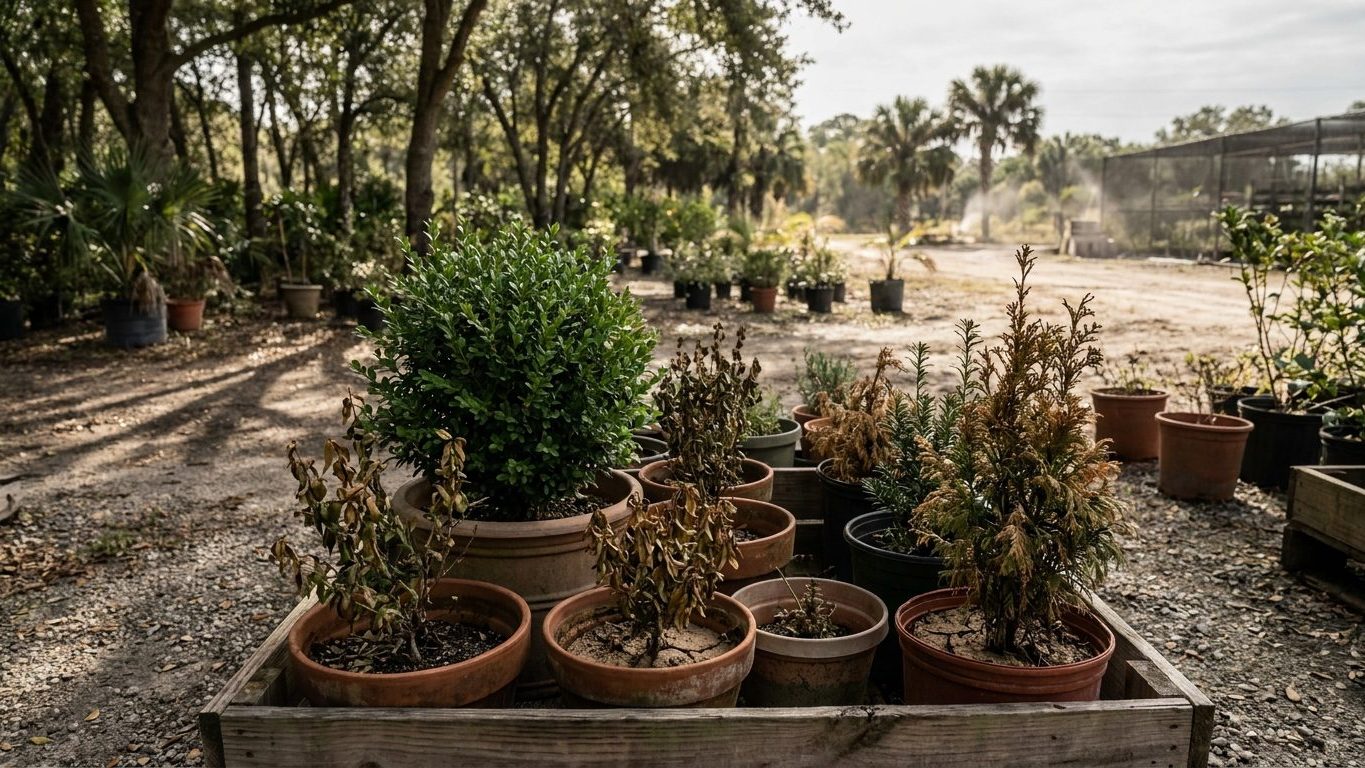

Nine of the twelve hedge plants we track hold across all of Nebraska, one holds in only part of it, and two are not hardy here at all. Leyland cypress and cherry laurel are the two that fail. Boxwood is the one that depends on your zone. Nebraska runs from USDA zone 4a to 5b, and that spread decides which plant-tag promises you can trust.
What actually holds in Nebraska
The USDA Plant Hardiness Zone Map 2023 (built on 1991-2020 normals) places Nebraska between zones 4a and 5b. That system rests on a single variable, the average annual extreme minimum temperature. The hardiness ranges for each plant come from the NC State Extension Gardener Plant Toolbox, and we checked them against that Nebraska range. The result sorts hedge plants into three buckets, not two.
The two that will not make it
Leyland cypress (x Hesperotropsis leylandii) and cherry laurel (Prunus laurocerasus) are not hardy anywhere in Nebraska. Both are popular evergreen hedges in milder regions, and a plant tag or a national online seller will not check your zone for you. Planting either here means buying a fast, handsome hedge that will not last through the winters. If you want a broadleaf evergreen or a tall evergreen screen, the nine survivors below cover both jobs.
The one that depends on your zone
Boxwood (Buxus sempervirens) holds only in zones 5a and 5b. In 4a it does not. That makes it a real yes for some Nebraska yards and a real no for others, so look up your own zone on the USDA map before you order. Where it holds, it grows 3 to 6 inches a year and stays a hedge of 2 to 6 feet, pruned in late spring after the last frost. It regrows from old wood.
The nine that hold everywhere
These survive the whole 4a-5b range: American hornbeam, inkberry holly (evergreen), winterberry holly (loses its leaves in winter), eastern red cedar, privet, yew, arborvitae, eastern hemlock and arrowwood viburnum. Read “holds” as “survives,” though. A zone match says nothing about how well a plant grows, and the warm end of a plant’s range is often a heat limit rather than a cold one. A hedge that gets through January can still sulk through a Nebraska August. Treat the zone as the first filter, then ask your county extension office how each plant performs in your area.
The hedges you can never cut back down
Two of the nine cannot be cut back once they outgrow their spot: eastern red cedar (Juniperus virginiana) and arborvitae (Thuja occidentalis). Neither regrows from old wood. Cut into the bare, brown interior and it stays bare, and no amount of patience fills the hole. Every other plant on the list does regrow from old wood, which means a hard rejuvenation cut is a real option for them and a permanent scar for these two.
The mistake usually looks like this: an arborvitae that can reach 15 feet goes in under a window, with the plan to shear it back once it gets big. It never comes back. Arborvitae grows 6 to 9 inches a year and reaches 4 to 15 feet as a hedge. Eastern red cedar grows 12 to 24 inches a year and reaches 8 to 20 feet as a screen. Pick the spacing and the site for the size the plant will be in ten years, because the shears will not fix it later.
| Plant | Regrows from old wood | When to prune |
|---|---|---|
| Eastern red cedar | No | Late winter, light cuts only |
| Arborvitae | No | Late winter before growth starts, or midsummer |
| Yew | Yes | Late spring after the new growth hardens |
| Eastern hemlock | Yes | Late spring, light cuts only |
| Inkberry holly | Yes | Late winter, while dormant |
| Winterberry holly | Yes | Late winter, while dormant |
| Arrowwood viburnum | Yes | Right after flowering |
| American hornbeam | Yes | Midsummer, after the first flush |
| Privet | Yes | Twice a season, spring and midsummer |
| Boxwood (zones 5a and 5b only) | Yes | Late spring, after the last frost |
Look down that last column and you will see a pattern: none of these windows falls in autumn. With the calendar at September 29, the shears can stay in the shed until late winter for the hollies, cedar and arborvitae. Hemlock and yew wait for late spring.
Matching the plant to the job
Start with the height you need, because the range on these plants is wide. For a tall evergreen screen, eastern red cedar and eastern hemlock are the fastest, both adding 12 to 24 inches a year. Cedar reaches 8 to 20 feet and hemlock 10 to 20 feet. Arborvitae is slower and smaller at 4 to 15 feet. Hemlock does regrow from old wood, but the guidance is light cuts only, so do not count on a dramatic reset.
For a clipped, formal hedge, yew is the workhorse at 6 to 12 inches of growth a year and a size of 3 to 8 feet. Boxwood suits the same job at a lower height, but only if you are in zone 5a or 5b. Inkberry holly (5 to 15 feet, 6 to 12 inches a year) is the evergreen broadleaf option that holds across the whole state. Its cousin winterberry holly has the same size and growth rate but drops its leaves, so it works as a boundary rather than a year-round screen.
Speed has a price. Privet adds 2 to 3 feet a year and settles at 4 to 12 feet, which gets you privacy faster than anything else here. It also wants pruning twice a season, in spring and again in midsummer. Arrowwood viburnum (6 to 10 feet, 12 to 24 inches a year) is pruned right after flowering. American hornbeam grows about 12 inches a year to 6 to 15 feet and is trimmed in midsummer after its first flush of growth.
On timing, the NOAA NCEI U.S. Climate Normals for 1991-2020 give a reference airport station a last spring frost between April 12 and April 23, and a first fall frost between October 15 and October 26 (both are 32 F freeze probabilities in the 30 to 70 percent band). That is one station, not the state. Suburban and rural yards typically see the last spring frost later and the first fall frost earlier, often by one to two weeks. Check your own county before you set a planting date, and remember that from today the earliest reference-station frost is about two weeks off.
Other states get different lists from the same method. See Hedge Plants for Connecticut: What Holds, and What Only Looks Hardy and Hedge Plants for Alaska: What Holds, and What Only Looks Hardy for how much the answer shifts. The wider picture of hedge types and care lives in Hedges.
The ground you are planting into
Nebraska’s official state soil, named by state law in 1979, is the Holdrege series, a Mollisol. It is the deep, dark prairie soil that helped build the Corn Belt. USDA NRCS records representative surface-layer values for it (across 248 mapped components, queried August 29, 2026): a pH of about 6.2, which is slightly acid, and a texture of 11 percent sand, 22 percent clay and 67 percent silt. Organic matter is about 2.0 percent, and the soil is well drained.
Read that as a description of what the region’s ground tends to do, not of your yard. Silty loam like this usually takes a hedge root system well: it drains, it is close to neutral, and it holds moisture better than sand. But it is one series out of hundreds in the state. River bottoms, hill country and any lot a builder has scraped or filled can differ completely, and compacted subsoil under a thin layer of topsoil is common on new subdivisions. Those figures are also survey values for the surface layer of the mapped series, not a measurement of a worked garden bed, and your pH may not be 6.2.
The fix costs little. Send a soil sample through your county extension office, part of the University of Nebraska-Lincoln network at extension.unl.edu, and get your own numbers before you buy a row of plants. A test takes a few weeks, which is one more reason to plan now for spring planting if the fall window closes on you.
Common questions
Can I grow boxwood in Nebraska?
Only in zones 5a and 5b. It is not hardy in 4a. Look up your zone on the USDA Plant Hardiness Zone Map 2023 before ordering. If you are in a colder pocket, yew is the closest formal-hedge substitute that holds across the whole state, at 3 to 8 feet.
What evergreen can replace Leyland cypress or cherry laurel?
Neither of those is hardy here, so use one of the nine survivors instead. Arborvitae, eastern hemlock and eastern red cedar work as tall evergreen screens. Yew suits a clipped hedge, and inkberry holly is the evergreen broadleaf choice. Remember that arborvitae and red cedar will not regrow from old wood.
Which Nebraska hedge grows the fastest?
Privet, at 2 to 3 feet a year. Eastern red cedar, eastern hemlock and arrowwood viburnum follow at 12 to 24 inches a year. Privet needs two prunings a season, in spring and midsummer, so the fast growth comes with a steady maintenance job.
Does a zone match mean the hedge will thrive?
No. A zone match means the plant should survive your coldest winters. It does not tell you how the plant handles summer heat, and the warm end of a range is often a heat limit. Local performance is the missing piece, and your county extension office is the place to ask, with a soil test result in hand.