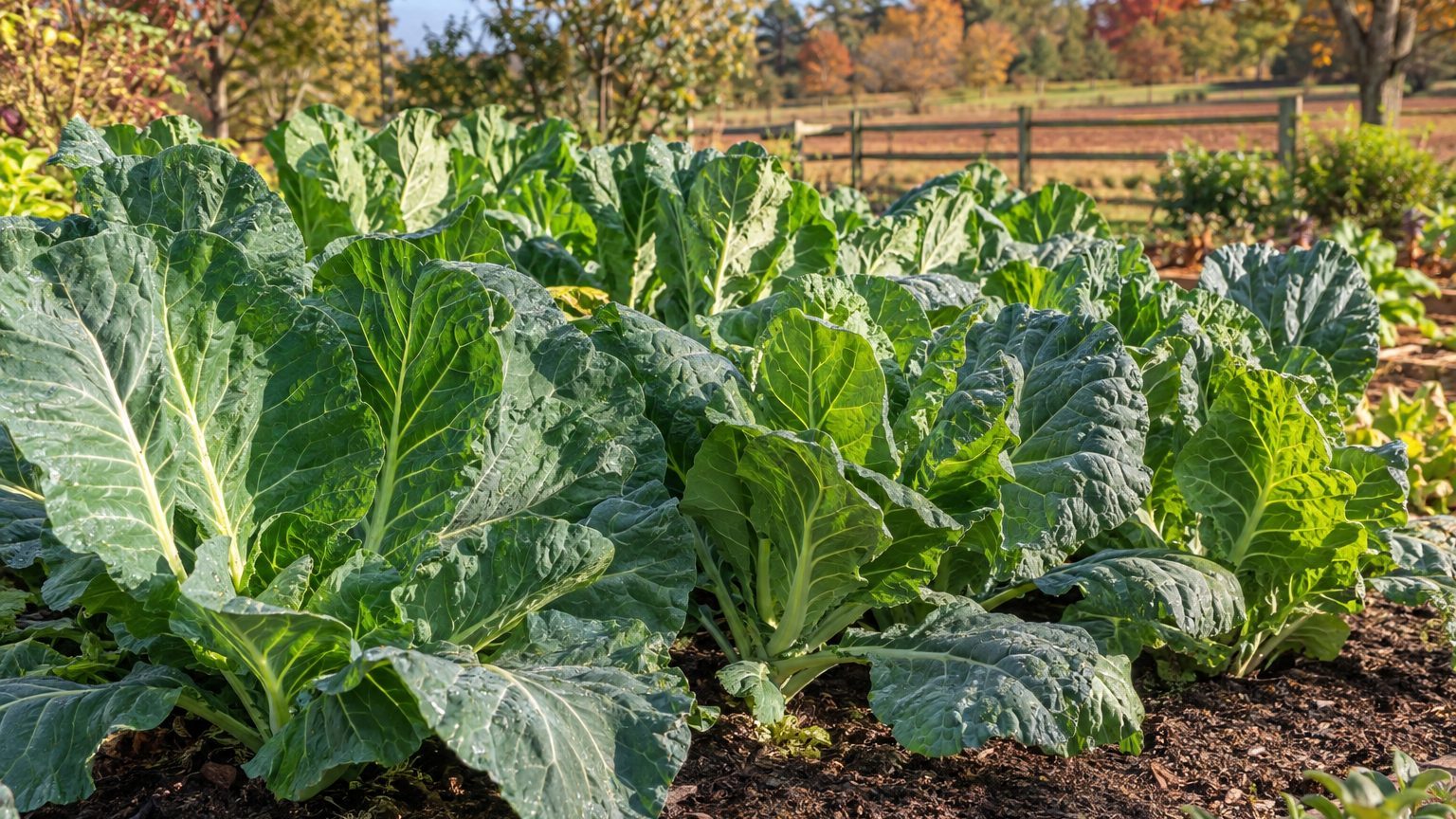

For most South Dakota gardens, the best collards are quick-maturing, compact types set out as transplants and grown as much for fall as for summer. Long-season Southern heirlooms, bred for a Georgia calendar, tend to run out of runway before the first hard freeze. Kale, mustard and turnip greens cover the gaps. This page has no county trial data, so use it as a starting point, not a verdict.
The short answer for South Dakota
Pick collards sold as early or fast-maturing, and read the days-to-maturity figure on the packet before anything else. In a short northern season that number matters more than leaf color, flavor claims or a variety’s Southern reputation. Start with transplants, not seed sown in the ground, and keep kale on hand as a backup. Cold hardiness is rarely the limit here. The calendar is.
The frost numbers explain why. At the reference station (Sioux Falls), NOAA’s 1991-2020 Climate Normals put the last spring 32°F freeze in a band running April 29 to May 9. That band is a probability, not a promise: it covers the dates where the chance of another freeze at or below 32°F falls between 30 and 70 percent. In fall, the same band runs from September 24 to October 4. You can see the underlying data in the NOAA NCEI normals for the station.
Treat those as reference-city dates, not a state-wide guarantee. Suburban and rural gardens typically see the last spring frost later and the first fall frost earlier than an airport station, often by one to two weeks, and more at elevation. A farm-edge garden can lose a good chunk of what looks like a comfortable season on paper.
That leaves a decision by type, and the table below sums it up. Summer heat is not the deciding factor here. Season length is.
| Type | Fit for South Dakota | How to use it |
|---|---|---|
| Early, compact collards | Best match for a short season | Transplants set out after frost risk fades |
| Tall, slow Southern collards | Risky; may not finish | Only with a head start, and expect a smaller harvest |
| Kale | Reliable backup | Same bed, same timing, often faster to pick |
| Mustard and turnip greens | Quick fillers | Spring and late-summer sowings |
Timing details, including how to work backward from your frost date, live on When to Plant Collards in South Dakota. The broader crop overview is in Growing Collards in South Dakota.
What will not work here
The slowest collards come first. A variety that needs a long, warm run to reach full size can be caught by frost in late September or early October, right when it should be at its best. You would get a plant that looks healthy and yields little more than baby leaves. That is fine if you like tender greens, but it is not what the seed catalog promised.
Overwintering is the second failure. The mean daily minimum of the coldest month at the reference station is 8.5°F. That is an average of the nightly lows, so the real nights in a bad January go well below it. Advice from Southern gardeners about leaving collards in the ground for a spring harvest, or planting in late fall for winter picking, does not carry over. Plan to pull the crop after the hard freezes and treat it as an annual.
Third, planting on the reference-city frost date. April 29 to May 9 is where the odds of another 32°F freeze run between 30 and 70 percent, so a transplant set out on those dates faces a real chance of a frost after it goes in. In a rural garden that runs a week or two later than the airport, the odds get worse. Collards tolerate a light frost, but a hard one on a freshly planted, soft seedling is a different matter. Have row cover or old bedsheets ready, or wait.
Fourth, watering on a fixed weekly schedule. Plains summers can swing between dry, windy stretches and heavy storms, and a shallow, once-a-week soak does little for a shallow-rooted leaf crop in a dry July. Plants stressed in the heat turn tough and can taste sharp. A layer of mulch and a habit of checking the soil by hand does more than any schedule.
Finally, close spacing paired with high hopes. Crowded plants in a short season compete for light and nutrients and finish smaller, not faster. Give each collard room to fill out, and put the extra plants in a separate bed where you can pull them young as greens.
What changes across South Dakota
South Dakota is not one garden. The USDA Plant Hardiness Zone Map (2023 edition, built on 1991-2020 normals) places the state anywhere from zone 3b to 5b. That is a wide spread, and there is no single answer for the whole state. The zone system rests on one variable, the average annual extreme minimum temperature, so it tells you about winter cold, not about how many frost-free weeks you get.
For collards, that distinction matters. Because you will grow them as an annual, the zone tells you less than your local frost dates do. A gardener in a colder zone will feel the difference mostly at the two ends of the season: later planting out in spring, and an earlier end to harvest in fall. The reference-city figures above sit in the middle of that range, not at either extreme.
If you garden in the north, or at higher elevation such as the Black Hills, shift toward the fastest types on the list and lean harder on kale. Start transplants indoors, use row cover on both ends of the season, and choose the earliest-maturing collard you can find. Expect fewer full-size leaves than the packet photo suggests. A garden in the warmer southeast has more slack, and the slower types become a reasonable gamble there.
Do not guess which band you fall into. Look up your own location on the USDA map, and use it alongside your county frost dates. The two together give you a better picture than either alone.
Where to check this for your own county
Your state extension service is the best next stop. South Dakota’s is at extension.sdstate.edu, listed in the USDA NIFA directory of land-grant extension services. It is a free source staffed by people who know the local soil, weather and pests.
Look for two things. The first is a local planting calendar, ideally one written for your county or region, with a spring and a fall window for cool-season greens. The second is any list of varieties trialled nearby. Not every county will have collard trials, and this page cannot promise they exist. If there are none, ask about kale or other brassica greens, since a trial for a close relative tells you a lot.
Your county office can also tell you the typical last and first frost dates for your area, which is more useful than any airport station. A county recommendation beats a state one, every time. This page is the state one: it gives you the shape of the decision, and the extension gives you the specifics for your ground.
Checking this against your own garden
Your own observations outrank every date here. Three are worth watching, and none needs equipment.
First, soil warmth by feel. Push your hand a few inches into the bed in spring. If it feels cold and clammy, wait. A bed that warms early, such as one against a south wall or a raised bed, tells you that you can plant sooner than your neighbor with a low, shaded plot.
Second, watch where frost lingers. On a clear, calm morning after a cold night, see which parts of the yard stay white longest. Low spots hold cold air and frost late in spring and early in fall. If your collards live there, shorten your season on paper.
Third, watch the first true leaves on your seedlings, the ones that follow the initial rounded pair. If they appear slowly on a windowsill, the spot is too cool or dim. Seedlings that stretch and flop are asking for more light. Once they have several true leaves and have been hardened off outdoors, they are ready for the bed.
Keep a short notebook of dates each year. After two or three seasons, your own record will be a better guide than any airport normal.
Common questions
Can collards survive a South Dakota winter?
Not reliably. The coldest month’s mean daily minimum at the reference station is 8.5°F, and actual lows run lower. Collards handle light frost, but treat them as annuals here and plan to pull them after the hard freezes.
Is kale a better choice than collards?
In a short season, kale is often the safer bet because many types mature faster. Collards are still worth growing if you choose an early, compact type. Many gardeners plant both in the same bed.
Should I start collards from seed indoors or sow directly?
Transplants give you a head start, which matters when the season is short. Work backward from your own last frost date, and see the planting calendar page linked above for the timing method.
Will a fall frost ruin my collards?
A light frost usually will not. A hard freeze can end the crop. At the reference station, the first fall freeze band runs September 24 to October 4, and rural gardens often see it one to two weeks earlier.