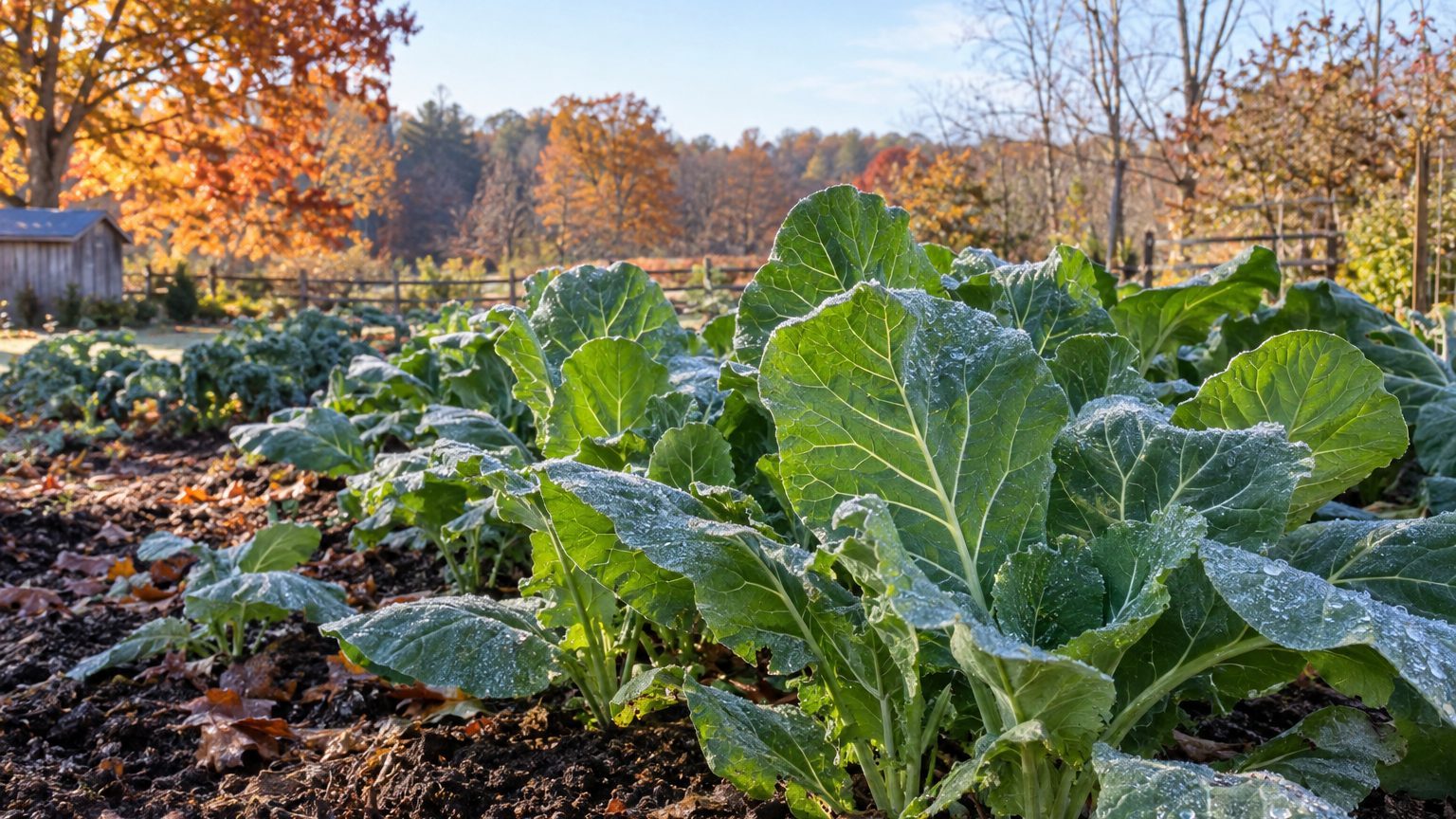

Set collard transplants in the garden between May 7 and May 18, and start the seed indoors about four to six weeks before that. Those dates come from NOAA’s 1991-2020 climate normals, and they describe odds, not guarantees. A short second planting for fall is possible, but only with cover. For the full growing picture, see Growing Collards in Wyoming.
The short answer for Wyoming
Plan on transplanting collards during the May 7 to May 18 window, and count backward from it for indoor seed. The window is the last spring frost range from NOAA NCEI’s 1991-2020 Climate Normals (station USW00024018), and it comes with a caveat. It is not the date frost stops. It marks the band where the probability of a 32°F freeze falls between 30 and 70 percent. On the early end of the window, another freeze is still more likely than not. On the late end, it is still roughly a one-in-three shot.
The other end of the season is the first fall frost window: September 24 to October 5, on the same NOAA basis. Between the two windows the state’s reference figure is roughly 130 frost-free days at 6,000 feet. That is the entire budget for anything that dislikes freezing. Collards are tougher than most garden crops, since they shrug off light frost, but a Wyoming gardener still plans around that 130-day number because it dictates which varieties finish and when the plants can go out.
The dates above are for one reference station. Wyoming does not have one frost date, and frost can arrive in any month at higher elevations. So read the calendar below as a starting frame and adjust it with your own elevation in mind.
| Task | Timing | Reasoning |
|---|---|---|
| Start seed indoors | About 4 to 6 weeks before the spring window opens | Gives sturdy transplants instead of leggy ones |
| Harden off | The week before transplanting | Wind and sun at altitude burn tender leaves |
| Transplant outdoors | May 7 to May 18, with cover on nights forecast near freezing | Collards tolerate light frost, not repeated hard freezes on young plants |
| Direct-sow seed | After the window, once soil has warmed | Cold soil stalls germination and eats into a 130-day season |
| Harvest wrap-up | Fall window, September 24 to October 5 | A light frost is fine; a hard freeze ends the crop |
Which types actually finish inside that budget is a separate question, and The Best Collards and Greens for Wyoming covers it. The short version: with a season this size, favor the quicker types and start them as transplants.
What will not work here
Start with the plan most Southern growing advice assumes: sow in the ground, thin, and let the plants run all summer. Roughly 130 frost-free days is not a long runway. The slowest, largest collard types are bred for seasons that stretch far longer, and in Wyoming they may still be sizing up when the September 24 to October 5 window arrives. You get a plant that looks healthy and yields little.
Planting on the average date is the second trap. The May 7 to May 18 range is a 30 to 70 percent probability band, which means a freeze after May 18 is not a freak event. Gardeners who set out unprotected transplants on May 7 are betting against roughly even odds. Collards are hardy enough to survive many of those nights, but small transplants that were grown indoors take a real hit from a hard freeze combined with wind.
Overwintering is the third. Collards standing in the row all winter are a Southern habit, and it does not carry over. The mean daily minimum of the coldest month at the Cheyenne reference station is 18.1°F. That is an average of the nightly lows, not the record low, so plenty of nights run colder. In the state’s northern and high-elevation gardens, where hardiness zones run lower, the plants have even less chance. Treat collards here as an annual and pull them at the end of the season.
A fourth failure is late sowing for fall. Sow in August and the seedlings are still tiny when the first fall frost window opens. Cool weather slows growth further, so a plant that would have doubled in size in July barely moves in October. If you want a fall crop, sow earlier in summer and plan for baby leaves rather than full heads of mature foliage.
Watering deserves one honest note. This page does not carry a Wyoming rainfall figure, so it makes no claim about a weekly schedule. But high, open, windy ground dries out faster than most gardeners expect, and a once-a-week soak that works in a humid state can leave shallow-rooted collards stressed between waterings. Check the soil a few inches down before you decide, not the calendar.
Finally, going without season extension is a mistake here. The CAUTION in the regional data is blunt on this point: extension is not optional at 6,000 feet. Row cover, a cold frame, or water-filled plant protectors are what turn a coin-flip spring into a workable one.
What changes across Wyoming
Wyoming is not one garden. On the USDA Plant Hardiness Zone Map (2023 edition, built on 1991-2020 normals), the state spans zones 3a to 6a, a spread of three full zones. That system uses one variable only: the average annual extreme minimum temperature. It tells you how cold the worst nights get, not how long the growing season lasts, so it is a rough guide for collards rather than a planting calendar.
Because the range is so wide, there is no single answer for the whole state. The dates on this page are anchored to the Cheyenne reference area, and other parts of Wyoming differ, sometimes by weeks. Frost is possible in any month at higher elevations, which means a mountain-valley garden can lose a July planting to a cold snap that a lower plains garden never sees.
Here is how to shift the calendar. If you garden in the northern part of the state, or at altitude, treat May 7 to May 18 as the earliest you should plant, not the target date. Move transplanting later, be ready to cover plants for weeks after that, and lean on the fastest varieties you can find. The fall window compresses in the same way: frost can arrive before September 24 at higher elevation, so plan to finish harvest earlier.
Gardeners at lower elevations may find they have a bit more room, though this page does not carry local frost data for those spots, and it would be guesswork to promise extra days. Look up your own location on the USDA Plant Hardiness Zone Map, which lets you search by ZIP code, rather than assuming which zone you fall in. Your neighbor across a ridge or a river valley may be in a different one.
Where to check this for your own county
Your state extension service is the next stop. The University of Wyoming Extension is listed in the USDA NIFA Land-Grant University Extension directory at https://www.uwyo.edu/uwe/. From there you can find your county office and its vegetable guidance. What you want is the local planting calendar and any trial results for varieties grown in your county, not the state overview.
This page is the state-level view, and a county recommendation beats a state one every time. Counties in Wyoming differ in elevation, wind exposure and frost timing, and county extension staff see what actually survives in local gardens. When their calendar and this page disagree, follow theirs.
When you contact them, ask for the county’s vegetable planting calendar and the last and first frost dates they use, then ask specifically whether collards or other brassica greens have been trialled nearby. If they have, note the variety names and days to maturity, and compare them with the 130 frost-free days above.
One disclosure about what this page lacks: it has no Wyoming extension collard calendar to point to. The only extension calendar in our records is a lawn-care calendar for tall fescue from Clemson University in South Carolina, which is the wrong crop and the wrong state, so it is not used here. If your county office has a vegetable calendar, it is a better source than anything on this page.
Checking this against your own garden
Your own observations outrank every date above. Three things are worth watching, and none needs equipment.
First, soil warmth by feel. Push your bare hand a few inches into the bed in the morning. If the soil still feels cold enough to make your fingers ache, seed will sit and sulk. Beds that warm up early tell you that you have a sheltered microclimate, perhaps against a south-facing wall. Beds that stay cold late are telling you to wait longer than the calendar suggests.
Second, the first true leaves on your indoor seedlings. The round seed leaves come first; the true leaves follow. When two or three true leaves have formed, the plants are close to ready for hardening off. If they are slow, your indoor spot is too cool or too dim, and your transplant date will slip accordingly.
Third, where frost lingers. On a cold spring morning, walk the yard and note which spots stay white the longest. Low corners, where cold air pools, may frost weeks after the higher, breezier parts of the same lot. That pattern is a map of your microclimate, and it tells you where to put the collards and where to put the row cover.
Write down the date of the last morning you see frost on your grass each spring, and the first in fall. After two or three years, those notes will tell you more than any station average.
Common questions
Can I direct-sow collards in Wyoming?
Yes, but with limits. Wait until after the May 7 to May 18 window, and until the soil has warmed enough that seed will germinate. Direct-sown plants give up weeks compared with transplants, so most gardeners with a 130-day budget start indoors instead.
Will collards survive a Wyoming winter?
Do not count on it. The coldest month’s mean daily minimum at the Cheyenne reference station is 18.1°F, and the state’s hardiness zones run from 3a to 6a. Plan on collards as a one-season crop.
Do I really need row cover?
For spring, yes, in most parts of the state. The last spring frost range is a probability band, and frost is possible in any month at higher elevations. Cover is what covers that gap for young transplants.
Can I plant a second crop for fall?
You can try, but the fall frost window of September 24 to October 5 arrives soon after mid-summer. Sow early enough that plants are well established before then, and treat the harvest as a bonus. Light frost is tolerated, so the crop does not have to end the day the window opens, though a hard freeze will finish it.