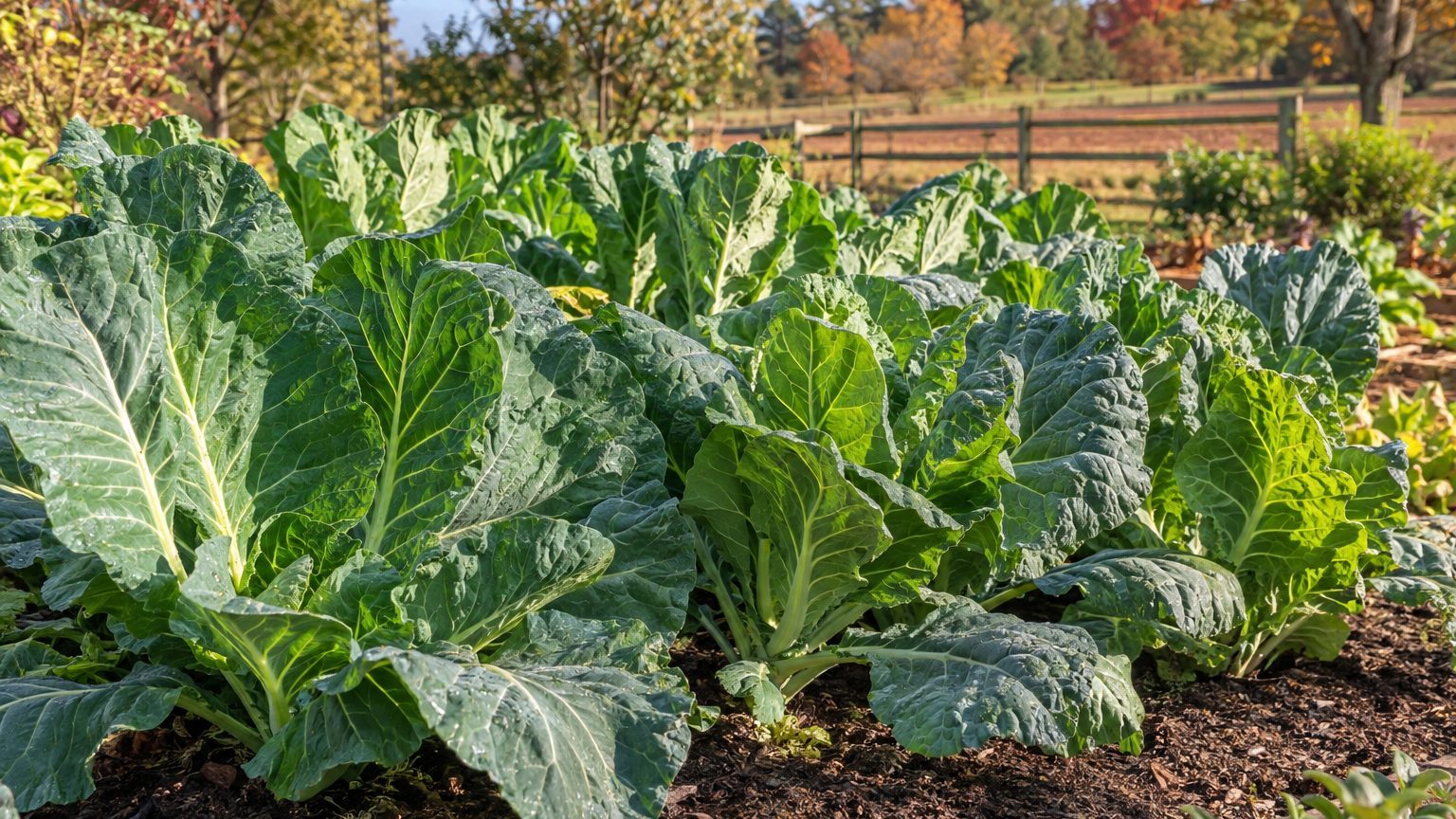

Pick the fastest-maturing open-leaf collard you can find, set it out as a transplant, and plan on a fall harvest. Vermont’s frost-free stretch is short, and collards bred for the long Southern summer often run out of calendar here. Kale, mustard, and turnip greens fill in where collards fall short. The rest of this page shows how the numbers back that up and where the picture shifts.
The short answer for Vermont
By type, Vermont favors early-maturing, open-leaf collards, plus kale and other quick greens. Long-season Southern-style collards are the gamble. The reason is arithmetic. At Burlington, NOAA’s 1991-2020 Climate Normals put the last spring 32°F freeze in a band of April 30 to May 10, and the first fall freeze between October 3 and October 13. Each range marks where the chance of a 32°F freeze sits between 30 and 70 percent. It is a probability, not a promise.
Count the days between the two bands and you get somewhere from 146 to 166. That is at the mildest corner of the state. Collards shrug off a light frost, so the fall end stretches a little. The spring end does not, because a transplant set out too early can be knocked back by one bad night. For the full picture of planting and care, see Growing Collards in Vermont.
Choose collards by days to maturity
Seed packets and catalog listings print days to maturity. In Vermont, favor the shorter numbers. A variety that needs nearly the whole frost-free window to size up leaves no margin for a cool June or a late transplant date. Collards are also a cut-and-come-again crop. You can pick lower leaves young while the plant keeps growing, so you are not waiting on a full-sized plant. This page does not have county trial data for named varieties in Vermont, so it stays with types rather than naming a winner.
The greens that fit alongside
| Type | Fit for Vermont | Why |
|---|---|---|
| Early open-leaf collards | Good | Shorter maturity, harvested leaf by leaf, handle light fall frost |
| Long-season Southern collards | Risky | Built for a long warm season this calendar does not offer |
| Kale | Strong | Generally tougher in the cold than collards, a sensible backup |
| Mustard and turnip greens | Strong | Quick to harvest, fit in spring and fall gaps |
| Swiss chard | Good | Steady through summer, tolerates light frost |
What will not work here
Direct-sowing collards outdoors in early April fails first. At Burlington the last-freeze band does not even open until April 30, and the Green Mountains and Northeast Kingdom run later. Seed in cold soil sits and sulks, and whatever does sprout is exposed to the next freeze. Transplants set out before the band closes need a cover on cold nights, or you should wait.
Slow varieties and late sowings
A long-season collard sown in the ground on May 10 spends its first weeks as a seedling. It has fewer than 146 days as a real plant before October 3, and that figure is for the mildest part of the state. Southern gardeners can sow a slow variety in spring and pick well into the next year. Vermont gardeners get a single stretch of warm growth. Collards tolerate light frost, so October 3 to October 13 is a soft edge rather than a wall. A hard freeze, though, ends the harvest for good.
Late-summer sowing for fall picking is another shaky bet with the slow types. The plants go into the ground with the days already shortening and the first-freeze band closing in. Quick mustard and turnip greens handle that timing far better.
Overwintering
Burlington’s mean daily minimum in its coldest month is 12.9°F. That is an average of the nightly lows, which means plenty of nights run colder, and this page does not have record lows. Growing collards through winter, the way gardeners do in the South, is not a reliable plan. Treat them as annuals, and expect any survivors to be a bonus. Outside Burlington, winters are harsher still.
The page also lacks Vermont rainfall or humidity figures, so it makes no ruling on watering schedules or plant spacing. What the numbers do show is that cold and the calendar limit collards here, not summer heat.
What changes across Vermont
There is no single answer for the whole state. The USDA Plant Hardiness Zone Map (2023 edition, built on 1991-2020 normals) spreads Vermont across zones 3b-5b. That is a wide gap. The zone is built on one variable, the average annual extreme minimum temperature, so it speaks to winter survival and says little about how many growing days you get. Frost dates do that job. Look up your own spot on the USDA map rather than guessing from a neighbor’s garden.
In the north and at altitude
Burlington sits on Lake Champlain, the mildest corner of the state, and every date in this article comes from that station. The Green Mountains and the Northeast Kingdom run substantially shorter. Readers there should treat the Burlington dates as the best case. Shift toward the earliest-maturing types, start transplants indoors, and keep a row cover handy for both ends of the season. Kale and quick greens deserve more of the bed than a slow collard does.
Near the lake and in the valleys
The Champlain side has the most room for a collard to finish. Even so, small differences matter. Cold air drains downhill on still nights and pools in low spots, so a garden at the bottom of a slope can frost while one fifty feet higher stays clear. The same yard can hold both conditions, which is why local observation beats any zone number.
Where to check this for your own county
Your state extension service is the next stop. For Vermont that is the University of Vermont’s extension, at https://www.uvm.edu/extension. Look for two things there. The first is a local planting calendar for collards, kale, and other cool-season greens. The second is any variety trials run in your county, which tell you what has actually performed in your local soil and weather.
A county recommendation beats a state one, and this page is the state one. It relies on a single reference station and a probability band. When you find a local calendar, check which frost threshold it uses and where the dates come from. Extension calendars are often organized by crop instead of by state, so find the sheet for the crop you are growing. Then compare the dates with When to Plant Collards in Vermont, which works from the same frost numbers. If the two disagree, trust the one closer to your zip code.
Checking this against your own garden
Your own observation outranks every date above. Three things are worth watching, and none needs equipment beyond your hands and eyes.
- Soil warmth by feel. Push your hand into the bed. If it feels cold and clammy after a few seconds, transplants will stall. Slow warming tells you your spot runs cool.
- The first true leaves. On indoor seedlings, the first leaves after the seed leaves show a plant ready to harden off. If they arrive later than the packet suggests, your indoor setup is short on light or warmth, and you should adjust the sowing date.
- Where frost lingers. Walk the yard on a cold morning. White grass that stays put marks a frost pocket, and bare patches mark the warm spots where collards belong.
Then write down the date of your last spring frost each year. Three seasons of notes will tell you more about your microclimate than a state page can.
Common questions
Can collards survive a Vermont winter?
Do not count on it. Burlington’s coldest-month mean daily minimum is 12.9°F, and colder places run lower. Plan on collards as an annual and treat any survivor as luck.
Is kale a better choice than collards in Vermont?
Kale is generally the tougher plant in the cold and a good backup, but the two do different jobs in the kitchen. Many Vermont gardeners grow both and lean on early collard types.
Should I start collards indoors or sow them in the garden?
Transplants make the most of a short season, since they skip the slowest weeks outdoors. Keep them covered or indoors until the spring freeze band (April 30 to May 10 at Burlington) has passed.
Do the Burlington dates apply to the Northeast Kingdom?
No. Burlington is the mildest corner of the state, and the Green Mountains and the Northeast Kingdom run substantially shorter. Use Burlington as the best case and check with your county extension office.