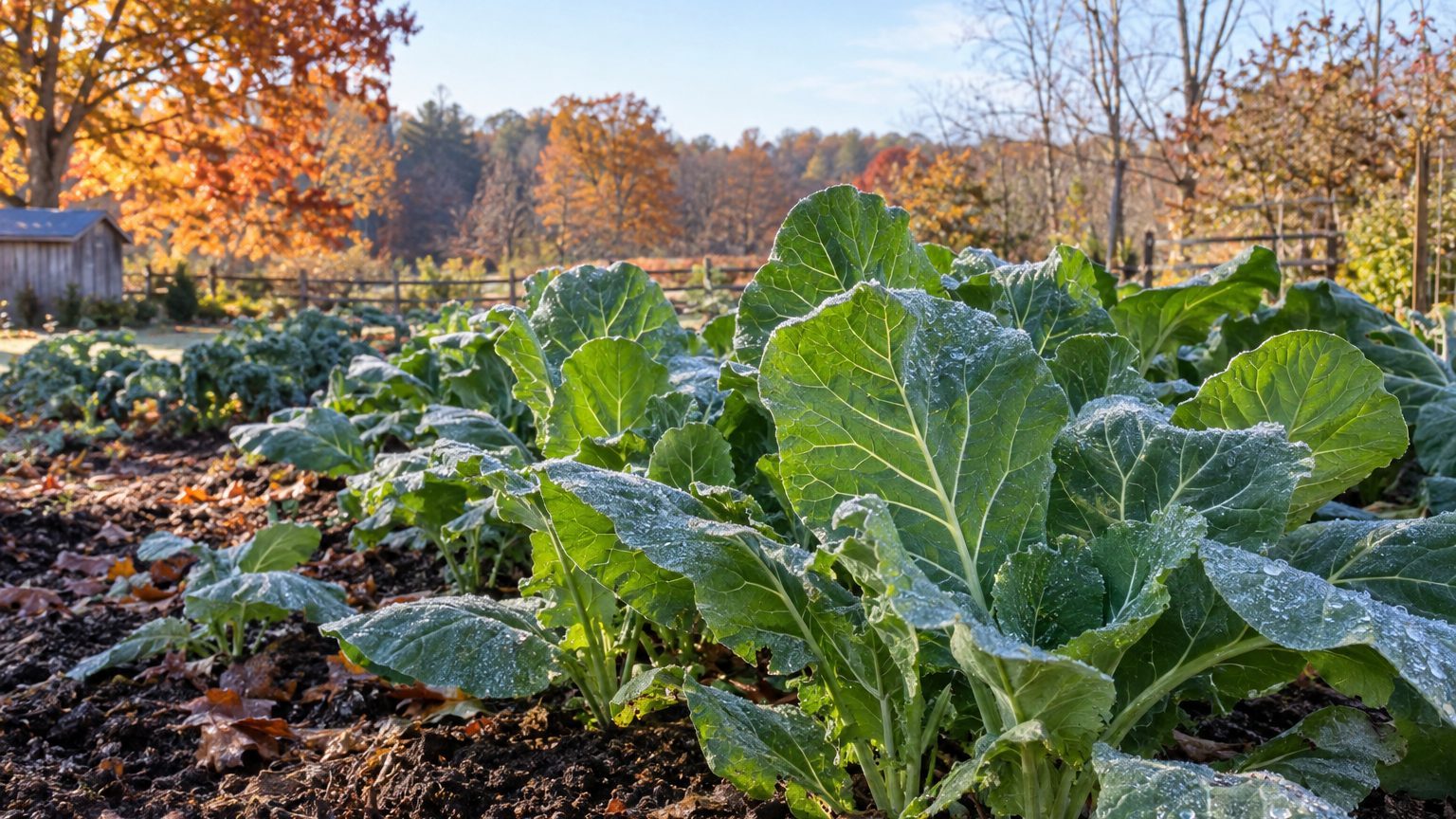

Start collards indoors in spring, move them into the garden around Vermont’s last frost, and count back from the first fall frost to check that your variety has time to finish. That is the whole calendar. The sections below turn it into dates and show where a lake and a mountain range shift them.
The short answer for Vermont
In Burlington, transplant collards into the garden between April 30 and May 10, and sow seed indoors about six weeks earlier, in mid-to-late March. Those dates are odds rather than a promise, and they come from the one Vermont station this page has data for.
What the frost dates actually measure
The figures come from NOAA’s 1991-2020 Climate Normals for the Burlington station. They are probabilities of a 32°F freeze. The last spring freeze falls in the 30-to-70-percent band from April 30 to May 10, and the first fall freeze in the same band from October 3 to October 13. Early in the band a late freeze is still a real possibility. Late in it, the odds have mostly swung your way.
Between the two windows lie roughly 156 days in Burlington. Collards are one of the few garden crops that use the whole stretch and then some. They tolerate light frost, so a transplant set out in the spring window is not gambling the way a tomato would be. Keep a floating row cover or an old sheet nearby for the nights when a hard freeze is forecast.
Working the calendar
- Mid-to-late March: sow seed indoors in trays, near a bright window or under a light.
- Late April to mid-May: harden off for several days, then transplant.
- Summer into October: harvest lower leaves as the plant grows, and keep picking after the first light frosts, which sweeten the leaves.
To check a variety, take the days to maturity printed on the seed packet and count back from October 3, the early edge of the fall window. If the answer lands before your transplant date, pick something faster. The Best Collards and Greens for Vermont sorts varieties by exactly that measure.
What will not work here
Short seasons punish late starts
Sow seed outdoors on July 1 and you have 94 days until October 3, and the last weeks are cool and short on daylight. A slow, long-season collard sown then reaches the first freeze as a seedling, not a harvest. The Southern habit of a summer sowing for a winter pot of greens does not transfer. A Vermont fall crop has to be planted early enough that it is already big when the days shorten, so treat late June as a stretch and July as too late for anything but the fastest types.
Direct-seeding on the first warm weekend fails for a related reason. April soil in much of the state is cold and often wet, and seed sitting in it either rots or stalls while weeds get ahead. Indoor starts skip that stall entirely and are the safer route for most gardeners here.
Winter ends the crop
Burlington’s coldest month has a mean daily minimum of 12.9°F. That is an average, so many nights run colder. In much of the South, collards stand through winter and get picked into the new year. Here they do not. A hard freeze finishes them, usually within weeks of the fall window, and no amount of mulch turns a Vermont bed into a winter garden without a cold frame or a tunnel. Plan to eat the crop, not to overwinter it.
Crowding in wet summers
Collards grow into big, broad-leafed plants. Squeezed close together, they hold moisture on the leaves after rain and dew, and that invites leaf disease and gives cabbage worms a sheltered place to feed. Tight spacing that looks efficient in April looks like a thicket by August. Give each plant real room and pick the lowest leaves as you go so air moves through the bed.
What changes across Vermont
Burlington is the mildest corner of the state, so treat every date above as the optimistic edge. The USDA Plant Hardiness Zone Map (2023 edition, built on 1991-2020 normals) puts Vermont at 3b to 5b. That spans five half-zone steps: 3b, 4a, 4b, 5a and 5b. A single answer for the whole state does not exist.
The zone rating rests on one variable, the average annual extreme minimum temperature. It tells you how cold winter gets, not how many frost-free days you have. For collards, which you will grow as an annual, the frost dates matter more. But the two tend to move together. A garden in a colder zone usually has a later last spring frost and an earlier first fall frost.
This page has frost dates only for Burlington. The Green Mountains and the Northeast Kingdom run substantially shorter, and we do not have station data for them. If you garden up north or at altitude, shift in three ways. Transplant later, when the cold has actually lifted from the soil. Favor the faster varieties. And treat October 3 as a ceiling for your harvest, not a midpoint, counting back from an earlier fall frost than Burlington’s.
Do not guess your own zone from a neighbor or a seed catalog. Look up your location on the USDA Plant Hardiness Zone Map. Even within one town, a valley floor and a hillside can sit in different half-zones. The general growing guide, Growing Collards in Vermont, covers the rest of the season once the plants are in.
Where to check this for your own county
The University of Vermont’s extension service is the place to go: https://www.uvm.edu/extension. It is Vermont’s land-grant extension, and the USDA’s directory lists it as the state’s official office.
Once there, look for two things. The first is the local vegetable planting calendar, ideally one written for your part of the state, with spring and fall transplant dates for cool-season crops. The second is any list of varieties trialled in your county, meaning grown side by side under local conditions rather than recommended from a catalog. A collard that sailed through a trial in the Champlain Valley says little about a garden in the Northeast Kingdom, but a trial near you says a lot.
A county recommendation beats a state one. This page is the state one, built from a single Burlington station and a statewide hardiness range. It gets you to the right month, not the right week. This page also does not have a UVM collards-specific calendar, so it does not cite one. If the extension has published such a calendar, use it over anything here.
Checking this against your own garden
Every date above is an average. Your garden’s own signals outrank them, and three are easy to watch without any equipment.
First, the soil. In spring, push a bare hand a few inches into the bed. If it feels raw and cold, wait. If it crumbles rather than clumping into a wet lump and feels neutral against your skin, the roots will be comfortable. Beds in sun and shelter warm first, so this tells you which corner of your yard is your early one.
Second, the plants that flower on their own schedule. When the catkins, the male flowers, open on willow or birch near you, note the date. One year is an anecdote, but after two or three seasons it becomes a local marker you can compare with the calendar. Third, the seedlings themselves. Once the first true leaves appear, they are ready for hardening off. Slow, leggy seedlings mean your indoor spot is too dim or too warm.
Keep one note in the garden shed: the date of your last 32°F morning. Frost-pocket spots, where white grass lingers, are the ones to plant last.
Common questions
Can I direct-sow collards in Vermont?
Yes, once the soil has warmed, which usually means the spring frost window or later. Transplants get a head start on a short season, so most Vermont gardeners find them the safer choice.
Can collards go out before the last frost?
They tolerate light frost, so an early transplant is less risky than for tender crops. But the frost dates here are a 30-to-70-percent band, and a hard freeze can still arrive. Keep a cover ready.
How late can I plant for a fall crop?
This page has no fixed cutoff date. Count back from October 3 using the days to maturity on your seed packet, and allow extra time because growth slows as the weather cools.
Will collards survive a Vermont winter?
Not in the open. With a coldest-month mean daily minimum of 12.9°F in Burlington, and colder elsewhere, plan to harvest them as an annual before a hard freeze ends the plant.